SAMPLE REGISTRATION SYSTEM (SRS) STATISTICAL REPORT 2024

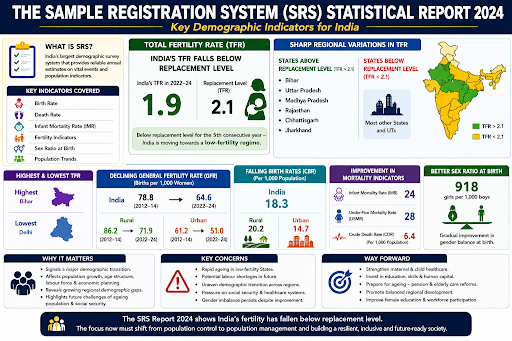
The SRS Report 2024 reveals India's Total Fertility Rate dropped to 1.9, falling below the 2.1 replacement level. Despite improved infant mortality and a stable death rate, regional disparities signal an impending transition toward an ageing population.
Description

Why In News?

According to the Sample Registration System (SRS) Statistical Report 2024, India's Total Fertility Rate (TFR) has fallen to 1.9, dipping below the replacement level of 2.1.

What Is the Sample Registration System (SRS)?

Administrative Authority: The Office of the Registrar General & Census Commissioner, Ministry of Home Affairs, conducts the survey.

Scale and Scope: It is one of the world's largest demographic surveys, covering a sample population of approximately 8.9 million people across 8,839 sample units.

Core Objective: The SRS provides annual estimates of the Crude Birth Rate (CBR), Crude Death Rate (CDR), Infant Mortality Rate (IMR), and other fertility and mortality indicators.

Methodology: The system utilizes a Dual Record System to ensure data accuracy:

  • Continuous Enumeration: Resident part-time enumerators (often ASHA workers or teachers) record vital events as they occur.
  • Retrospective Survey: Full-time supervisors conduct independent six-monthly surveys to verify data.
  • Matching and Verification: Data from both sources undergo a matching process, with field verification for any discrepancies.

Origin: Initiated as a pilot in 1964-65, the SRS reached full-scale operation in 1969-70. The 2024 report uses the Census 2011 sampling frame.

What Are the Major Findings of the SRS Statistical Report 2024?

Fertility and Birth Indicators

  • Total Fertility Rate (TFR) Collapse: India’s national TFR fell to 1.9, dropping below the Replacement Level Fertility of 2.1 for the first time in SRS history.
  • Regional Contrast:
    • Highest TFR: Bihar (2.9) remains the state with the highest fertility.
    • Lowest TFR: Delhi (1.2) recorded the lowest fertility in the country.
  • States Above Replacement Level: Only six states remain above the 2.1 mark: Bihar, Uttar Pradesh, Madhya Pradesh, Rajasthan, Chhattisgarh, and Jharkhand.
  • Crude Birth Rate (CBR): The national CBR declined from 21.0 in 2014 to 18.3 in 2024.
    • Rural CBR: 20.2
    • Urban CBR: 14.7

Mortality and Health Indicators

  • Infant Mortality Rate (IMR) Improvement: The national IMR dropped to 24 deaths per 1,000 live births (down from 30 in 2019).
    • Kerala reported the lowest IMR (8), while Chhattisgarh reported the highest (36).
  • Under-Five Mortality Rate (U5MR): The national U5MR stands at 28, showing a steady decline from previous years.
  • Crude Death Rate (CDR): The national CDR settled at 6.4 in 2024, a slight decrease from 6.7 in 2014.
  • Medical Attention before Death: A critical gap persists; 45.5% of all deaths in India occurred without qualified medical attention. Only 40.2% of deaths took place in a hospital.

Population Composition and Age Structure

  • Demographic Dividend: The working-age population (15–59 years) expanded to 66.4% (up from 64% in 2014).
  • Young Population (0–14 years): This segment shrank to 24.0% of the total population.
  • Ageing Population (60+ years): The elderly segment rose to 9.7%. Kerala has the highest share of senior citizens at 15.1%.
  • Median Age: India’s median age is 29.2 years, significantly younger than global peers like China (40.2 years).

Gender and Marriage

  • Sex Ratio at Birth (SRB): The national average stands at 918 girls per 1,000 boys.
    • Highest SRB: Chhattisgarh (978) and Kerala (974).
    • Lowest SRB: Uttarakhand (872).
  • Marriage Trends: The mean age at effective marriage for females rose to 23.1 years.
    • 73.5% of women now marry at age 21 or older.
    • West Bengal recorded the highest proportion of child marriages (marriages before age 18) at 6.3%.  

Why is India's Fertility Rate Declining?

Rapid Urbanization: Urban environments favor smaller family units due to space constraints and higher living costs.

Improved Female Education: Higher educational attainment for women directly correlates with lower fertility rates and better reproductive health choices.

Increased Access to Contraception: Greater availability and awareness of family planning methods empower couples to manage birth spacing.

Delayed Marriage: The mean age of marriage for women is rising (now 23.1 years), which reduces the reproductive window.

Preference for Smaller Families: Changing societal norms and economic pressures have shifted the desire toward fewer children to ensure better investments in health and education.

Demographic Transition: India is moving from a phase of "population explosion" to a period of "aging population" and "shrinking workforce expansion."

Source: NEWINDIANEXPRESS

PRACTICE QUESTION

Q. Consider the following statements regarding the findings of the Sample Registration System (SRS) Statistical Report 2024:

  1. India’s Total Fertility Rate (TFR) has dropped below the replacement level.
  2. The rural Total Fertility Rate remains higher than the urban Total Fertility Rate.
  3. Communicable diseases remain the leading cause of death in India. 

Which of the statements given above are correct? 

A) 1 and 2 only 

B) 1 and 3 only 

C) 2 and 3 only 

D) 1, 2, and 3 

Answer: A 

Explanation:

According to the Sample Registration System (SRS) Statistical Report 2024, released by the Office of the Registrar General & Census Commissioner, only the first two statements are correct: 

  • Statement 1 is correct: India's Total Fertility Rate (TFR) has dropped to 1.9, which is below the standard replacement level of 2.1
  • Statement 2 is correct: The rural TFR remains higher than the urban TFR. The report indicates a rural TFR of 2.1 compared to an urban TFR of 1.5.
  • Statement 3 is incorrect: While communicable diseases remain a concern, India is undergoing a "demographic transition" where non-communicable diseases (NCDs) like cardiovascular issues and diabetes have overtaken communicable diseases as the leading cause of death. The SRS report specifically highlights persistent gaps in chronic disease management and geriatric care. 

Frequently Asked Questions (FAQs)

India's national TFR has declined to 1.9, which is below the replacement level of 2.1.

Bihar holds the highest TFR in the country at 2.9, while Delhi recorded the lowest TFR at 1.2.

The Infant Mortality Rate (IMR) improved slightly, dropping to 24 deaths per 1,000 live births in 2024.


Free access to e-paper and WhatsApp updates

Let's Get In Touch!