The Reserve Bank of India has proposed safeguards, including a universal kill switch, a one-hour transaction delay for amounts over ₹10,000, shadow credits for unverified accounts, and a trusted person mandate, to combat rising digital payment frauds occurring nationwide.
Why In News?
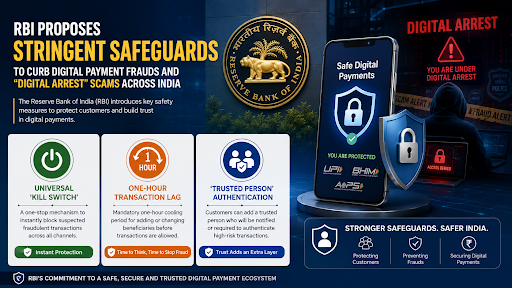
The Reserve Bank of India (RBI) proposed a universal ‘kill switch’ to curb escalating digital payment frauds and "digital arrest" scams across the country.
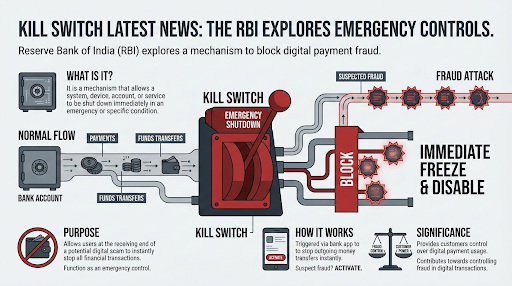
What Is RBI’s ‘Kill Switch’ Mechanism?
The Kill Switch serves as an emergency security protocol that empowers users to immediately freeze all outbound financial operations from their bank accounts or digital wallets with a single action.
It utilizes a universal architecture that covers the entire electronic payment spectrum, including the Unified Payments Interface (UPI), IMPS, and NEFT.
It includes a Switch On/Switch Off facility that provides granular channel toggling, allowing users to selectively disable specific transaction modules (like international transfers) while keeping standard functions (like ATM withdrawals) active.
Customers activate the switch directly via mobile banking apps, designated SMS codes, or toll-free portals whenever they suspect malicious activity.
Banks require stringent digital verification or a physical branch visit to deactivate the kill switch and restore payment functionalities.
What is Digital Scams?
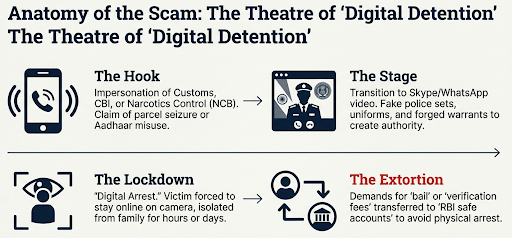
Digital Scams involve fraudulent activities where malicious actors utilize social engineering, coercion, or impersonation to manipulate victims into voluntarily authorizing fund transfers.
Common tactics include digital arrests (fraudsters posing as law enforcement officials via video calls), refund fraud, and AI-driven deepfake impersonations.
The surge in cybersecurity incidents from 10.29 lakh in 2022 to 22.68 lakh in 2024 reflects the growing scale and complexity of digital threats in India. (Source: PIB)
Digital scams show a rising trend in India due to several factors:
Rapid digital adoption currently outpaces consumer financial literacy, rendering massive populations, especially the youth and senior citizens, highly vulnerable.
Fraudsters leverage advanced AI and machine learning technologies to bypass automated security alerts and traditional risk-scoring models.
The instant nature of digital payments limits the scope for timely intervention and recovery of stolen funds.
Organized fraud networks actively exploit mule accounts to rapidly launder stolen money across the financial ecosystem.
RBI Plan to Strengthen Digital Payment Security
Mandatory One-Hour Hold
RBI proposes a lagged credit mechanism that delays high-value push payments exceeding Rs 10,000 by one hour to allow time for fraud detection.
Trusted Person Authentication
Mandates an additional verification layer by a designated trusted individual for vulnerable segments, such as senior citizens, particularly for transactions exceeding Rs 50,000.
Shadow Credit Implementation
Cap annual credits at Rs 25 lakh for accounts lacking enhanced due diligence; banks will hold any excess inflows as "shadow credits" until the beneficiary justifies their legitimacy.
Digital Payments Intelligence Platform
Establish a centralized infrastructure that provides network-level intelligence and real-time data sharing across all payment systems to detect anomalies.
Real-Time Payee Lookup
Introduce beneficiary name validation to give users instant feedback on whether the recipient’s name matches the account details before finalizing fund transfers.
Customer Liability Compensation
Introduces a compensation mechanism to reimburse victims of small-value fraudulent electronic banking transactions.
Conclusion
Implementing the RBI’s robust digital security framework establishes a resilient, zero-trust financial ecosystem that balances rapid technological progress with vital consumer protection.
Source: INDIANEXPRESS
|
PRACTICE QUESTION Q. Consider the following statements regarding the Reserve Bank of India's (RBI) recent proposals to curb digital payment frauds:
Which of the statements given above is/are correct? A) 1 only B) 2 only C) Both 1 and 2 D) Neither 1 nor 2 Answer: C Explanation: Statement 1 is correct: A one-hour "cooling-off" window is proposed for high-value transactions (specifically those exceeding ₹10,000). This would temporarily hold the funds, giving users a chance to review, verify, or cancel suspicious transactions before the final settlement. Statement 2 is correct: The RBI has proposed a 'Kill Switch' facility. This emergency option allows customers to instantly disable or "switch off" all digital payment transactions from their accounts in a single stroke, severely limiting a scammer's ability to drain funds. |
It is an emergency security protocol that allows users to instantly disable all digital payment transactions and freeze their accounts to prevent capital from being siphoned off during suspected frauds.
The RBI proposed capping annual credits at ₹25 lakh for accounts without enhanced due diligence. Inflows beyond this threshold are parked as "shadow credits" and are released only after the bank verifies their legitimacy to combat mule accounts.
In this scam, fraudsters impersonate law enforcement officials via video calls, creating a fear of arrest to coerce victims into staying online for hours and transferring large sums of money to fraudulent accounts.



© 2026 iasgyan. All right reserved