The Ministry of Home Affairs formed a high-level committee chaired by Justice P.P. Naolekar to study unnatural demographic changes and illegal immigration in India. The panel will recommend structural and legal solutions for identifying, detaining, and deporting infiltrators.
Why In News?
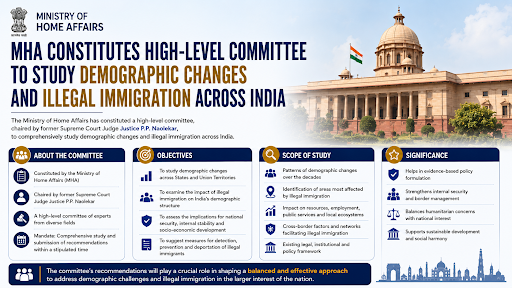
The Ministry of Home Affairs constituted a high-level committee, chaired by former Supreme Court Judge Justice P.P. Naolekar, to study demographic changes and illegal immigration across India.
What Is the Justice Prakash Prabhakar Naolekar Committee?
Prime Ministerial Mandate: Prime Minister Narendra Modi first announced the 'High-powered Demography Mission' during his Independence Day speech on August 15, 2025.
Cabinet Approval: The Union Cabinet formally approved the proposal in September 2025.
Official Notification: The Ministry of Home Affairs (MHA) issued the notification for the committee’s formation on May 26, 2026.
Duration: The committee must submit its final report within one year (by May 2027). The MHA may grant a six-month extension if necessary.
Powers: The committee can request records from any ministry, state government, or public authority and decide its own procedures for inquiry and consultation.
What Is the Mandate of the Naolekar Committee?
The primary mission of the committee is to conduct a comprehensive assessment of demographic changes occurring due to illegal migration and other "unnatural" causes.
Terms of Reference (ToR)
Cause Analysis: Study causes such as cross-border activities, economic opportunities, and socio-environmental factors.
Identification of Factors: Pinpoint underlying reasons for shifts, including orchestrated migration and abnormal settlement patterns.
Community-Level Analysis: Analyze structural population changes at the level of religious or social communities, especially where data deviates from broader trends.
Deportation Framework: Recommend a streamlined, permanent mechanism for the identification, detention, and deportation of illegal immigrants.
Border Management: Suggest institutional mechanisms to strengthen border control and population stabilization systems.
Centre-State Coordination: Propose a policy framework to enhance coordination between the central and state governments regarding demographic imbalances.
What Is “Demographic Change” in the Indian Context?
Demographic change refers to population shifts that occur outside of normal birth and death rates.
Core Drivers
National Security Implications
What Are the Major Challenges Before the Committee?
Internal Security and Sovereignty
Illegal immigration corridors are co-opted by transnational syndicates for human trafficking, arms smuggling, and the infiltration of radicalized elements.
The unchecked influx poses a challenge to the present and future social structure of the nation.
Ethnic Conflict and Social Harmony
Manipur Crisis: The influx of Chin-Kuki refugees fleeing Myanmar after the 2021 coup is cited as a catalyst for ethnic friction regarding land rights and political representation.
Social Displacement: "Unnatural" population surges strain public infrastructure, healthcare, and local agrarian economies, leading to violent internal friction.
Protection of Indigenous and Tribal Identities
Land Alienation: In regions like the Santhal Pargana (Jharkhand) and Sixth Schedule areas, illegal immigrants exploit loopholes (e.g., benami transactions or marriages of convenience) to usurp tribal lands.
Minority Status: Unchecked growth threatens to make indigenous populations minorities in their ancestral homelands.
Electoral and Administrative Integrity
Electoral Demography: The illegal procurement of Aadhaar and Voter IDs artificially skews the democratic process.
Data Deficit: India lacks contemporary granular data because the last Census was conducted in 2011.
How Can India Address Demographic Challenges?
Operational and Technological Measures
CIBMS Deployment: Shifting from physical patrolling to a Comprehensive Integrated Border Management System (CIBMS) using ground sensors, thermal imagers, and aerostats.
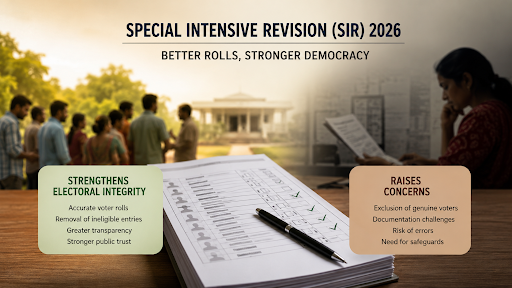
Identity Audits: Implementing Special Intensive Revision (SIR) of Electoral Rolls to detect irregular entries and prevent the disenfranchisement of native populations.
Legal and Institutional Frameworks
Statutory Enforcement: Utilizing the Foreigners Act, 1946 (now Immigration and Foreigners Act, 2025) which places the burden of proof on the individual to prove citizenship.
Institutional Mechanisms: Establishing a permanent operational mechanism for fair and time-bound deportation.
Socio-Economic Strategies
Managing Labor Mobility: Establishing formal frameworks for inter-state migration to fill labor gaps in aging southern states (where TFR is 1.6–1.7) using the "youth surplus" from northern states.
Silver Economy: Preparing for the "greying" population (projected to be 20.5% by 2051) by innovating in geriatric healthcare and elder-tech.
Repurposing Infrastructure: As the 0–14 age cohort shrinks, converting under-utilized "uneconomic schools" into community wellness or lifelong learning centers.
Conclusion
The Naolekar Committee represents a strategic shift from reactive border policing to a proactive, data-driven defense of sovereignty, tribal identity, and electoral integrity.
Source: NEWSONAIR
|
PRACTICE QUESTION Q. "Unchecked illegal immigration acts as a catalyst for ethnic conflict and threatens the demographic stability of tribal areas." Evaluate. 150 words |
It is a high-level central committee established by the Union Ministry of Home Affairs to investigate demographic changes caused by illegal immigration, infiltration, and other unnatural population shifts across India.
Its main goal is to scientifically assess unnatural demographic shifts, identify patterns of abnormal population variations among communities, and recommend a time-bound legal framework for the identification, detention, and deportation of illegal immigrants.
Unchecked illegal immigration threatens to minoritize indigenous communities in their ancestral homelands and frequently exploits systemic loopholes to usurp tribal lands, heavily impacting regions protected under the Sixth Schedule and the Santhal Pargana Tenancy Act.




© 2026 iasgyan. All right reserved