The PM-WANI scheme enhances public Wi-Fi access across India through decentralized, license-free networks of Public Data Offices. Recent reforms introduce QR-based logins, standardized SSIDs, and affordable sachet plans to bridge the digital divide and foster grassroots entrepreneurship.
Why In News?
The Department of Telecommunications introduced citizen-friendly reforms to the PM-WANI scheme, including QR-based authentication and sachet-style short-duration Wi-Fi plans.
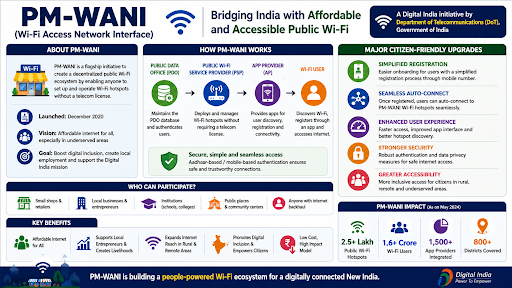
What is PM-WANI?
The Prime Minister's Wi-Fi Access Network Interface (PM-WANI) was launched by the Department of Telecommunications (DoT) in December 2020.
It is a framework designed to expand the availability of public Wi-Fi hotspots across India, specifically targeting rural and underserved areas.
It aligns with the National Digital Communications Policy (NDCP) 2018 to establish a robust digital communications infrastructure.
The ecosystem comprises four primary architectural elements:
|
Entity |
Role and Functions |
|
Public Data Office (PDO) |
Establishes and operates Wi-Fi Access Points. It provides last-mile connectivity and requires no registration or license fees. Local shops (kirana, tea stalls) serve as PDOs. |
|
Public Data Office Aggregator (PDOA) |
Acts as an aggregator for multiple PDOs. It handles authentication, accounting, and user interfaces for buying data plans. PDOAs must register via the Saral Sanchar Portal. |
|
App Provider |
Develops the mobile application that users use to discover and select PM-WANI hotspots. These providers authenticate users and facilitate digital payments. |
|
Central Registry |
Maintained by the Centre for Development of Telematics (C-DoT). It keeps records of all App Providers, PDOAs, and PDOs to ensure interoperability. |
What are the New Reforms Introduced Under PM-WANI?
TRAI Tariff Capping: The Telecom Regulatory Authority of India (TRAI) prescribed a cap on tariffs charged by ISP (Internet Service Provider) and TSP (Telecom Service Provider) to PDOs. Providers cannot charge PDOs more than twice the retail broadband tariff for plans up to 200 Mbps.
QR-Based Login: The framework now supports QR-based login mechanisms to simplify the user authentication process.
Short-Duration Plans: Providers offer affordable coupons in small denominations ranging from Rs. 2 to Rs. 20, catering to the urban poor and rural populations.
Zero License Fees: The government eliminated license and registration fees for PDOs, PDOAs, and App Providers to lower the barrier for small and micro-entrepreneurs.
Self-Declaration Certification: Initially, PDOAs receive a provisional certificate based on self-declaration to allow immediate service commencement, followed by formal lab certification.
Why is PM-WANI Important for India's Digital Public Infrastructure?
PM-WANI serves as a critical pillar of the Digital Public Infrastructure (DPI) by focusing on inclusivity and economic stimulation.
Bridges the Digital Divide: While urban connectivity is high, rural internet density remains low at 46 per 100 users. PM-WANI targets this gap to improve rural literacy and economic growth.
Promotes Micro-Entrepreneurship: The scheme transforms local businesses, such as kirana stores and tea shops, into Wi-Fi providers, creating new revenue streams in the informal sector.
Supports Digital India: By providing affordable, high-speed internet, the scheme enables access to essential digital services in education, health, governance, and commerce.
Economic Stimulus: Enhanced internet access directly contributes to GDP growth and fosters a local manufacturing supply chain for Wi-Fi equipment.
Open-Source Foundations: Like Aarogya Setu and DigiLocker, PM-WANI is built on open-source digital platforms, ensuring scalability and transparency.
Conclusion
PM-WANI democratizes internet access by empowering small entrepreneurs to provide affordable, last-mile broadband connectivity across India's rural and urban landscapes.
Source: NEWSONAIR
|
PRACTICE QUESTION Q. Consider the following statements regarding the Prime Minister Wi-Fi Access Network Interface (PM-WANI) scheme:
Which of the statements given above is/are correct? (a) 1 and 2 only (b) 2 and 3 only (c) 1 and 3 only (d) 1, 2, and 3 Answer: (b) Explanation: Statement 1 is Incorrect: Public Data Offices (PDOs) are not required to pay any registration or license fee to the government. To encourage widespread participation and entrepreneurship (such as by local shopkeepers and tea stall owners), the Department of Telecommunications (DoT) has explicitly exempted PDOs from licensing, registration, and fee requirements. Statement 2 is Correct: Recent reforms introduced by the DoT have implemented QR-based authentication to simplify connectivity for secondary devices. This allows users to connect devices like laptops to PM-WANI hotspots by scanning a QR code via an authenticated mobile app, eliminating the need for repeated OTP verification. Statement 3 is Correct: The Central Registry, which maintains the details of App Providers, PDOAs, and PDOs, is indeed maintained by the Centre for Development of Telematics (C-DoT). |
The Prime Minister's Wi-Fi Access Network Interface (PM-WANI) is a framework launched by the Department of Telecommunications to provide affordable, high-speed public internet connectivity through a decentralized, license-free model.
The ecosystem comprises Public Data Offices (PDOs) that set up the hotspots, PDO Aggregators (PDOAs) that handle authorization and accounting, App Providers who build user interfaces, and the Central Registry maintained by C-DoT.
It is a micro-transaction pricing model that sells small windows of internet access at ultra-low price points, making the internet highly affordable for daily commuters, students, and low-wage workers.





© 2026 iasgyan. All right reserved