The ban on cow slaughter in India triggers widespread constitutional debates over Article 48 versus fundamental rights, severely disrupting the agrarian economy, leather, and meat industries, while disproportionately affecting marginalized livelihoods and exacerbating the rural stray cattle menace.
Why In News?
Debates over strict slaughter laws and animal cruelty rules have highlighted agricultural distress, stray cattle, and the constitutional conflict between Article 48 and Fundamental Rights.
|
Read all about: Economic Impact of Animal Slaughter Ban |
What is the Significance of cows in Indian culture and Society?
Religious and Sacred Status
Hindus, Jains, Zoroastrians, and Buddhists revere the cow as sacred. Vedic era scriptures equate cow slaughter with killing a human and advocate non-violence toward all quadrupeds.
Economic Centrality: In the agrarian economy, the cow serves multiple functions:
Historical Evolution of Protection
What are the Frameworks for Cow Protection in India?
Article 48 (Organization of Agriculture and Animal Husbandry): This article directs the State to:
Constituent Assembly Debates:
Judicial Interpretations:
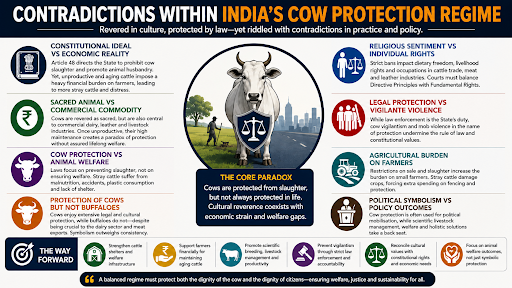
What Are the Major Contradictions Within India's Cow Protection Regime?
The Dairy-Beef Paradox: India is the world's largest producer and consumer of milk, yet it is also the second-biggest exporter of (buffalo) beef globally.
Economic Asset vs Liability: Rural farmers historically viewed buffalo and cows as a "double investment." Once an animal ceased producing milk, its sale for meat provided capital.
Definitions of "Cattle": While the religious taboo centers on the cow, regulations like the Prevention of Cruelty to Animals (Regulation of Livestock Markets) Rules, 2017 used a broad definition of "cattle" including bulls, bullocks, cows, buffalo, steers, heifers, calves, and camels, disrupting the supply chain for buffalo meat, which is not a religious taboo.
Slaughterhouse Supply Chains: Modern, government-approved slaughterhouses rely on livestock markets for their supply.
What Are the Social and Governance Challenges Associated With Cow Protection?
Rise of Vigilantism: "Cow vigilantes" (Gau Rakshaks) use violence to disrupt cattle supply chains. This has led to mob lynchings and attacks targeting minority communities, specifically Muslims and Dalits.
Impact on Livelihoods and Industry
Caste Stigma and Labor
Nutritional Impact: Beef is a cheap source of protein (21-26%%) compared to rice (6-8%).
Erosion of Federalism: Cattle slaughter is a State subject under the Constitution.
Stray Cattle Menace: Bans on slaughter lead to a surge in stray cattle.
Way Forward
Policy Recalibration: Amend the Livestock Market Rules to distinguish between religious sentiments regarding cows and the economic necessity of the buffalo meat and leather industries.
Formalization of the Sector: Provide legal recognition and licenses to Dalit leather workers and skinners to protect them from harassment and provide them with social security.
Investment in Infrastructure: Strengthen the Animal Market Committees to ensure livestock markets meet sizing and infrastructural norms without shutting down the supply chain.
Support for Rural Farmers: Develop a state-supported mechanism to handle unproductive cattle so they do not become a financial burden on small-scale dairy farmers.
Judicial Clarity: The Supreme Court needs to clear contradictory rulings regarding the fundamental rights of butchers and traders (Article 19(1)(g)) versus the directive of Article 48.
Strengthening Law Enforcement: State governments must curb vigilantism and ensure that the "protection of cows" does not become a cover for communal or caste-based violence.
Conclusion
India's cow protection laws shows a deep-seated tension between religious sentiments and the economic viability of the dairy, leather, and meat industries.
Source: THEHINDU
|
PRACTICE QUESTION Q. Critically analyze the socio-economic impacts of the ban on cow slaughter on the agrarian economy and marginalized communities in India. 150 words |
Article 48 is a Directive Principle of State Policy that directs the State to organize agriculture and animal husbandry on modern, scientific lines. It specifically instructs the State to take steps for preserving and improving breeds, and prohibiting the slaughter of cows, calves, and other milch and draught cattle.
The ban heavily disrupts the USD 12 billion leather industry and the meat export sector, leading to job losses primarily in the unorganized sector. It also makes dairy farming less viable, as maintaining an unproductive cow costs a farmer approximately USD 94.12 per month, turning the animal into an economic liability.
The laws disproportionately harm Dalits and Muslims who traditionally work as cattle traders, skinners, and butchers. The ban reduces access to cheap protein (heme iron), increasing severe anemia rates among these communities, and exposes them to violence and mob lynching by cow vigilantes.



© 2026 iasgyan. All right reserved