The Supreme Court of India has issued comprehensive guidelines to combat child trafficking and trace missing children by establishing a nationwide victim protection plan, presuming kidnapping in missing cases, and mandating sensitive judicial evaluation of victim testimonies for rehabilitation.
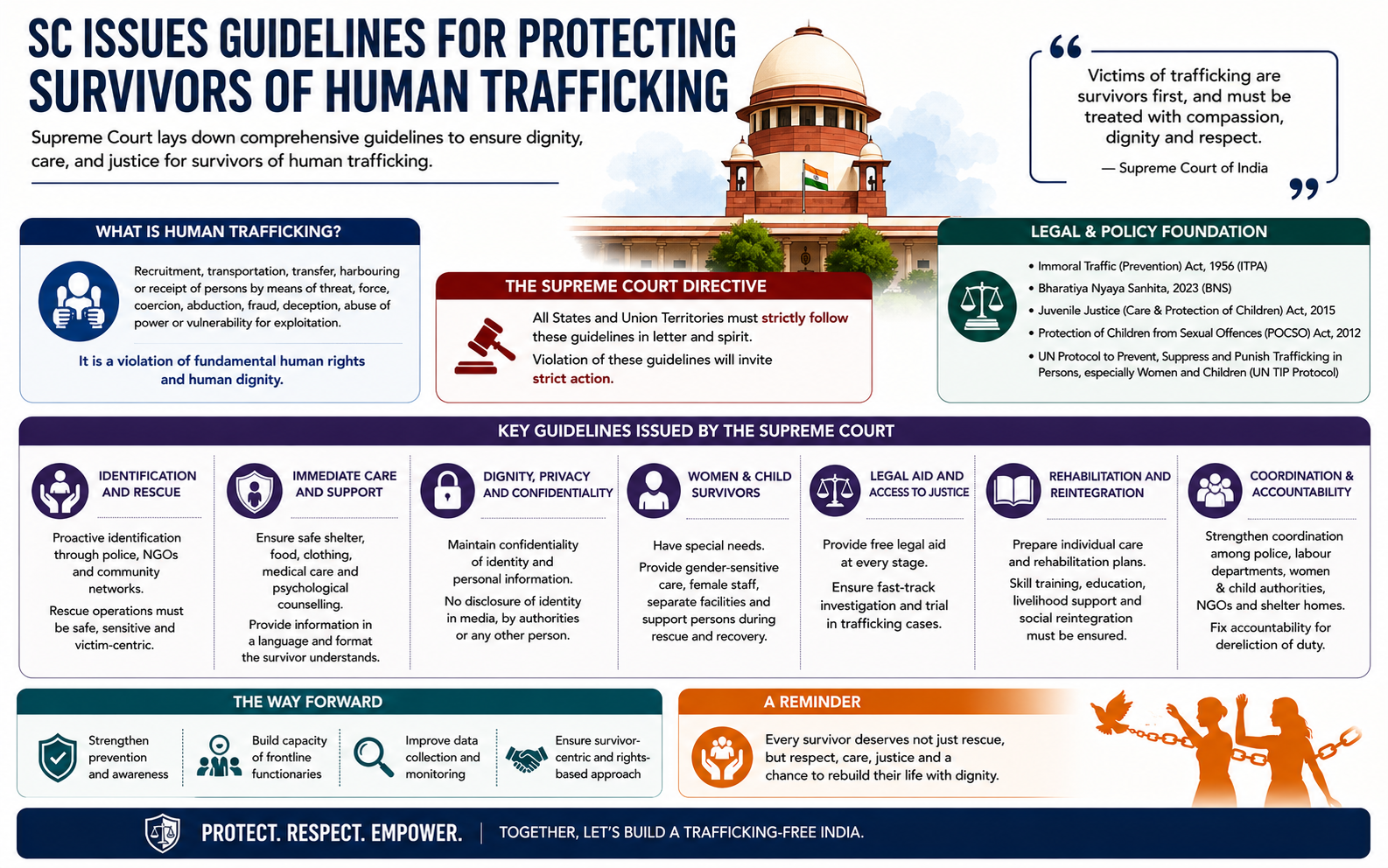
The Supreme Court mandated a nationwide victim protection framework and the presumption of kidnapping in missing child cases to combat trafficking and support survivor rehabilitation.
|
Read all about: SC SOP ON HUMAN TRAFFICKING l SUPREME COURT ON CHILD TRAFFICKING |
Section 370 of the Indian Penal Code (IPC), 1860 defines trafficking as the recruitment, transportation, harboring, transfer, or receipt of a person for the purpose of exploitation.
The Means: Traffickers use threats, force, coercion, abduction, fraud, deception, or abuse of power. They may also use inducements, such as payments or benefits, to gain control over a person.
The Purpose (Exploitation): Exploitation includes physical or sexual exploitation, slavery or practices similar to slavery, servitude, or the forced removal of organs.
Irrelevance of Consent: Under the law, the consent of the victim is immaterial in determining the offense of trafficking.
A Continuing Offense: Trafficking operates as a "basket of crimes" across three primary stages:
Recent judgments from the Supreme Court establish a comprehensive framework for victim protection and judicial appreciation of evidence.
Nationwide Victim Protection Plan
The Court mandates a plan covering rescue, identification, rehabilitation, prosecution, and institutional coordination.
Threshold Inquiry: Police must conduct an immediate inquiry to distinguish trafficking from voluntary adult sex work to prevent the misuse of laws and the indiscriminate criminalization of vulnerable individuals.
Article 21 Integration: The Court holds that the right to rehabilitation flows directly from the right to live with dignity under Article 21 of the Constitution.
Institutional Convergence: Authorities must integrate the Juvenile Justice (JJ) Act and POCSO Act with anti-trafficking efforts, ensuring coordination between Child Welfare Committees (CWCs), Anti-Human Trafficking Units (AHTUs), and One Stop Centres.
Five Key Interim Directions
To address the systemic failure in tracing missing children, the Court issued these binding orders:
Guidelines for Evidence and Victim Testimony
Status as "Injured Witness": Courts must treat a trafficked child as an injured witness, not an accomplice.
Credibility of Testimony: A conviction can rest on the sole testimony of the victim if it is credible and convincing.
Handling Inconsistencies: Courts must not disbelieve a child's testimony based on minor inconsistencies, late reporting, or hesitation, as trauma and stigma often affect communication.
Sensitivity to Vulnerability: Judicial appreciation of evidence must account for the victim’s socio-economic and cultural vulnerability, particularly for those from marginalized communities.
Alarming Backlog: As of May 2026, approximately 47,000 children remain untraced in India. The National Crime Records Bureau (NCRB) reported that 83,350 children went missing in 2022 alone.
Complex Organized Structures: Trafficking networks operate through complex, layered crime verticals (recruitment, transport, harboring). These intersections are often veiled, making it difficult for victims to provide a linear narrative of their exploitation.
Data Fragmentation: The lack of real-time coordination between police tracking systems and child welfare databases allows traffickers to operate across state boundaries with impunity.
Institutional Dormancy: Many AHTUs exist only on paper and lack the necessary powers or will to dismantle interstate syndicates.
Socio-Economic Exploitation: Traffickers systematically target marginalized groups and those in areas of acute poverty, civil unrest, or natural disasters.
India's anti-trafficking regime is built on constitutional, statutory, and international pillars.
Constitutional Safeguards
|
Provision |
Guarantee |
|
Article 23 |
Prohibits trafficking in human beings and forced labor ('begar'). |
|
Article 21 |
Guarantees the right to life and dignity; includes protection from exploitation. |
|
Article 24 |
Bans child labor in hazardous industries. |
|
Article 39(e) & (f) |
Directs the State to protect children from abuse and abandonment. |
Statutory Provisions
Immoral Traffic (Prevention) Act, 1956 (ITPA): Focuses on commercial sexual exploitation.
Protection of Children from Sexual Offences (POCSO) Act, 2012: Addresses sexual abuse of minors.
Juvenile Justice (Care and Protection of Children) Act, 2015: Governs the rescue and rehabilitation of children in need of care.
Bonded Labour System (Abolition) Act, 1976: Targets forced labor.
Other Relevant Laws: Child Labour (Prohibition and Regulation) Act, 1986; Prohibition of Child Marriage Act, 2006; and Information Technology Act, 2000 (for cyber-enabled trafficking).
The NALSA Scheme 2015
The National Legal Services Authority (NALSA) provides a 360-degree approach (Prevention, Rescue, and Rehabilitation):
Hit the Economics of Trafficking: Authorities must investigate banking and property details to trace money laundering. Legal provisions for the attachment and confiscation of proceeds of crime must be strictly applied.
Adopt a Victim-Centric Approach: Ensure victim-witness protection and provide long-term medical and psychological support. Efforts must focus on social recognition and assimilation rather than just physical rescue.
Strengthen Source-Area Vigilance: Empower Panchayati Raj institutions and Village Level Child Protection Committees (VLCPC).
Ensure Organized Crime Investigation: Police must investigate the entire chain of conspirators—from the recruitment agent to the transit facilitators—rather than only the final exploiter.
Monitor Migration: Register all employment agents and monitor migration for work in vulnerable districts to promote safe migration practices.
Establish a Centralized Database: A unified national database is required to coordinate interstate cases and track the reintegration of rescued victims to prevent re-trafficking.
Human trafficking is a direct assault on constitutional dignity, requiring a judicial system that treats victims as injured witnesses and an executive that prioritizes database integration and organized crime prosecution.
Source: THE HINDU
|
PRACTICE QUESTION Q. Human trafficking is not merely a law-and-order issue; it is a challenge to constitutional morality, human dignity, and social justice. 150 words |
The Supreme Court has directed the police to proceed on a presumption of kidnapping upon every report of a child going missing, shifting the default stance from passive inquiry to active criminal investigation.
Courts must evaluate testimonies with sensitivity and realism, treating the minor as an "injured witness." Testimonies should not be discarded solely because of minor inconsistencies or a lack of precise step-by-step clarity.
Article 23 prohibits human trafficking and forced labor, Article 24 bans child labor in hazardous industries, and Article 21 guarantees the right to life and dignity, protecting individuals from sexual exploitation.




© 2026 iasgyan. All right reserved