To tackle human trafficking and trace missing persons, the Supreme Court mandated a uniform SOP focusing on the "golden hour." Led by P.M. Nair, the committee aims to fix systemic apathy through technological integration and victim-centric rehabilitation.
The Supreme Court of India directed the formation of a high-level committee to create a uniform and time-sensitive Standard Operating Procedure (SOP) for combating human trafficking and tracing missing persons.
A uniform SOP is essential to address systemic failures in governance and law enforcement at the grassroots level.
Dismal Conviction Rates: Between 2018 and 2022, India registered over 10,000 human trafficking cases, but the conviction rate for offenders remains an extremely low 4.8%. This points to flawed initial investigations and poor evidence collection. (Source: NCRB)
Rising Incidence of Exploitation: Cases under the Immoral Traffic (Prevention) Act saw increase from 1,497 in 2022 to 2,166 in 2023, highlighting the growing scale of the problem and the need for a standardized response (Source: PIB)
Inter-State Coordination Failures: Human trafficking is an organized, transnational crime where victims are moved swiftly across state borders. A lack of a pan-India SOP allows traffickers to exploit jurisdictional gaps between state police forces.
Lack of Accountability: The Supreme Court has noted the apathy of state governments, mandating that cases of missing persons must be kept active "not just on paper, but actually on the ground also" until the person is found.
The Protocol to Prevent, Suppress and Punish Trafficking in Persons, Especially Women and Children (also known as the Palermo Protocol), which supplements the United Nations Convention against Transnational Organized Crime (UNTOC) defines trafficking through three pillars:
In India, the specific criminal definition was updated through the Criminal Law (Amendment) Act, 2013, following the recommendations of the Justice Verma Committee.
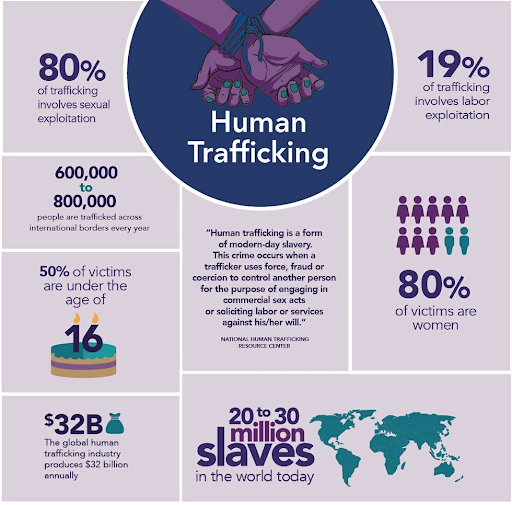
Push Factors (Supply Side)
Poverty and Economic Despair: Chronic poverty remains the primary driver. Families in debt bondage often fall prey to traffickers promising lucrative jobs.
Climate Change and Disasters: Migration forced by environmental degradation or natural disasters creates vulnerable populations.
Lack of Education: High illiteracy rates prevent individuals from understanding formal labor contracts, making them susceptible to deception.
Pull Factors (Demand Side)
Cheap Labour Demand: Industries like brick kilns, agriculture, and garments often seek unregulated, low-cost labour to maximize profits.
The "Hidden" Sex Industry: High demand for commercial sexual exploitation fuels the trafficking of women and minors from neighboring countries like Nepal and Bangladesh.
Emerging Challenges
Traffickers are increasingly using technology for their operations. This includes cyber-trafficking, online grooming through social media, and luring victims into "scam compounds."
The UNODC 2022 Global Report identifies "Cyber-Trafficking" as a burgeoning threat.
Constitutional Safeguards
Article 23: Prohibits trafficking and forced labour.
Article 24: Prohibits child labour in hazardous factories.
Article 39 (e) & (f): Directive Principles (DPSP) mandate the state to ensure that the health and strength of workers and children are not abused (Source: Constitution of India).
Statutory Framework
The Immoral Traffic (Prevention) Act, 1956 (ITPA): The primary law for officiating the suppression of commercial sexual exploitation.
The Bonded Labour System (Abolition) Act, 1976: Aimed at ending the practice of debt bondage.
The Protection of Children from Sexual Offences (POCSO) Act, 2012: Provides a stringent legal framework for protecting children from sexual abuse and trafficking.
The Child Labour (Prohibition and Regulation) Amendment Act, 2016: Completely prohibits the employment of children below 14 years.
Institutional Mechanisms
Anti-Human Trafficking Units (AHTUs): These are specialized police units established in districts. The Ministry of Home Affairs (MHA) has provided funding to set up AHTUs in nearly all districts.
National Investigative Agency (NIA): Under the NIA (Amendment) Act, 2019, the NIA is empowered to investigate human trafficking cases with transnational or inter-state links.
Ujjawala Scheme: A comprehensive scheme for prevention of trafficking and rescue, rehabilitation, and re-integration of victims of trafficking for commercial sexual exploitation.
Swadhar Greh: Provides primary need shelter, food, clothing, and medical treatment to women in difficult circumstances, including trafficked victims.
Mission Shakti (Sambal & Samarthya): An umbrella scheme that integrates various women's safety and empowerment programs, including those for trafficked survivors.
TrackChild & Khoya-Paya Portals: Digital platforms to track missing and found children, directly aiding in the recovery of trafficked minors.
|
Important Judicial Pronouncements Vishal Jeet vs Union of India (1990): The SC directed the government to set up an advisory committee to address the issues of child prostitution and trafficking. Praja Foundation vs State of Maharashtra: Emphasized the need for better data collection and sensitization of the police force. Budhadev Karmaskar vs State of West Bengal (2011): The Supreme Court famously stated that sex workers also have a right to dignity under Article 21 and directed the state to provide vocational training to those wishing to leave the trade. |
Pending Legislation: Trafficking in Persons (Prevention, Care and Rehabilitation) Bill
The proposed Bill aims to address the loopholes in the ITPA 1956. Key features include:
International Cooperation
Trafficking is a cross-border crime. India has signed several Bilateral Memorandums of Understanding (MoUs):
To eliminate trafficking, a shift from a "police-centric" to a "victim-centric" approach is required.
Learn Lessons from Global Best Practice
|
Best Practice |
Key Feature |
Lesson for India |
|
|
AMBER Alert System (United States) |
An early warning system that broadcasts information about missing children instantly via TV, radio, digital signs, and mobile alerts. |
Develop a localized, digital-first rapid broadcast system to mobilize immediate community vigilance upon registration of a missing person complaint. |
|
|
Child Advocacy Centers (CACs) Model (Europe) |
A single, safe, and child-friendly center where rescued victims interact with police, social workers, psychologists, and medical professionals to avoid re-traumatization. |
Mandate the involvement of trained Child Welfare Officers and NGOs at police stations during the initial reporting and investigation stages. |
|
Ending human trafficking in India requires a multi-dimensional approach that integrates the strict enforcement of the Bharatiya Nyaya Sanhita with the early passage of the Trafficking in Persons Bill, focusing on the seamless execution of the Rescue, Rehabilitation, and Reintegration pillars to achieve SDG Target 8.7 by 2030.
Source: THEHINDU
|
PRACTICE QUESTION Q. Despite a robust constitutional framework under Article 23, human trafficking remains a persistent challenge in India. Critically analyze. 150 words |
The Supreme Court ordered a uniform, time-sensitive SOP to overcome systemic delays and jurisdictional disputes in grassroots policing. The court emphasized the importance of the "golden hour" to maximize the chances of successfully rescuing missing persons before they are trafficked across borders.
Climate trafficking occurs when severe environmental changes and natural disasters displace populations, creating vulnerable "climate refugees." Traffickers exploit this distress migration—as seen in the Sundarbans after Cyclone Amphan—by luring victims into forced labor or prostitution under the guise of providing livelihoods.
The AMBER Alert is a rapid emergency broadcast network in the United States that instantly circulates details of missing children across local radio, TV, and mobile networks. Implementing a localized, digital-first version in India would help mobilize immediate community vigilance during the critical first hours of a person going missing.




© 2026 iasgyan. All right reserved