The Union Cabinet extended the SARTHAK-PDS scheme until March 2031 with a ₹25,530 crore outlay. By integrating financial assistance and SMART PDS, it leverages AI, ML, and Blockchain to modernize foodgrain distribution, ensure last-mile delivery, and minimize leakages.
Why In News?
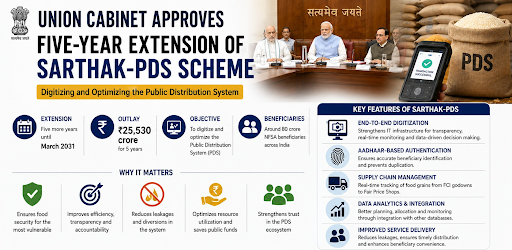
The Union Cabinet approved the five-year extension of the SARTHAK-PDS scheme until March 2031 with a ₹25,530 crore outlay to digitize and optimize the public distribution system.
|
Read all about: Public Distribution System (PDS) l Public Distribution System (PDS) Reform l From Food Access to Nutrition Adequacy l 2 Crore People Removed From PDS |
What is the SARTHAK-PDS Scheme?
The SARTHAK-PDS (Scheme for Assistance in Ration Transport and Handling-Income with Automation in PDS) is an umbrella initiative approved by the Union Cabinet to strengthen and modernise the distribution of foodgrains across India.
Duration and Outlay: The Cabinet approved the extension of the scheme for five years, continuing until March 2031, with a total financial outlay of ₹25,530 crore.
Consolidation of Programmes: The scheme merges two existing initiatives:
Dual Mandate: It provides assured financial support for the handling and movement of grains while simultaneously building a unified, citizen-centric, and interoperable PDS architecture.
Administrative Framework: It brings financial assistance and digital governance in India under a single administrative framework to streamline the implementation of the NFSA 2013.
What Are the Key Features of the SARTHAK-PDS Scheme?
Advanced Technology Stack: The scheme deploys Artificial Intelligence (AI), Machine Learning (ML), Natural Language Processing (NLP), and Blockchain to modernise operations.
Unified Architecture: It establishes standardised architectures and unified databases to enable real-time monitoring across the supply chain.
Oversight Mechanisms: The framework includes State Command Control Centres for data-driven oversight and ISO-certified process frameworks to ensure security and operational sustainability.
Grievance Redressal: AI-driven grievance redressal and analytics systems to improve responsiveness to beneficiary concerns.
Operational Digitisation: It builds upon the success of SMART PDS, which enabled the digitisation of ration cards, Aadhaar seeding, and the use of electronic Point of Sale (e-PoS) devices.
Revision of Norms: The Cabinet revised norms for central assistance to states regarding intra-state movement and handling, though the funding pattern remains the same.
How Does the Scheme Strengthen Food Security in India?
The SARTHAK-PDS scheme serves as a pillar for food security in India, ensuring that entitlements under the NFSA 2013 reach the vulnerable population.
Coverage: The system supports the legal entitlements of approximately 81.35 crore persons, covering up to 75% of rural and 50% of urban populations.
One Nation One Ration Card (ONORC): This initiative allows beneficiaries to access their rations from any Fair Price Shop (FPS) in the country. As of December 2025, 0.5% of transactions are inter-state, and 18% are intra-state portability transactions.
Aadhaar Integration: Approximately 99% of ration cards are seeded with Aadhaar, enabling biometric authentication at FPS to reduce impersonation and fraud.
Free Foodgrain Distribution: Under Pradhan Mantri Garib Kalyan Anna Yojana (PMGKAY), the government provides foodgrains for free (approved until 2029). The expected cost for this over five years is approximately ₹12 lakh crore.
Rice Fortification: To address nutritional deficiencies and anemia, the Cabinet approved the distribution of fortified rice (containing iron, folic acid, and Vitamin B12) under all welfare schemes until December 2028.
What Are the Major Concerns Associated with the Public Distribution System?
Outdated Population Data: Coverage is still based on the 2011 Census, many eligible beneficiaries may be excluded from the NFSA 2013 benefits.
Inclusion and Exclusion Errors: A 2024 ICRIER study estimated leakages at 28% for 2022-23, many households that moved out of poverty remain as beneficiaries, while new poor households are excluded.
Procurement Concentration: Procurement remains geographically skewed. In 2024-25, 92% of wheat came from just three states (Punjab, Haryana, and Madhya Pradesh), leading to long transport chains and higher costs.
Excessive Stock Levels: The Food Corporation of India (FCI) holds stocks above buffer norms. As of January 2026, rice stocks were four times the required norm, increasing storage costs and subsidy outgo.
Logistical Inefficiencies:
Nutritional Imbalance: The PDS basket remains heavily cereal-centric (rice and wheat), with miniscule allocation for coarse grains (1.6% in 2025-26).
FPS Dealer Margins: The All India FPS Dealers Federation has criticized the recent commission increase of 10 paise per kilogram as grossly inadequate.
What Reforms Are Needed to Make the Public Distribution System More Effective?
Procurement: Encourage Decentralised Procurement (DCP) in all states to reduce transport costs and align with local tastes.
Technology: Implement Automated Electronic Weighing Machines at all FPS to prevent tampering with quantities.
Beneficiary Identification: Conduct fresh surveys to update Priority Households (PHH) and Antyodaya Anna Yojana (AAY) lists based on current income and standard of living; use the 2027 Census data for re-determination.
Nutritional Diversity: Diversify the commodity basket by including more coarse grains (Jowar, Bajra, Ragi) and pulses.
Direct Benefit Transfer: Explore cash transfers indexed to inflation as an alternative to physical distribution in select areas to reduce leakage.
Infrastructure: Accelerate the construction of steel silos and conduct a comprehensive cost-benefit analysis of hired vs. owned storage.
FPS Management: Introduce a tiered reward system for dealers based on service quality and minimal grievances.
Conclusion
The SARTHAK-PDS Scheme integrates AI-driven technology and consolidated financial assistance to modernize the food security network and ensure the transparent delivery of essential commodities to 81.35 crore citizens until 2031.
Source: THEHINDU
|
PRACTICE QUESTION Q. The "NIRMAL" platform, frequently mentioned in the context of India's food security network, is primarily designed to: (a) Track the live movement of Food Corporation of India (FCI) trucks. (b) Act as an AI-driven beneficiary registry to remove duplicate and ghost beneficiaries. (c) Serve as a multilingual AI assistant for grievance redressal. (d) Facilitate direct cash transfers to farmers substituting the PDS system. Answer: (b) Explanation: Under SARTHAK-PDS, the government introduced NIRMAL, an AI-driven beneficiary registry to remove duplicate and ghost beneficiaries. ASHA is the multilingual AI assistant, and SAKSHAM tracks supply chains. |
SARTHAK-PDS (Scheme for Assistance in Ration Transport and Handling-Income with Automation in PDS) is a Cabinet-approved umbrella scheme aimed at modernizing India's public distribution system using advanced technologies, operating with a central outlay of ₹25,530 crore till March 2031.
It integrates two ongoing schemes: (i) Assistance to State Agencies for intra-State movement of foodgrains and FPS dealers' margin under NFSA, and (ii) SMART PDS (Scheme for Modernization and Reforms through Technology in Public Distribution System).
The scheme introduces three major AI-powered platforms: NIRMAL (an AI-driven registry to remove duplicate beneficiaries), ASHA (a multilingual AI assistant for grievances), and SAKSHAM (an AI supply-chain platform for GPS tracking and route optimization).




© 2026 iasgyan. All right reserved