

Copyright infringement not intended
Picture Courtesy: PIB
Context
Artificial Intelligence (AI) is transforming societies globally, and India is at the forefront of this digital revolution. From powering innovative governance to revolutionizing economic sectors, AI is not just a technological advancement but a strategic imperative for India's future.
|
Read all about: BASICS OF ARTIFICIAL INTELLIGENCE l ARTIFICIAL GENERAL INTELLIGENCE (AGI) l AI REGULATION ACROSS THE WORLD l INDIAN GOVT'S AI ROADMAP |
Artificial Intelligence (AI) is a key driver of technological change, enabling machines to simulate human intelligence for tasks like learning, reasoning, and problem-solving.
For India, AI is not just a technological tool but a strategic asset for achieving economic growth and inclusive development, central to the vision of Viksit Bharat @ 2047.
Why is AI Crucial for India?
AI is pivotal for transforming India from a technology consumer to a productivity-driven digital powerhouse. Its importance stems from several key areas:
|
AI Ecosystem in India (Source: PIB) India’s technology sector is expanding rapidly, with annual revenues projected to cross $280 billion this year. Over 6 million people are employed in the tech and AI ecosystem. India hosts 1,800+ Global Capability Centres, including more than 500 focused on AI. Stanford AI Index places India among the top four countries in AI skills, capabilities, and policies. India has around 1.8 lakh startups, and nearly 89% of new startups launched last year used AI in their products or services. On the NASSCOM AI Adoption Index, India scores 2.45 out of 4, showing that 87% of enterprises are actively using AI solutions. Leading sectors in AI adoption include industrial and automotive, consumer goods and retail, banking, financial services and insurance, and healthcare. Together they contribute around 60% of AI’s total value. According to 2024 NASSCOM’s report “Advancing India’s AI Skills”, India’s AI talent base predicted to grow from about 6 to 6.5 lakh professionals to more than 12.5 lakh by 2027 |
India's AI Strategy and Key Government Initiatives
India's AI strategy is driven by the vision of "Making AI in India" and "Making AI Work for India". This is supported by a robust policy framework and targeted missions.
National Strategy for Artificial Intelligence (2018)
This foundational document by NITI Aayog identified five key sectors for AI adoption: healthcare, agriculture, education, smart cities, and infrastructure/mobility. It laid the groundwork for building a vibrant AI ecosystem in the country.
Launched in March 2024 with an outlay of ₹10,371.92 crore for five years, this mission aims to build a comprehensive AI ecosystem.
|
Component |
Objective and Key Features |
|
IndiaAI Compute Capacity |
To build a high-end AI computing infrastructure. A public-private partnership will establish a capacity of over 10,000 GPUs, which will be accessible to startups, academia, and researchers. |
|
IndiaAI Innovation Centre |
To lead the development and deployment of indigenous Large Language Models (LLMs) and foundational models, focusing on Indian languages and data. |
|
National Datasets Platform (NDP) |
To create a unified platform (AIKosh) providing high-quality, curated datasets from government and other sources to support AI innovation, ensuring data is discoverable and accessible. |
|
IndiaAI Application Development |
To promote AI applications in critical sectors like healthcare, agriculture, and education, and establish Centres of Excellence (CoEs) to promote domain-specific innovation. |
|
IndiaAI FutureSkills |
To expand AI education by integrating it into undergraduate and graduate curricula and funding fellowships to build a skilled AI workforce. |
|
Safe & Trusted AI |
To develop frameworks for responsible AI, including ethical guidelines, bias mitigation, and regulatory sandboxes to ensure safe and trustworthy deployment. |
Legal and Ethical Frameworks
Digital Personal Data Protection (DPDP) Act, 2023: This Act provides a legal framework for data processing, impacting AI systems by mandating principles like consent, purpose limitation, and data minimization.
IT Rules, 2021: These rules require social media platforms to identify and remove unlawful content, including harmful AI-generated deepfakes and misinformation.
MeitY's AI Governance Framework: It promotes seven principles for ethical AI, including safety, accountability, fairness, and transparency, to guide responsible AI development and deployment in India.
Human Capital Deficit
Despite a large talent pool, there is a demand-supply gap for specialized AI skills. The demand for AI/ML specialists is currently 1.5 times the available talent pool, requiring massive upskilling initiatives. (Source: NASSCOM)
Data Governance and Privacy
AI's reliance on vast datasets raises critical concerns about privacy, security, and algorithmic bias. Ensuring the ethical use of data and compliance with the DPDP Act is paramount.
Inadequate Infrastructure
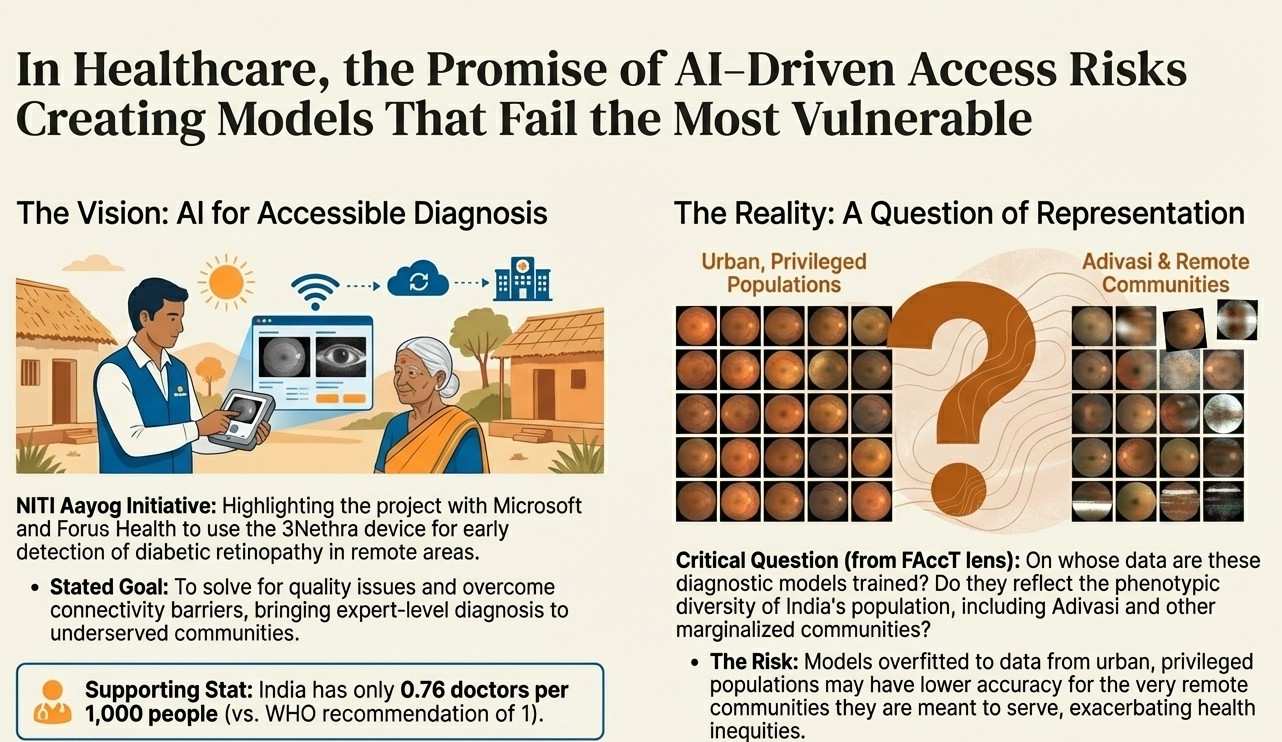
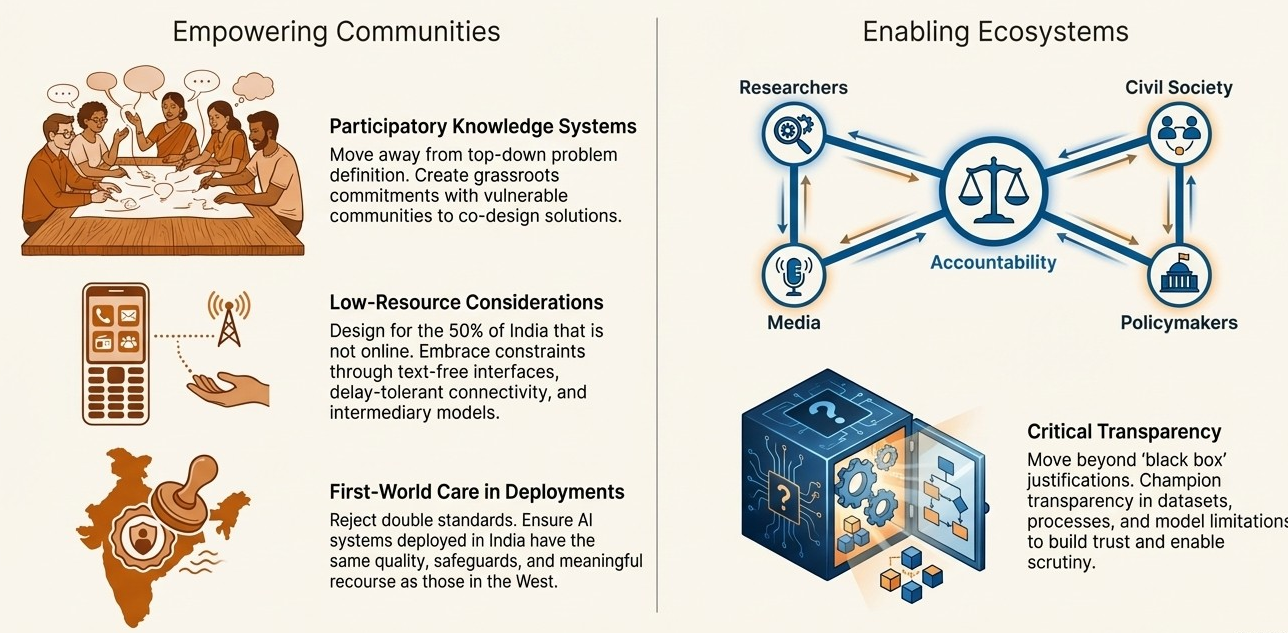
While improving, access to high-performance computing, high-speed internet, and quality data remains inconsistent, especially in semi-urban and rural areas.
Algorithmic Bias and Ethics
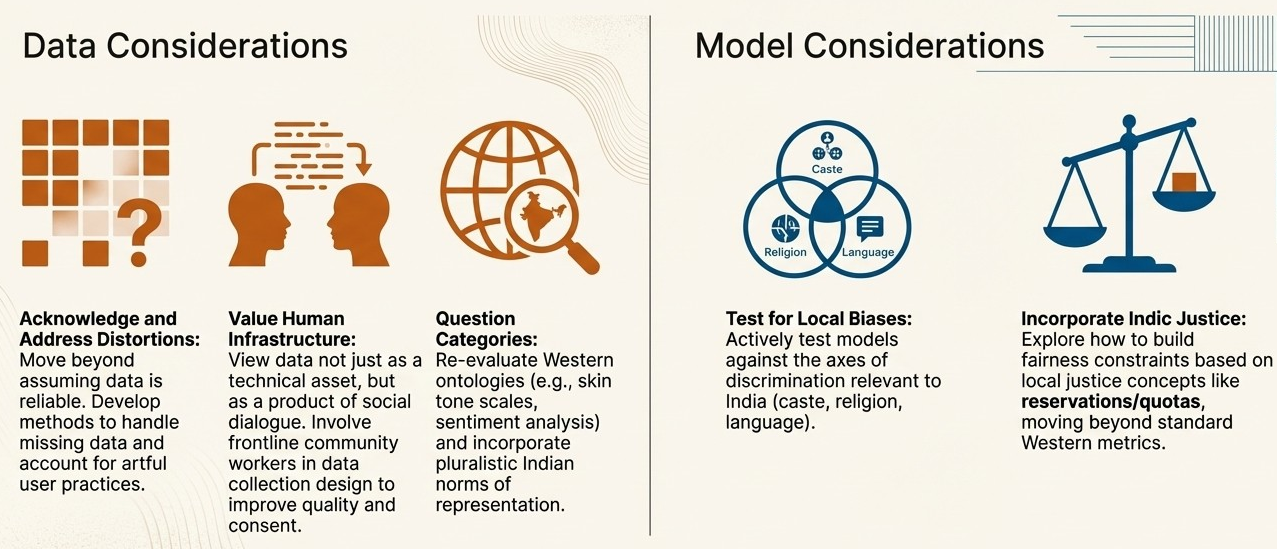
AI models trained on incomplete or skewed data can perpetuate societal biases. The "black box" nature of some AI systems, where decision-making is not transparent, poses an accountability challenge.
Lack of High-Quality Local Data
The scarcity of structured and labeled datasets in diverse Indian languages hinders the development of inclusive and representative AI models.
 Way Forward
Strengthen the Core Infrastructure
Accelerate investment in scalable compute infrastructure, cloud services, and cybersecurity. Making high-quality government datasets accessible through platforms like the National Datasets Platform is crucial.
Build an AI-Ready Workforce
Implement nationwide reskilling and upskilling programs (like NASSCOM's FutureSkills Prime) and modernize university curricula to create a pipeline of industry-ready AI professionals.
Enforce Robust Governance
Develop a comprehensive and adaptive national AI regulatory framework that promotes innovation while ensuring ethical use, accountability, and protection of citizen rights.
Encourage Indigenous Innovation
Encourage the development of sovereign foundational models and LLMs trained on diverse Indian data and languages (e.g., initiatives like BharatGen and Bhashini) to ensure relevance and reduce dependency.
 Promote a Collaborative Ecosystem
Strengthen partnerships between the government, private sector, academia, and startups to accelerate research, development, and the deployment of scalable AI solutions.
 Conclusion
Artificial Intelligence represents a transformative opportunity for India to leapfrog traditional development paths. By strategically investing in compute capacity, nurturing its vast talent pool, and building a robust framework for ethical governance, India can successfully navigate the challenges and cement its role as a responsible and leading AI power.
Source: PIB
|
PRACTICE QUESTION Q. Analyze the potential of AI in transforming India's informal sector and its contribution to the vision of 'Viksit Bharat 2047'. 150 words |
The main objective of the IndiaAI Mission is to build a comprehensive and sovereign AI ecosystem in India. It aims to strengthen the country's AI capabilities through initiatives in computing infrastructure, data, skill development, and application development to drive economic growth and inclusive development, aligning with the vision of "Making AI in India and Making AI Work for India."
BharatGen AI is India's first government-funded, homegrown multimodal large language model (LLM). It supports 22 Indian languages and integrates text, speech, and image capabilities. Built on Indian datasets, it provides a sovereign AI platform for startups and researchers, capturing India's linguistic and cultural diversity.
The Digital ShramSetu Mission is a visionary initiative proposed by NITI Aayog to empower India's 490 million informal workers using frontier technologies. It aims to use tools like voice-first AI interfaces to overcome literacy barriers, smart contracts for transparent payments, and digital micro-credentials for upskilling, ensuring the benefits of AI reach the grassroots level.
© 2026 iasgyan. All right reserved