The Sixth Schedule’s Autonomous District Councils aim to protect tribal autonomy in Northeast India. However, the GHADC controversy over restricting non-tribals from elections highlights tensions between safeguarding tribal identity and ensuring democratic rights, exposing governance, financial, and accountability challenges that demand urgent institutional reforms.
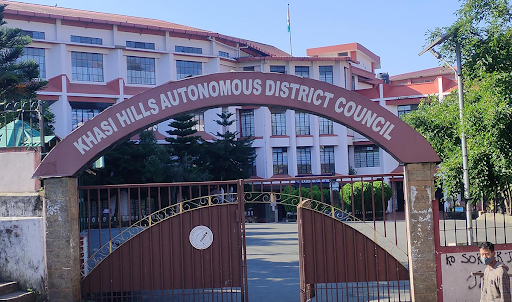
Copyright infringement not intended
Picture Courtesy: thenewsmill
The Meghalaya government postponed the April 2026 Garo Hills Autonomous District Council (GHADC) elections following violent protests.
It is a local self-governing body established to provide tribal communities with self-governance, autonomy, and cultural preservation
Constitutional Basis and Key Objectives
Structure and Powers of Autonomous District Councils (ADCs)
ADCs function as mini-legislatures with a degree of autonomy in legislative, executive, judicial, and financial matters.
Composition: An ADC has up to 30 members serving a five-year term. Of these, 26 are elected through adult suffrage, and 4 are nominated by the Governor.
|
Power |
Details |
|
Legislative Powers |
ADCs can make laws on subjects like land management (excluding reserved forests), inheritance, marriage, divorce, and social customs. However, all laws require the Governor's assent to become effective. |
|
Executive Powers |
They are empowered to establish and manage primary schools, dispensaries, markets, roads, and waterways within their jurisdiction. |
|
Judicial Powers |
ADCs can constitute Village Councils or courts to adjudicate disputes between tribes based on customary law. The High Court's jurisdiction over these matters is specified by the Governor. |
|
Financial Powers |
They have the authority to collect land revenue and impose certain taxes. They can also manage licenses for mineral extraction. |
Overlapping Jurisdictions
Frequent conflicts arise between ADCs and state governments over legislative and administrative domains, hindering effective governance.
Financial Dependency
Despite taxation powers, most ADCs are heavily reliant on grants from state and central governments, which compromises their autonomy.
Lack of Accountability
Allegations of financial mismanagement and corruption are common, compounded by a lack of robust oversight and transparency mechanisms.
Balancing Tradition and Modernity
ADCs struggle to integrate traditional governance systems and customary laws with the framework of a modern democratic state.
Inter-Community Friction
Tensions often exist between the majority tribe and minority groups within the same ADC, as seen with the Chakma-Hajong communities in Mizoram.
Clarify Constitutional Ambiguities
Parliament or the judiciary should provide clear guidance on the powers and limits of ADCs, especially concerning election regulations.
Strengthen Financial Autonomy
Implement recommendations for direct funding to ADCs and consider proposals like the 125th Constitutional Amendment Bill, which suggests creating State Finance Commissions to review ADC finances.
Enhance Accountability
Institute mechanisms for social audits, greater transparency, and bring ADCs under the ambit of anti-defection laws to ensure stability and good governance.
Promote Inclusive Dialogue
Encourage structured dialogue between tribal and non-tribal communities to build consensus on a model of governance that protects tribal identity without disenfranchising other long-term residents.
The Sixth Schedule's Autonomous District Councils must evolve into more financially independent, accountable, and inclusive bodies to effectively safeguard tribal heritage and promote self-governance, balancing cultural preservation with democratic goals.
Source: ANINEWS
|
PRACTICE QUESTION Q. With reference to the Autonomous District Councils (ADCs) in India, consider the following statements:
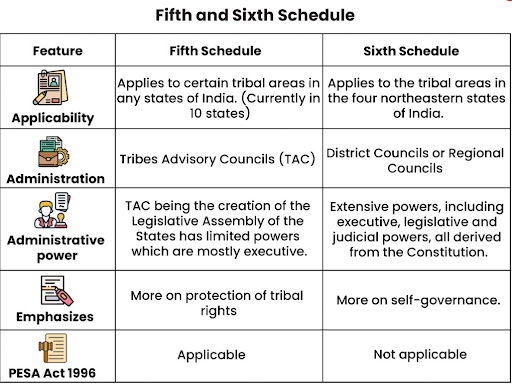
Which of the statements given above is/are correct? A. 1 and 2 only B. 3 only C. 1 and 3 only D. 1, 2 and 3 Answer: B Explanation: Statement 1 is incorrect: Autonomous District Councils (ADCs) are created under the Sixth Schedule, not the Fifth Schedule. The Fifth Schedule deals with "Scheduled Areas" and provides for Tribes Advisory Councils (TACs), but it does not establish ADCs. Statement 2 is incorrect: Under the Sixth Schedule, the Governor of the state—not the President—has the power to organize, re-organize, increase, or decrease the areas of autonomous districts. The President's power to increase or decrease areas applies specifically to "Scheduled Areas" under the Fifth Schedule. Statement 3 is correct: In Sixth Schedule areas, Acts of Parliament and State Legislatures do not automatically apply. Their applicability depends on specific directions or notifications—usually by the Governor (for Assam) or the President (for others like Meghalaya, Tripura, and Mizoram)—which may include specific modifications or exceptions. |
The Sixth Schedule, under Article 244(2), is a constitutional provision for the administration of tribal areas in Assam, Meghalaya, Mizoram, and Tripura. It allows for the creation of Autonomous District Councils (ADCs) to enable self-governance and protect the distinct culture and customs of tribal communities.
ADCs are bodies established under the Sixth Schedule with a degree of legislative, executive, judicial, and financial autonomy. They can make laws on subjects like land, forests, and social customs, manage local administration, and constitute courts to handle cases based on customary law.
ADCs have powers to make laws on specific subjects like land management and social customs, establish and manage primary schools and markets, constitute village courts, assess and collect land revenue, and impose certain taxes.





© 2026 iasgyan. All right reserved