Copyright infringement not intended
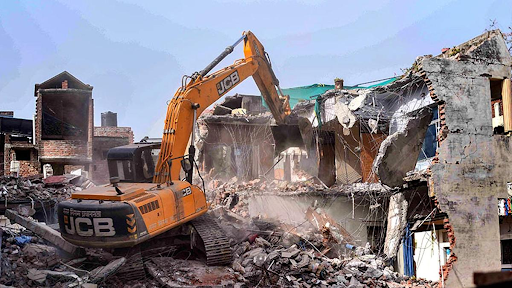
Picture Courtesy: THEHINDU
Context
The Allahabad High Court ruled that immediate demolitions following FIRs are unconstitutional and violate due process, stating that punishment is exclusively a judicial function.
What is Bulldozer Justice?
Bulldozer Justice is a term used to describe the punitive practice where government authorities use heavy machinery to demolish the homes and businesses of individuals accused of crimes—such as rioting, rape, or murder— without following established legal procedures.
While authorities justify these actions as "anti-encroachment drives" against unauthorised constructions, critics and the judiciary view them as a form of extra-judicial collective punishment that bypasses the courts.
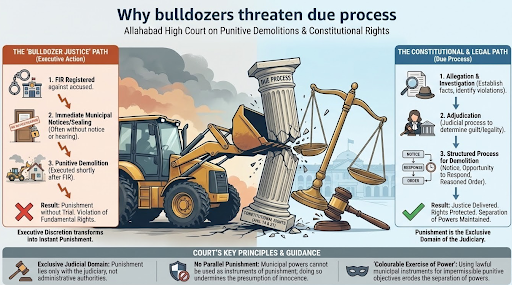
How "Bulldozer Justice" Violates Core Constitutional Principles?
Violation of the Rule of Law: The Rule of Law mandates that the state must act according to established legal procedures rather than arbitrary discretion.
Breach of Separation of Powers: Under the Constitution, the power to adjudicate guilt and award punishment belongs solely to the judiciary, not the executive.
Infringement of Fundamental Rights: "Bulldozer Justice" directly impacts several Fundamental Rights guaranteed under Part III of the Constitution:
Imposition of Collective Punishment: Demolishing a home punishes the entire family of the accused, including innocent women, children, and the elderly.
Violation of Natural Justice: The principles of Natural Justice require that a person be given an opportunity to be heard (audi alteram partem) before any adverse action is taken.
Supreme Court Guidelines on Bulldozer Justice
In the case of In Re: Directions in the Matter of Demolition of Structures (2024), the Supreme Court laid down legally binding, pan-India guidelines to prevent arbitrary demolitions.
Prohibition on Punitive Demolition: The Court explicitly forbade the demolition of a property as a punitive measure, calling such actions "wholly unconstitutional."
Mandatory Notice Period: A minimum show-cause notice of 15 days must be served to the property owner or occupier before any demolition.
Right to a Hearing: The affected party must be given an opportunity for a personal hearing to present their case.
Reasoned "Speaking Order": The authorities must issue a detailed written order explaining why demolition is the only viable option and why alternatives like fines (compounding) are not applicable.
Transparency through Documentation: The entire process, from serving notice to the final demolition, must be videographed to ensure accountability.
Personal Liability for Officials: Officials who violate these guidelines will be held personally liable for providing restitution and paying damages for the demolished property.
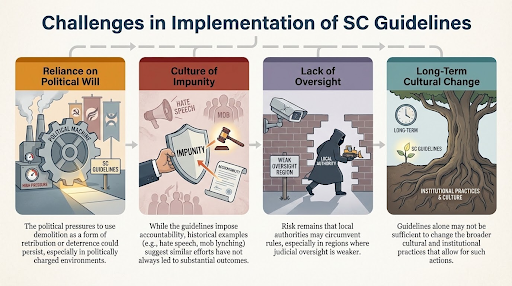
Way Forward
Strict Enforcement of SC Guidelines
State governments must institutionalize the Supreme Court's guidelines through training, audits, and robust internal accountability mechanisms.
Sustained Judicial Vigilance
High Courts must continue to act as watchful sentinels, taking suo motu cognizance and providing swift redressal against arbitrary executive actions.
Legislative Reforms
Municipal and urban planning laws should be amended to include clauses that explicitly prohibit their use for punitive purposes related to criminal cases.
Strengthen Official Accountability
Implement measures for the personal liability of erring officials, including making them responsible for compensation and facing departmental action.
Shift Focus to Criminal Justice Reform
The state must invest in strengthening police investigation, prosecution, and judicial infrastructure to ensure timely and fair trials, making extra-legal measures redundant.
Conclusion
To preserve the Rule of Law in India, the path forward must include enforcing accountability, and leveraging digital transparency to ensure the bulldozer is used for construction, not unconstitutional destruction
Source: THEHINDU
|
PRACTICE QUESTION Q. "The executive cannot become a judge, jury, and executioner." In light of this statement, critically analyze the constitutional challenges posed by 'punitive demolitions' in India. 150 words |
"Bulldozer Justice" is a colloquial term referring to the state practice of demolishing the properties of individuals accused of crimes (often shortly after an FIR is filed), ostensibly for violating municipal building by-laws, but perceived as extrajudicial punishment.
Under the Indian Constitution, the power to determine guilt and impose punishment lies exclusively with the Judiciary. When the Executive (police/municipality) demolishes a home as retribution for a crime, it usurps the judicial function, violating the Separation of Powers.
While not explicitly listed, the Supreme Court has interpreted the "Right to Shelter" as an integral part of the Right to Life under Article 21 in cases like Olga Tellis v. Bombay Municipal Corporation (1985) and Chameli Singh v. State of U.P. (1996).




© 2026 iasgyan. All right reserved