The PM E-DRIVE Scheme, replacing FAME-II with a ₹10,900 crore outlay, has driven over 22 lakh EV sales by January 2026, prioritising e-buses and two-wheelers. Aadhaar-linked e-vouchers and charging expansion improve delivery, but lithium dependence, grid greening, and infrastructure gaps demand stronger domestic manufacturing and ecosystem development.
Copyright infringement not intended
Picture Courtesy: thehindu
Context
The PM Electric Drive Revolution in Innovative Vehicle Enhancement (PM E-DRIVE) Scheme supported the sale of over 22.12 lakh electric vehicles (EVs) as of January 2026.
|
Read all about: GOVERNMENT LAUNCHES PM E-DRIVE SCHEME l PM E-DRIVE: PUSH FOR ELECTRIC VEHICLES |
What is PM E-DRIVE Scheme?
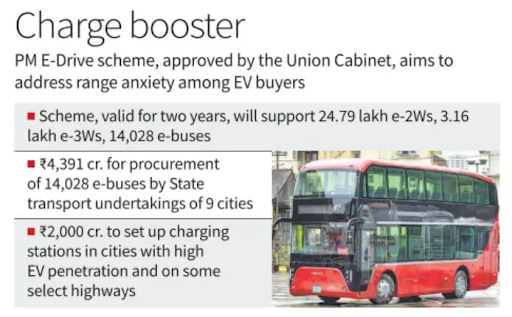
The initiative was launched in 2024 with a budget of ₹10,900 crore, is designed to accelerate the adoption of electric vehicles (EVs) and establish a robust domestic manufacturing base.
Managed by the Ministry of Heavy Industries (MHI), the scheme replaces previous programs like FAME-II and is effective until March 31, 2026 (with certain components like e-trucks and e-buses extended to 2028).
Key Components & Subsidies
The scheme provides financial support through two primary mechanisms:
Eligibility & How it Works
Advanced Batteries: Only vehicles equipped with advanced battery technology (like Lithium-ion) qualify; lead-acid models are excluded.
E-Voucher System: To ensure a paperless and transparent process, the scheme introduces Aadhaar-authenticated e-vouchers.
Local Manufacturing: To support Aatmanirbhar Bharat, Original Equipment Manufacturers (OEMs) must follow a Phased Manufacturing Programme (PMP) to ensure domestic value addition.
Exclusions: Private electric four-wheelers (cars) are excluded from demand incentives, as the focus is on mass mobility and commercial transport.
What is the significance of the PM E-DRIVE Scheme?
Combating Vehicular Pollution
Transport sector contributes around 14% of India’s CO2 emissions. Promoting zero emission EVs is essential for improving air quality in cities. (Source: Bureau of Energy Efficiency)
Reducing Import Dependency
India imports over 85% of its crude oil, making the shift to EVs crucial for boosting energy security and reducing the Current Account Deficit and forex outflow.
Meeting Climate Commitments
The scheme is a key tool for achieving India's ambitious goal of reaching Net Zero emissions by 2070, a commitment made at COP26.
Bridging the Cost Gap
The upfront cost of an EV is currently 20-30% higher than a comparable Internal Combustion Engine (ICE) vehicle; government incentives are essential to achieve mass affordability until price parity.
Challenges
Charging Infrastructure Deficit
Actual installation of charging stations, especially in Tier-2 and Tier-3 cities, has been slow due to challenges in land acquisition and grid connectivity.
Supply Chain Vulnerabilities
India is heavily dependent on imports for key battery minerals like Lithium, Cobalt, and Nickel. India imports nearly 70-80% of its lithium-ion cell requirements, primarily from China.
Financing Hurdles
The high upfront cost of EVs remains a major barrier. The demand for including EVs under Priority Sector Lending (PSL) has not been fully implemented by all banks.
Grid Stability
The Central Electricity Authority (CEA) has raised concerns that unmanaged mass charging could destabilize local power grids. The rollout of smart charging solutions and Time-of-Day (ToD) tariffs is inconsistent across states.
Way Forward
Enhance Local Manufacturing
Enforce the Phased Manufacturing Programme (PMP) to build a domestic supply chain for batteries and other critical components, reducing import dependency.
Develop a Circular Economy
Create a robust policy for battery recycling and urban mining to manage end-of-life batteries and recover valuable materials, as recommended by NITI Aayog.
Promote Smart Charging
Integrate EVs with the power grid through "Smart Charging," which encourages charging during off-peak hours or when renewable energy generation is high, thus balancing the grid and reducing emissions.
Learning from Global Best Practices
Conclusion
The proposed "PM e-DRIVE 2.0" should transition from a subsidy-driven to an ecosystem-led growth model, focusing on heavy vehicles, battery standardization, grid modernization with solar-to-EV integration, and mandated urban EV charging infrastructure to achieve Net Zero 2070 goal.
Source: PIB
|
PRACTICE QUESTION Q. "Subsidies act as a catalyst, but ecosystem enablement ensures sustainability." Discuss this statement in the context of the PM E-DRIVE scheme. 150 words |
The PM Electric Drive Revolution in Innovative Vehicle Enhancement (PM E-DRIVE) is a Government of India scheme with an outlay of Rs. 10,900 crore to promote the adoption of electric vehicles (EVs) and replace the FAME-II scheme. It focuses on mass public transportation, 2-wheelers, and charging infrastructure.
Unlike FAME-II, PM E-DRIVE utilizes Aadhaar-authenticated e-Vouchers. Buyers generate a voucher at the time of purchase, which is signed by the dealer and uploaded to a central portal. This ensures transparency and prevents data misappropriation.
The scheme provides demand incentives for electric two-wheelers (e-2Ws), electric three-wheelers (e-3Ws), electric ambulances, electric trucks, and electric buses. Private electric cars are generally not the primary focus for subsidies under this specific scheme compared to public transport.




© 2026 iasgyan. All right reserved