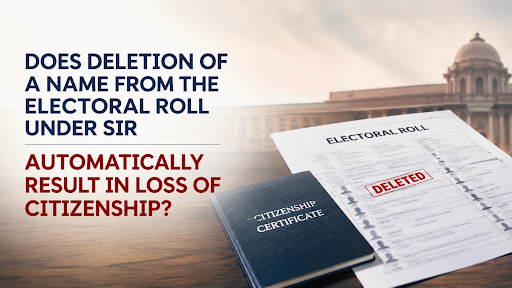
A motion to remove Chief Election Commissioner over alleged partisan conduct in the Special Intensive Revision (SIR) has raised concerns about the independence of the Election Commission of India. The issue revives debates on electoral reforms and the 2023 change in the appointment process.
Copyright infringement not intended
Picture Courtesy: THEHINDU
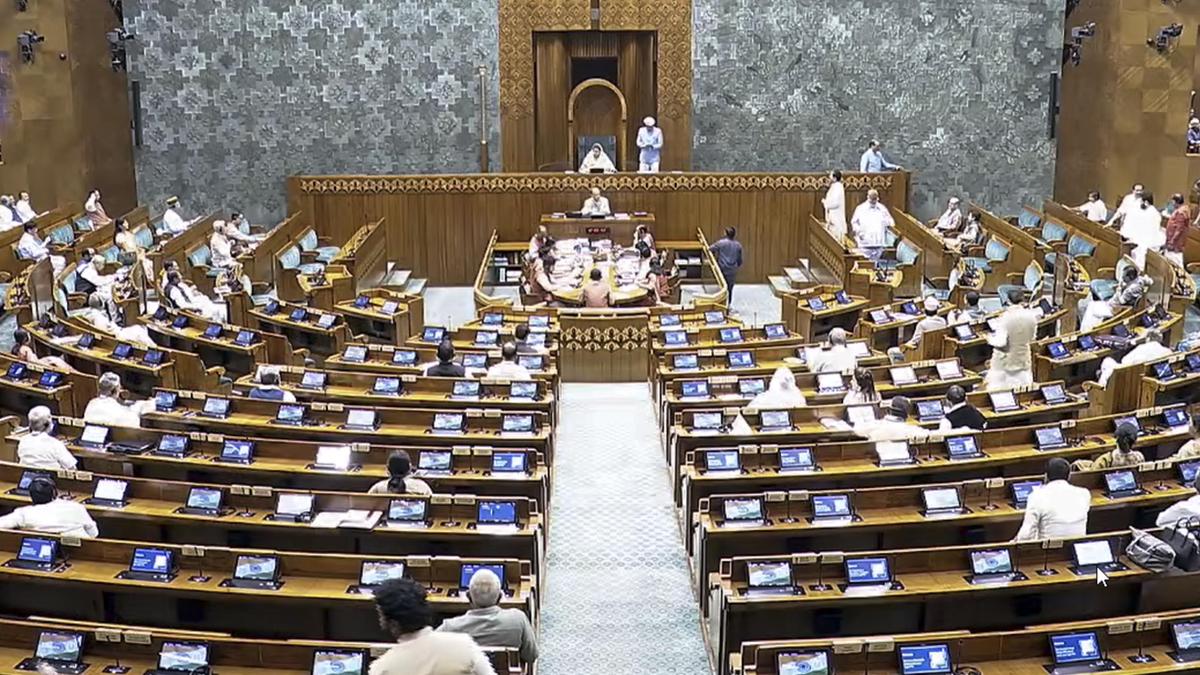
Opposition Parties submitted a notice in both the Houses of Parliament seeking the removal of Chief Election Commissioner (CEC).
What is the Process for Removal of CEC?
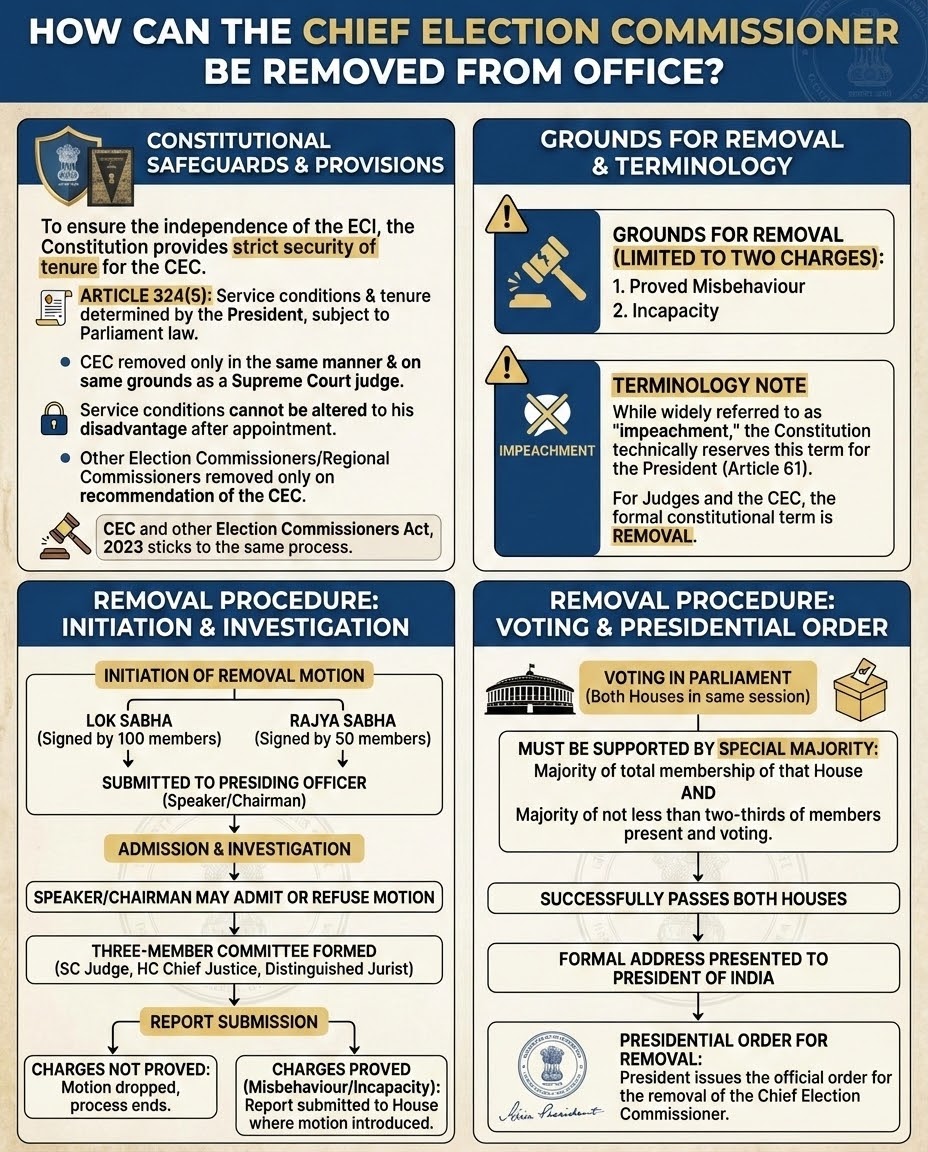
Article 324(5) of the Constitution states that the CEC can only be removed from office "in like manner and on the like grounds as a Judge of the Supreme Court."
Other Election Commissioners or Regional Commissioners can be removed only on the recommendation of the CEC.
The Chief Election Commissioner and other Election Commissioners (Appointment, Conditions of Service and Term of Office) Act, 2023, maintains the constitutional process for the resignation and removal of the CEC and other ECs.
Parliamentary Procedure (as per the Judges (Inquiry) Act 1968)
Initiation of Motion: A removal motion must be signed by at least 100 members of the Lok Sabha or 50 members of the Rajya Sabha.
Admission of Motion: The Speaker (in Lok Sabha) or the Chairman (in Rajya Sabha) has the discretion to either admit or reject the motion.
Inquiry Committee: If admitted, the presiding officer forms a three-member committee to investigate the charges. The committee consists of:
Investigation and Report: The committee conducts a formal investigation and submits its findings to the Parliament.
Parliamentary Vote: If the committee finds the CEC guilty, the motion is taken up for voting in both Houses.
Presidential Order: After the motion is passed by both Houses, an address is presented to the President, who then issues the formal order for removal.
|
Area of Concern |
Key Recommendation / Judgment |
Current Status / Issue |
|
Appointment Process |
In the Anoop Baranwal vs Union of India (2023) case, the Supreme Court mandated a selection committee comprising the Prime Minister, the Leader of the Opposition (LoP), and the Chief Justice of India (CJI). |
The new CEC and Other ECs Act, 2023, replaced the CJI with a Union Cabinet Minister nominated by the PM, raising concerns about executive dominance. |
|
Security of Tenure for ECs |
The Law Commission (255th Report) recommended that Election Commissioners (ECs) should have the same constitutional protection against removal as the CEC. |
Currently, ECs can be removed by the President solely on the recommendation of the CEC, making them vulnerable to pressure. |
|
Financial & Administrative Autonomy |
The Dinesh Goswami Committee (1990) recommended an independent secretariat for the ECI and that its expenditure be 'charged' upon the Consolidated Fund of India. |
The ECI still depends on the government for its funds (voted upon by Parliament) and for the appointment of its staff, which can compromise its functional autonomy. |
 Source: THEHINDU
|
PRACTICE QUESTION Q. With reference to the Chief Election Commissioner and Other Election Commissioners (Appointment, Conditions of Service and Term of Office) Act, 2023, consider the following statements: 1. The selection committee for the appointment of the CEC consists of the Prime Minister, the Leader of Opposition in the Lok Sabha, and the Chief Justice of India. 2. The President of India appoints the CEC based on the recommendation of a Search Committee headed by the Cabinet Secretary. Which of the statements given above is/are correct? A. 1 only B. 2 only C. Both 1 and 2 D. Neither 1 nor 2 Answer: D Explanation: Statement 1 is incorrect: According to the Chief Election Commissioner and Other Election Commissioners (Appointment, Conditions of Service and Term of Office) Act, 2023, the Selection Committee consists of the Prime Minister (Chairperson), the Leader of Opposition in the Lok Sabha (or leader of the largest opposition party), and a Union Cabinet Minister nominated by the Prime Minister. The Chief Justice of India (CJI) is not a member of this committee under the 2023 Act, though the CJI was included in the temporary mechanism previously directed by the Supreme Court in the Anoop Baranwal case. Statement 2 is incorrect: While the President of India appoints the CEC, the recommendation comes from the Selection Committee, not directly from the Search Committee. The role of the Search Committee, which is headed by the Minister of Law and Justice (not the Cabinet Secretary as per the final Act provisions), is to prepare a panel of five names for the consideration of the Selection Committee. The Selection Committee has the power to consider candidates other than those suggested by the Search Committee. |
As per Article 324(5) of the Constitution, the CEC can only be removed from office in the same manner and on the same grounds ("proved misbehaviour or incapacity") as a Judge of the Supreme Court. This involves an inquiry by a committee and subsequent passing of the removal motion by a special majority in both Houses of Parliament.
No, the Speaker of the Lok Sabha (or the Chairman of the Rajya Sabha) has the discretion to either admit or reject the motion for removal even if it has the required number of signatures.
Following the Supreme Court's judgment, the Parliament passed the Chief Election Commissioner and Other Election Commissioners Act, 2023. This new law replaced the Chief Justice of India in the selection committee with a Union Cabinet Minister nominated by the Prime Minister, a move criticized for restoring executive dominance.





© 2026 iasgyan. All right reserved