The Supreme Court upheld the Election Commission's Special Intensive Revision (SIR) of Bihar's electoral rolls, affirming its statutory validity under the Representation of the People Act, 1950. The verdict clarified that Aadhaar serves as identity, not proof of citizenship, balancing electoral purity with due process and voter rights.
Why In News?
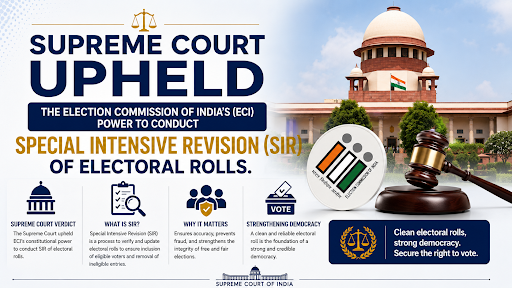
The Supreme Court upheld the Election Commission of India's (ECI) power to conduct the Special Intensive Revision (SIR) of electoral rolls.
What Is the Special Intensive Revision (SIR) of Electoral Rolls?
The Special Intensive Revision (SIR) is an electoral roll update conducted by the Election Commission of India (ECI).
Procedural Mechanism: Unlike the ordinary summary revision framework under Section 21(2), the SIR involves a fresh house-to-house verification.
Temporal and Territorial Flexibility: Section 21(3) allows the ECI to undertake this exercise “at any time” and for “any constituency or part of a constituency,” granting the Commission broad procedural discretion.
Core Objective: The exercise aims to ensure electoral rolls remain accurate, inclusive, and legally valid, addressing systemic inaccuracies caused by rapid urbanization, migration, and duplication of entries over decades.
Supreme Court on the SIR Exercise
The Supreme Court upheld the ECI’s power to conduct the SIR.
Reservoir of Power: The Court described Article 324 as a “reservoir of power” that enables the ECI to act in areas where legislation is silent to secure free and fair elections.
Mutual Accommodation: The Court ruled that Articles 324 and 327 (Parliamentary power to make laws on elections) operate in “mutual accommodation.” The ECI’s authority survives as long as it is exercised consistently with parliamentary law.
Broad Discretion under Section 21(3): The phrase “in such manner as it may think fit” vests the ECI with wide procedural discretion. The Court clarified that the word “any” in the Act can embrace “all” constituencies if inaccuracies are systemic.
Legitimate Baseline: The Court found the use of the 2003 electoral roll as a rational benchmark because it was the last roll produced through intensive house-to-house verification and preceded the Citizenship (Amendment) Act, 2003 requirements.
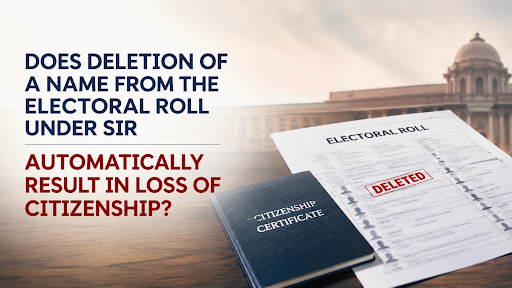
Presumption of Eligibility: While a person on the roll enjoys a presumption of citizenship, this presumption is not absolute or irrebuttable. The SIR is an inquisitorial and verification exercise, not a final adjudication of citizenship.
What Were the Major Concerns Raised Against the SIR Exercise?
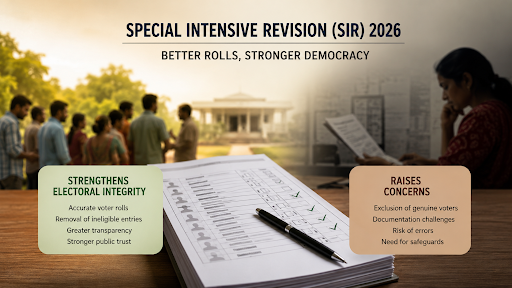
Demographic Engineering: Allegations of “structural rigging” to alter the composition of the electorate before the Assembly Elections.
Mass Disenfranchisement: Bihar's electorate dropped from 7.89 crore to 7.24 crore before the 2025 state election. While 65 lakh names were deleted, only 3.66 lakh were confirmed ineligible.
Documentation Barriers: The ECI excluded previously accepted documents like Ration Cards and the Electors Photo Identity Card (EPIC) as proof for re-verification. Petitioners argued this imposed an onerous evidentiary burden on the poor and marginalized.
What Are the Challenges in Conducting SIR Exercises?
Time Pressure on BLOs: Booth Level Officers (BLOs) operated under unrealistic timelines, leading to many forms being filled without actual physical verification.
Digital Infrastructure Failures: Frequent glitches in the digital infrastructure used to upload data hindered the accuracy of the revision.
Inconsistent Instructions: Procedural guidelines kept changing; for instance, forms were initially rejected without documents but later allowed to be submitted with documents provided at a later date.
Agency Bias: The Supreme Court’s allowance for Booth Level Agents (BLAs)—who are politically affiliated—to participate in voter registration and verification raised concerns regarding neutrality.
What Is the Way Forward?
Strict Document Standards: The Supreme Court directed the inclusion of the Aadhaar Card as a valid identity document (per Section 23(4) of the RPA), while clarifying it does not constitute proof of citizenship.
Referral to Competent Authorities: Where the ECI doubts a person's citizenship, it must refer the case to the competent authority under the Citizenship Act for formal adjudication rather than deleting the name summarily.
Right to Restoration: Individuals deleted from the 2003 roll on citizenship grounds must have their claims decided before major elections. If found to be citizens, their names must be restored to the electoral rolls.
Judicial Review: Electors erroneously deleted due to shifting, death, or duplication remain entitled to challenge ECI decisions through judicial review.
Independent Auditing: There is a growing call for social audits and transparent, statutory scrutiny of draft rolls to prevent opaque administrative interventions.
Conclusion
The Special Intensive Revision is a constitutionally valid tool for electoral integrity, however, its implementation requires rigorous safeguards to prevent systemic disenfranchisement and executive overreach.
|
Read all about: ELECTION COMMISSION ANNOUNCED SPECIAL INTENSIVE REVISION l SPECIAL INTENSIVE REVISION (SIR) OF ELECTORAL ROLLS |
Source: THEHINDU
|
PRACTICE QUESTION Q. Consider the following statements regarding the Special Intensive Revision (SIR) of electoral rolls:
Which of the statements given above is/are correct? A) 1 only B) 2 only C) Both 1 and 2 D) Neither 1 nor 2 Answer: B Explanation: Statement 1 is incorrect: While Article 324 of the Constitution vests the Election Commission of India (ECI) with the power of superintendence, direction, and control of elections, it does not explicitly define or mandate the conduct of a Special Intensive Revision (SIR) specifically before every State Legislative Assembly election. Statement 2 is correct: The ECI invokes Section 21(3) of the Representation of the People Act, 1950 to direct a special revision of electoral rolls. This is typically done to correct mass inaccuracies, systemic errors, or outdated entries caused by migration or duplicate names, as well as to ensure electoral roll integrity. |
SIR is a targeted, comprehensive, and time-bound house-to-house verification exercise conducted by the Election Commission of India (ECI) to cleanse the electoral rolls of duplicate, deceased, or shifted voters, and to enrol eligible citizens.
The Supreme Court upheld the ECI's power to conduct the SIR under Article 324 of the Constitution and Section 21(3) of the Representation of the People Act, 1950. The Court stated that the exercise was proportionate and advanced the constitutional goal of free and fair elections.
The Supreme Court firmly ruled that while the Aadhaar card can be accepted as a valid identity document (the 12th acceptable document for the SIR), it does not constitute proof of citizenship.



© 2026 iasgyan. All right reserved