The Strait of Hormuz is vital for India’s energy security. Any conflict disrupting supplies would spike oil prices, widen the current account deficit, raise inflation, and hurt key sectors. India responds by diversifying imports, boosting reserves, securing sea lanes, and advancing INSTC and Chabahar connectivity.
Copyright infringement not intended
Picture Courtesy: LIVEMINT
Context
The joint attack by the US and Israel on Iran has disrupted the logistics supply chain in the Strait of Hormuz.
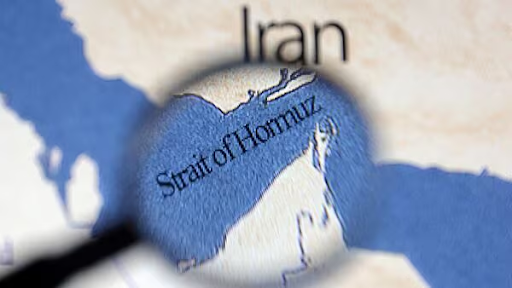
What is the Strait of Hormuz?
It links the Persian Gulf (west) with the Gulf of Oman and the Arabian Sea (southeast).
It is bordered by Iran to the north and Oman (Musandam exclave) and the United Arab Emirates (UAE) to the south.
Why is the Strait of Hormuz Critical for the Global Economy?
Global Energy Artery
The strait handles about 20-21% of the world's oil supply (17–20 million barrels daily) and 20-30% of global seaborne LNG shipments, including almost all Qatari exports. (Source: US Energy)
Primary Route for Asia
Approximately 83% of the crude oil via the strait is headed to Asian markets, mainly China, India, Japan, and South Korea. India, for example, sources about half its total oil imports through this route. (Source: US Energy)
Extreme Chokepoint Vulnerability
The strait is only 21–22 nautical miles wide at its narrowest, with shipping lanes just 2 miles wide each way. This narrowness makes it highly vulnerable to disruption from military action, blockades, or piracy.
India's Energy Lifeline: As the world's third-largest crude oil importer, India is vulnerable to disturbances in this region.
How Would a Conflict-Led Disruption in the Strait of Hormuz Impact the Indian Economy?
Surge in Crude Oil Prices
A $1 increase in Brent crude prices leads to an approximate ₹0.55 and ₹0.52 per litre rise in the retail prices of petrol and diesel in India, respectively. (Source: Emkay Global Financial Services)
Widening Current Account Deficit (CAD)
A sustained $10/barrel oil price increase could widen India's Current Account Deficit (CAD) by about 0.4% of GDP, inflating the import bill, weakening the Rupee, and exacerbating imported inflation. (Source: RBI)
High Inflation
Higher fuel costs would cause widespread inflation, raising the prices of essential goods due to increased transportation costs, thus weakening household purchasing power and slowing economic growth.
Severe Fiscal Strain
Government pressure to reduce fuel excise duties for consumer protection would lower tax revenues, widen the fiscal deficit, and force cuts in essential capital expenditure, thus hindering long-term growth.
Most Vulnerable Indian Sectors
The economic shock would extend beyond the energy sector, affecting numerous industries that are dependent on crude oil and its derivatives.
|
Sector |
Nature of Vulnerability |
Economic Impact |
|
Oil Marketing Companies (OMCs) |
Direct exposure to crude price volatility. |
Severe margin compression and inventory losses; inability to pass on full costs to consumers leads to financial distress. |
|
Aviation |
Aviation Turbine Fuel (ATF) constitutes 40-50% of operating costs (Source: DGCA). |
Reduction in profit margins, forcing airlines to increase fares, which could reduce passenger demand. |
|
Fertilizers & Chemicals |
Heavy reliance on imported ammonia, urea, and naphtha from the Middle East. |
Raw material shortages and increasing input costs. Squeezed margins due to regulated fertilizer prices. |
|
Logistics & Shipping |
Dependence on safe maritime routes for trade. |
Increase in shipping freight rates and insurance premiums due to heightened risk, affecting all international trade. |
|
Paints, Adhesives & Tyres |
Use crude oil derivatives as key raw materials. |
Higher input costs directly impact profitability and may lead to increased prices for end consumers. |
What are India's Strategic Options to Mitigate These Risks?
Diversification of Energy Sources: Increasing crude oil imports from non-Gulf regions like the United States, Russia, Africa, and Latin America to reduce over-reliance on the Middle East.
Investment in Alternative Trade Corridors
Strengthening Strategic Petroleum Reserves (SPRs): India has established SPRs in Visakhapatnam, Mangaluru, and Padur, which provide a cushion against short-term supply disruptions.
Conclusion
To secure strategic autonomy, India must accelerate energy self-reliance and supply chain resilience by diversifying energy imports, fast-tracking INSTC, and expanding reserves amidst the geopolitical fragility of the Strait of Hormuz.
Source: LIVEMINT
|
PRACTICE QUESTION Q. The "Strait of Hormuz," often mentioned in the context of geopolitical tensions in West Asia, is a critical chokepoint for global trade because: (a) It connects the Mediterranean Sea to the Red Sea. (b) It is the only sea passage from the Persian Gulf to the open ocean. (c) It is the primary route for shipping goods from Europe to East Asia. (d) It contains the world's largest offshore oil fields. Answer: (b) Explanation: It serves as the only maritime route connecting the Persian Gulf (home to major oil producers like Saudi Arabia, Iraq, Kuwait, and the UAE) to the Gulf of Oman and the open waters of the Arabian Sea and Indian Ocean. |
It is located in the Middle East, situated between Iran to the north and Oman (the Musandam Peninsula) and the United Arab Emirates to the south. It connects the Persian Gulf with the Gulf of Oman and the Arabian Sea.
The strait is bordered by the territorial waters of Iran and Oman. While these countries have legal rights over their coastal waters, the strait is governed by international "transit passage" rules, which generally allow commercial and military vessels of all nations to pass through.
India is the world's third-largest oil consumer and imports over 88% of its crude oil. Approximately 50% of these imports—roughly 2.5 to 2.7 million barrels per day—transit through the Strait of Hormuz from key suppliers like Iraq, Saudi Arabia, the UAE, and Kuwait.


© 2026 iasgyan. All right reserved