

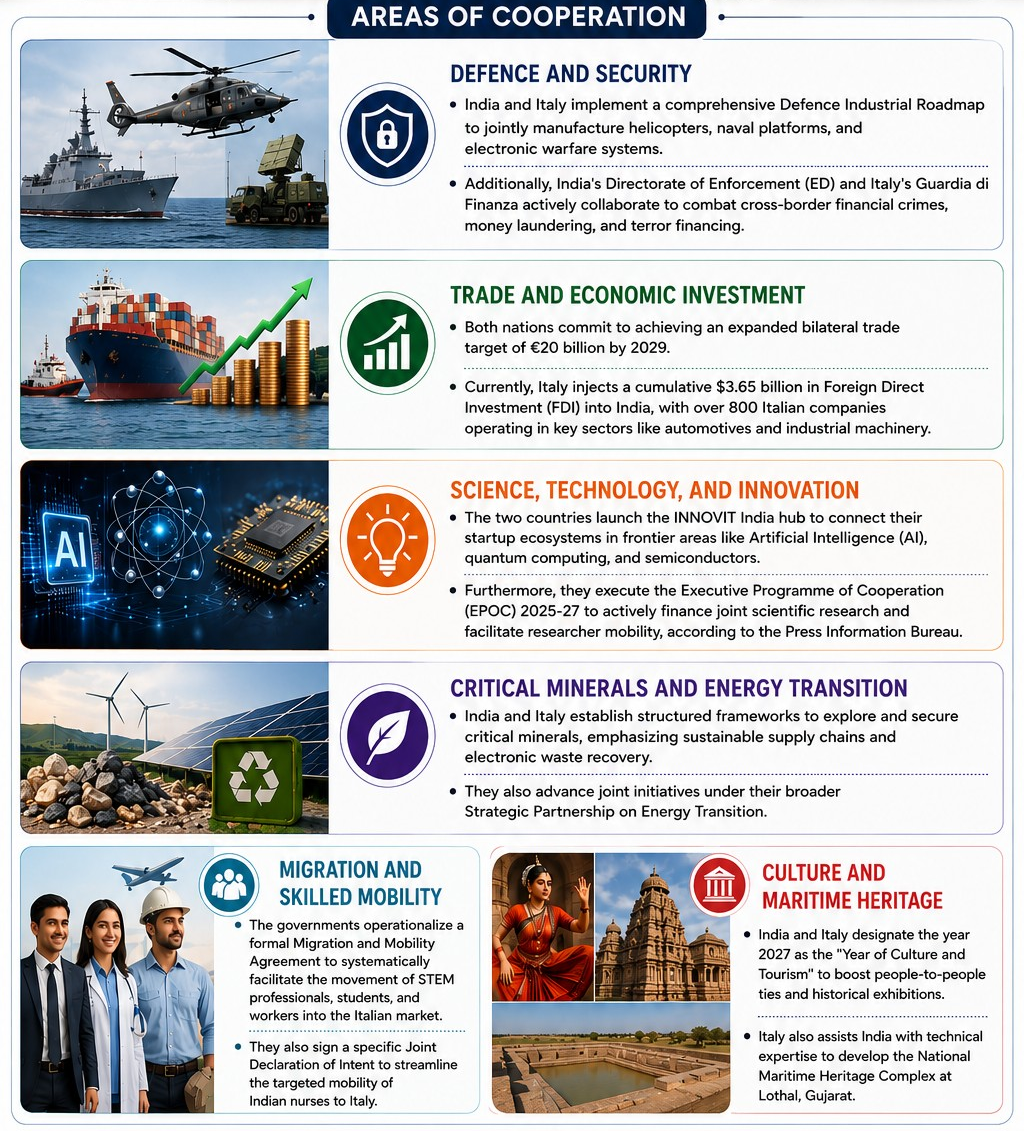
India and Italy outlined an expanded roadmap for a strategic partnership, targeting over €20 billion in bilateral trade by 2029.
Ancient & Historical Ties
India and Italy trace historical connections back to the 13th century when Marco Polo travelled the ancient spice route.
Indian troops played a vital role in liberating Italy during World War II.
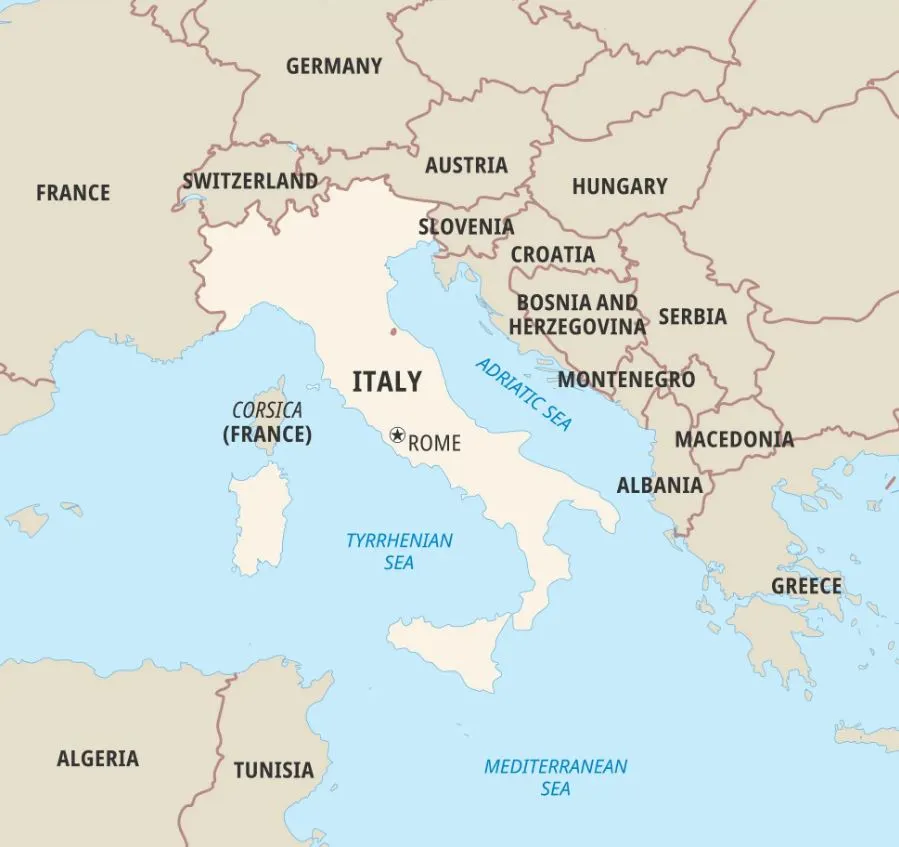 Modern Diplomatic Relations
Two nations formally established diplomatic relations in 1947.
The relationship faced major setbacks around 2012 due to the Italian Marines case and the AgustaWestland deal allegations, which strained diplomatic and legal ties until their resolution around 2021.
Strategic Revival (2021-2023)
Both nations announced a Strategic Partnership on Energy Transition in 2021.
In 2023, leadership elevated the ties to a comprehensive Strategic Partnership, incorporating the Migration and Mobility Agreement to facilitate legal professional movement.
Special Strategic Partnership (2026)
India and Italy upgraded their relationship to a Special Strategic Partnership in May 2026, driven by the implementation of the Joint Strategic Action Plan 2025-2029.
Trade and Investment Hub
Italy acts as India's 4th largest trading partner within the EU. The bilateral trade between the two countries was valued at US$ 13.74 billion in FY25. (Source: IBEF)
Italy is India's 3rd largest trading partner in export in EU, after Germany and Netherland and 4th largest trading partner in import after Germany, Belgium and France. (Source: IBEF)
Italy occupies the 19th position in foreign direct investment (FDI) equity inflows into India with a cumulative FDI amount of US$ 3.65 billion from April 2000 to September 2025. (Source: IBEF)
Defence Indigenisation & Co-production
Italy transitioned from a vendor to a partner in co-development and co-production. The recent Defence Industrial Roadmap establishes frameworks to jointly manufacture helicopters, naval platforms, and electronic warfare systems.
Anchor for IMEC and Connectivity
Italy positions its ports, such as Trieste and Genoa, as the European entry points for the India-Middle East-Europe Economic Corridor (IMEC).
The Blue-Raman submarine cable project connects India to Italy via the Middle East, bypassing maritime chokepoints and ensuring data security.
Geopolitical Alignment against BRI
Italy withdrew from China's Belt and Road Initiative (BRI), creating a strategic vacuum that perfectly aligns with India's efforts to promote transparent, debt-free global connectivity.
Italy participates in India-led global initiatives like the International Solar Alliance (ISA) and the Indo-Pacific Oceans Initiative (IPOI).
Advanced Science, Tech & Critical Minerals
India leverages Italian expertise to build resilient supply chains through a new Memorandum of Understanding on Critical Minerals.
Both countries launched the INNOVIT India innovation hub to collaborate on Artificial Intelligence, quantum computing, and supercomputing.
Diaspora and Skilled Mobility
The Indian community in Italy (estimated at 2.5 lakh) is the third largest community of Indians in Europe after the UK and the Netherlands. (Source: IBEF)
The Migration and Mobility Agreement facilitates the structured movement of Indian nurses, students, and STEM professionals into the Italian labor market.
 What are the Challenges in INDIA-Italy Relations
Geopolitical Instability & IMEC Disruption
Regional tensions, the ongoing conflict in Gaza, and Houthi security threats in the Strait of Hormuz disrupt maritime security and delay the operationalization of the India-Middle East-Europe Economic Corridor (IMEC).
High insurance costs and maritime risks also stall critical infrastructure projects like the Red Sea segment of the Blue-Raman submarine data cable, which aims to connect India to Italy .
Regulatory and Trade Bottlenecks
The prolonged negotiation phase of the India-EU Free Trade Agreement (FTA) restricts maximum economic integration and market access between India and Italy.
New European regulations like the Corporate Sustainability Due Diligence Directive (CSDDD) potentially impose strict environmental and human rights compliance burdens on cross-border energy trade and supply chains.
Academic and Skilled Mobility Hurdles
Complex visa procedures, bureaucratic delays, and challenges regarding the mutual recognition of academic qualifications hinder the seamless mobility of Indian students and professionals into Italy.
Indian Higher Educational Institutions face rigid curricula and structural barriers when attempting to forge collaborative international academic and research programs with foreign universities.
Trust Deficit due of Historical Friction
Past diplomatic crises, primarily the 2012 Enrica Lexie (Italian Marines) incident involving jurisdictional conflicts over the shooting of Indian fishermen,serve as a reminder of the fragility of maritime legal disputes and require continuous diplomatic engagement to prevent future trust deficits.
Execute the Strategic Action Plan
Implement the Joint Strategic Action Plan 2025-2029 through regular Foreign Ministers-led review mechanisms to continuously propel their newly elevated Special Strategic Partnership.
Accelerate Defence Co-Production
operationalize the Defence Industrial Roadmap to co-develop and co-produce advanced helicopters, naval platforms, and electronic warfare systems, boosting India's indigenous manufacturing capacity.
Operationalize IMEC Infrastructure
Fast-track IMEC implementation, modernizing maritime transport, port logistics, and subsea digital cables to cement Italy as India's primary gateway into Europe.
Fast-track the India-EU FTA
Italy and India must leverage their strong bilateral momentum to conclude the India-EU Free Trade Agreement, to achieve the shared goal of €20 billion in bilateral trade by 2029.
Expand Skilled Mobility and Social Security
Enforce the Migration and Mobility Agreement and conclude Social Security Agreement (SSA) to guarantee safe, legal, and beneficial pathways for Indian nurses, STEM professionals, and students entering Italy.
Deepen Frontier Technology Research
Utilize the INNOVIT India innovation hub and the Executive Programme of Cooperation (EPOC) 2025-27 to finance and develop projects in Artificial Intelligence, quantum computing, semiconductors, and green hydrogen.
By moving past historical hurdles to establish a Special Strategic Partnership, India and Italy consolidate a future-ready alliance anchored in defence co-production, IMEC-driven connectivity, and cutting-edge technological innovation.
Source: THEHINDU
|
PRACTICE QUESTION Q. Discuss the significance of the elevation of India-Italy ties to a "Special Strategic Partnership" in the context of India's evolving engagement with Europe. 150 words |
India and Italy elevated their bilateral ties to the level of a "Special Strategic Partnership" during Prime Minister Narendra Modi's official visit to Rome in May 2026.
The leaders of both nations have set a target to raise the bilateral trade from the current level of €13.74 billion to €20 billion by 2029.
They signed an MoU to establish a structured framework for collaboration in critical minerals, focusing on sustainability, resilient supply chains, and the recovery of critical minerals from unconventional sources like electronic waste.
© 2026 iasgyan. All right reserved