

The Indian rupee hit a record low by crossing 96 per dollar due to the West Asia crisis, sparking concerns among policymakers about it breaching the 100-mark.
|
Read all about: RUPEE DEPRECIATION : CAUSES, IMPACTS & INSTITUTIONAL RESPONSE l RUPEE DEPRECIATION AND RBI'S INTERVENTION |
Currency depreciation refers to the decline in the value of a domestic currency (such as the Indian Rupee) relative to a foreign currency (like the US Dollar).
Market forces of supply and demand determine this fall in a floating exchange rate system.
Why Do Currencies Depreciate?
Surging Crude Oil Prices: Since India imports over 85% of crude oil requirement, elevated prices—such as Brent crude crossing $111 per barrel—sharply increase the demand for dollars to pay import bills.
Foreign Capital Outflows: Foreign institutional investors (FIIs) sell domestic equities during periods of global uncertainty.
Geopolitical Instability: Global conflicts, such as the US-Iran tensions and disruptions in the Strait of Hormuz, trigger "flight to safety".
Narrowing Yield Differentials: When the US Federal Reserve maintains elevated interest rates, the yield gap between Indian and US government bonds shrinks.
Trade Deficits and Tariffs: A widening Current Account Deficit (CAD) and external trade pressures, such as the US imposing 50% tariffs on select Indian goods, reduce export competitiveness and strain the currency.
Why is Currency Depreciation a Concern for India?
Imported Inflation
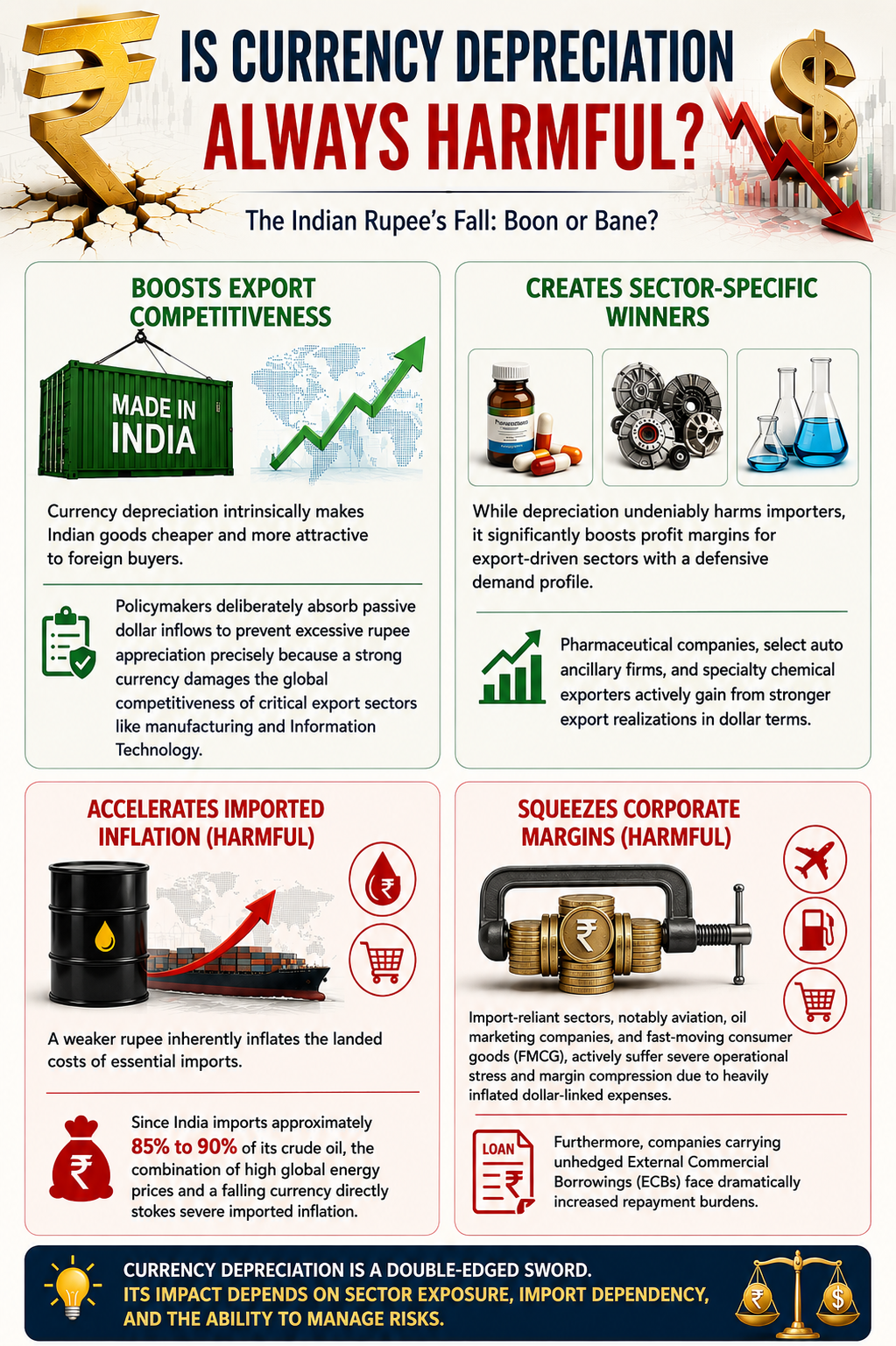
A weaker rupee inflates the landed cost of imports like crude oil, gold, and electronic components. If crude oil prices exceed baseline assumptions by 10%, domestic inflation can surge by 30 basis points. (Source: RBI)
Widening Current Account Deficit
Inflated import bills widen the trade deficit, placing structural strains on the Indian economy.
Corporate Margin Squeeze
Import-reliant sectors, including aviation, oil marketing companies, face margin pressures. Companies holding external commercial borrowings (ECBs) suddenly face heavily inflated repayment costs.
Negative Feedback Loop for Investors
Currency depreciation erodes the dollar-adjusted returns for existing foreign investors. This erosion triggers panic selling, driving a self-sustaining cycle of capital flight and currency weakness.
 How India Manages Currency Depreciation?
Executes Spot Market Interventions
The Reserve Bank of India (RBI) directly sells dollars from its foreign exchange reserves (specifically Foreign Currency Assets) in the spot market to absorb sudden dollar demand and arrest immediate currency depreciation.
Sterilizes Excess Liquidity
The RBI deploys the Market Stabilisation Scheme (MSS) and conducts Open Market Operations (OMOs) to withdraw surplus rupees and prevent domestic inflation after buying dollars.
Tightens the LAF Corridor
The central bank manipulates the Liquidity Adjustment Facility (LAF) to raise overnight call money rates, which makes borrowing rupees to short the currency prohibitively expensive for speculators.
Leverages the Forward Market
The RBI sells dollars in the forward market to manage future dollar liquidity and reassure markets without instantly depleting physical spot reserves.
Conducts USD/INR Swap Auctions
The central bank executes USD/INR Buy/Sell swap auctions (e.g., $5 billion for three years) to lower corporate hedging costs and inject durable rupee liquidity into the banking system.
Attracts NRI Deposits via FCNR-B
The RBI opens FCNR-B (Foreign Currency Non-Resident - Bank) swap windows to offer banks subsidized hedging rates, which successfully incentivizes massive foreign currency inflows from non-resident Indians during severe crises.
Enforces Strict Speculation Curbs
The RBI caps banks' net open positions in the onshore currency market at a strict maximum of $100 million per day to force lenders to reduce exposure and prevent large, one-sided bets against the Rupee.
Monitors the REER
Tracking the Real Effective Exchange Rate (REER) to measure currency overvaluation and ensure interventions protect India's fundamental export competitiveness.
Drives National Conservation Measures
Prime Minister urges citizens and businesses to adopt fuel conservation measures, expand work-from-home (WFH) arrangements, and curb non-essential imports to directly reduce energy demand and protect the import bill.
Executing Aggressive Monetary Tightening
During the severe oil shocks of the 1970s, global central banks deployed aggressive monetary tightening and raised interest rates to combat double-digit inflation triggered by energy supply disruptions.
Prioritizing Economic Growth Over Currency Defense
During the 2007–2008 global financial crisis, central banks cut interest rates to stimulate economic activity, choosing to support growth rather than defend their currencies against inflation spikes.
Holding Rates Steady Amid Geopolitical Crises
In response to the 2026 West Asia conflict, institutions like the South African Reserve Bank (SARB) hold rates steady and reassess inflation outlooks, while the US Federal Reserve exercises extreme caution, delaying rate cuts until 2027 to manage global inflation expectations.
Fast-Track Trade Agreements
Finalize the pending US-India trade deal to eliminate market uncertainty, restore investor confidence, and revive foreign portfolio inflows.
Build Structural Self-Reliance
Promote domestic manufacturing and self-reliance to reduce India's dependence on non-essential imports and permanently conserve foreign exchange reserves.
Track Macroeconomic Indicators
Monitor key technical indicators preemptively, specifically the Real Effective Exchange Rate (REER) for currency overvaluation, US 10-Year Treasury Yields for capital flight risks, and the RBI's net forward position for capital account stress.
Reallocate Capital to Quality Assets
Shift investments away from heavily leveraged companies and import-dependent firms. Redirect capital toward quality businesses that demonstrate strong pricing power and the ability to deliver growth despite global shocks.
Execute Opportunistic Reserve Accumulation
Accumulate reserves opportunistically and procure gold whenever global conditions temporarily stabilize to protect export competitiveness and rebuild the defensive war chest.
Diversify Investment Portfolios
Allocate 10% to 15% of investment portfolios to gold to hedge against imported inflation. Diversify broadly across regions and asset classes to withstand uncertainty and maintain cash-flow planning.
Implement National Conservation Measures
Adopt strict fuel conservation measures, expand work-from-home (WFH) arrangements, and reduce non-essential travel and imports to directly safeguard India's reserves.
India must blend proactive monetary interventions with deep structural reforms—like energy self-reliance and domestic manufacturing—to insulate the economy against volatile global currency shocks.
Source: REPUBLICWORLD
|
PRACTICE QUESTION Q. "A falling rupee creates a complex divergence of winners and losers across the Indian economy." Discuss. 150 words |
The Indian Rupee fell to historic lows, breaching ₹96 to the US Dollar, primarily due to escalating geopolitical tensions between the US and Iran. This conflict pushed Brent crude oil prices above $110 per barrel, leading to a massive surge in India's import bill and triggering heavy Foreign Portfolio Investor (FPI) outflows exceeding ₹2.62 lakh crore. Newly imposed US tariffs on India strengthened dollar demand.
The RBI does not target a fixed exchange rate but uses its massive forex reserves to contain volatility. Its primary tools include selling dollars in the spot market, engaging in USD/INR buy/sell swaps to inject durable rupee liquidity, and utilizing the forward market buffer to signal future dollar availability. It also tightens liquidity through the Liquidity Adjustment Facility (LAF) to make speculative shorting of the rupee more expensive.
Because India imports over 85% of its crude oil requirements, rising global oil prices directly increase the nation's import bill. Since oil is priced in US dollars, a weaker rupee means India pays significantly more for fuel. This combination of high oil prices and a weak currency leads to "imported inflation," directly raising retail inflation and forcing the RBI to lower its growth projections.
© 2026 iasgyan. All right reserved