

Indian Government mandates the disclosure of AI-generated content and establishes strict takedown timelines to combat the growing threats of misinformation and identity manipulation.
AI misinformation refers to verifiably false or misleading content that actors create, manipulate, and disseminate using artificial intelligence technologies.
Generative Models: Actors use Large Language Models (LLMs) and diffusion models to rapidly mass-produce synthetic media.
Synthetic Media Forms: This includes deepfakes, voice cloning, and realistic AI text mimicking truth.
Intelligent Hallucinations: Models often generate inaccurate but realistic content by mimicking training patterns without factual understanding.
Global Scale at Low Cost
Generative AI enables the mass fabrication of high-fidelity media with near-zero marginal cost, transforming forgery into a systemic global vulnerability.
Erosion of Public Trust
Unlabelled synthetic content induces "truth fatigue," severely degrading confidence in public institutions. The World Economic Forum identifies this as a major risk factor for declining societal trust.
Threats to Democracy
Adversaries use AI to manipulate voter perceptions and polarize society, undermining the integrity of electoral processes worldwide.
Surging Financial Fraud
Since 2022, deepfake scams have surged over 2,100% as criminals use AI voice clones and deepfakes for corporate impersonation, with projected losses over $40 billion by 2027 in the US only. (Source: Deloitte)
In India, cybersecurity incidents increased from 10.29 lakh in 2022 to 22.68 lakh in 2024 reflecting the growing scale and complexity of digital threats. (Source: PIB)
Social Media Amplification
Algorithms prioritize sensationalism, spreading fake news faster than truth and trapping users in "information cocoons" that deepen stereotypes.
AI-Driven Gender Violence
Adversaries weaponize AI to create sexualized deepfakes that disproportionately attack and humiliate women in public life.
Obsolescence of Traditional Verification
Modern AI's extreme anatomical fidelity hides anomalies from the human eye, rendering visual verification obsolete and necessitating metadata tracking and digital watermarking.
Risks to National Security
AI disinformation threatens sovereignty; for example, a fake Pentagon explosion image triggered market panics and US stock drops before being debunked.
Ineffectiveness of Automated Moderation: Fact-checking tools struggle with contextual ambiguity and varied user trust, hindering the deployment of uniform defense mechanisms against falsehoods.
Deceiving Consumers
Actors use misleading AI claims and dark patterns to manipulate behavior.
Threatening National Security
AI disinformation threatens sovereignty and safety. Synthetic content can trigger market panics or unrest before authorities can debunk falsehoods.
Assigning Product Liability
Complex AI tech and varied entities obscure accountability, hindering regulators from blaming specific developers or users for AI errors.
Contextual Ambiguity
Detection tools cannot easily identify satire or cultural nuances, letting misinformation slip through automated filters.
Lagging Regulation
Rapid AI agent evolution outpaces policy development, forcing constant oversight revisions to maintain control.
Standardizing Global Policy
Synthetic media's borderless nature requires universal metadata and watermarking standards to prevent regulatory fragmentation across jurisdictions.
Resolving Copyright Issues
Protecting creators while meeting AI training data needs triggers legal conflicts over data mining exceptions.
Addressing Multimodal Verification
Mixed-media misinformation hinders detection, requiring advanced tools and resources often unavailable to regulators.
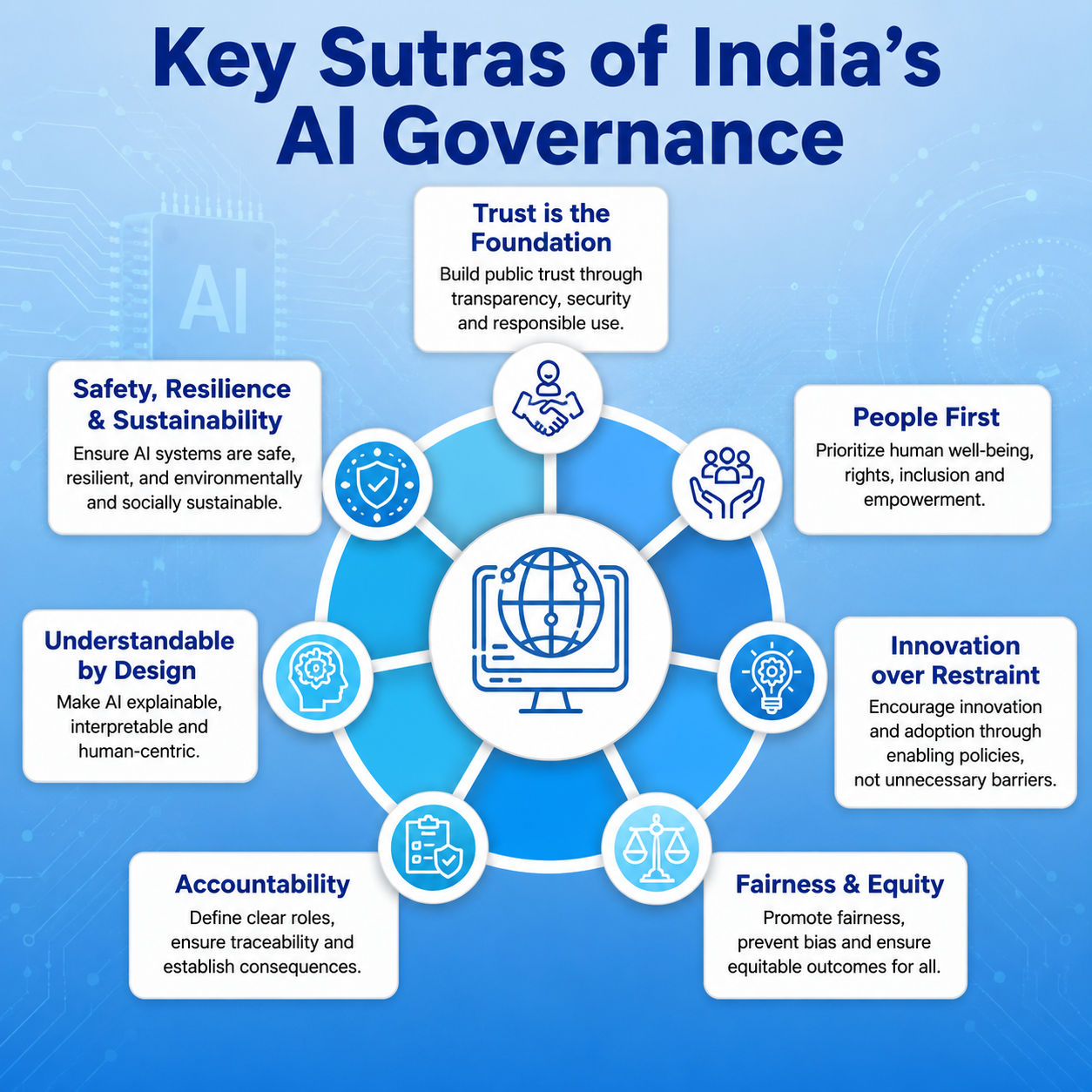
Notifying the India AI Governance Guidelines
The Ministry of Electronics and Information Technology (MeitY) establishes the India AI Governance Guidelines, enforcing seven core "sutras" (principles)—including safety, trust, understandable design, and accountability—to govern AI systems and prevent algorithmic biases.
 Amending Information Technology Rules
Mandates strict transparency through the amended Information Technology Rules, forcing platforms to visibly disclose AI-generated or altered content and imposing a tight three-hour deadline to remove synthetic misinformation upon receiving legal orders.
Enforcing the Digital Personal Data Protection (DPDP) Act
Implementing the DPDP Act to enforce consent, purpose limitation, and data minimization, actively holding developers accountable for training AI models on personal data without explicit authorization.
Prosecuting Cybercrimes under Bharatiya Nyaya Sanhita (BNS)
Law enforcement agencies apply the BNS, 2023, to aggressively prosecute identity theft, cheating by personation, and the distribution of forged, AI-generated obscene materials and deepfakes.
Establishing the AI Safety Institute (AISI)
The government institutes the AI Safety Institute to conduct comprehensive risk assessments, develop safety testing benchmarks, and provide technical guidance to the industry on machine unlearning and deepfake detection.
Deploying Consumer Protection Laws
Regulators invoke the Consumer Protection Act, 2019 to penalize misleading AI claims, dark patterns, and deceptive AI-driven advertisements, ensuring strict consumer safeguards in the digital economy.
Democratizing Safe AI Compute Infrastructure
Through the IndiaAI Mission, the government deploys subsidized AI computing infrastructure and launches the National Datasets Platform (AIKosh) to equip domestic startups with the verifiable resources necessary to build safe, indigenous, and culturally representative foundational models.
|
Can AI Also Be Used to Fight Misinformation? Automated Classification: AI models identify low-complexity synthetic media quickly, while tech platforms utilize hybrid pipelines combining AI bulk filtering with human review for cultural nuance. Style-Agnostic Detection: Models like SheepDog focus on news substance rather than style, making them resilient against LLM-driven "style attacks" designed to mimic reputable publishers. Digital Watermarking & Cryptography: Developers embed resilient watermarks (e.g., Google's SynthID) into pixels and attach cryptographic metadata (C2PA) to securely track content history and origins. Stepwise Fact-Checking: AI agents cross-reference claims with external databases. Effectiveness varies by audience; it reduces false beliefs in progressives, whereas conservatives prioritize human checkers and source reputation. |
Democratizing Scalable AI Infrastructure
Increasing Investments in public-cloud computing and subsidizes access to advanced Graphics Processing Units (GPUs) while expanding data repositories like the AIKosh platform to equip innovators with high-quality, representative datasets.
Cultivating an AI-Ready Workforce
Implement nationwide reskilling programs and modernize educational curricula across schools and universities to bridge the talent gap and transition the workforce for an automated digital economy.
Enforcing an Agile, Pro-Innovation Regulatory Framework
Develop adaptive governance models that encourage "Enable, then regulate" approach, carefully balancing rapid technological innovation with strict ethical safeguards and India-specific risk mitigation strategies.
Sovereign AI and DPI Integration
Promote indigenous innovation by constructing culturally relevant, multilingual foundational models (such as BharatGen) and integrating AI with Digital Public Infrastructure (DPI) to guarantee equitable, population-scale service delivery.
Instituting a National AI Incident Database
Establish a centralized incident reporting mechanism, collaborating with agencies like CERT-In, to track AI-induced harms, monitor system vulnerabilities, and deploy advanced threat-detection tools against digital misinformation.
Establishing Robust Institutional Ecosystems
Institutes collaborative frameworks—specifically Centres of Research Excellence (COREs) and International Centres for Transformational AI (ICTAIs)—to drive core and applied AI research through strategic public-private partnerships.
Advocating Global AI Diplomacy
Integrate AI governance into foreign policy, leveraging multilateral platforms like the UN and G20 to promote Global South representation and jointly construct universally accepted, equitable AI standards.
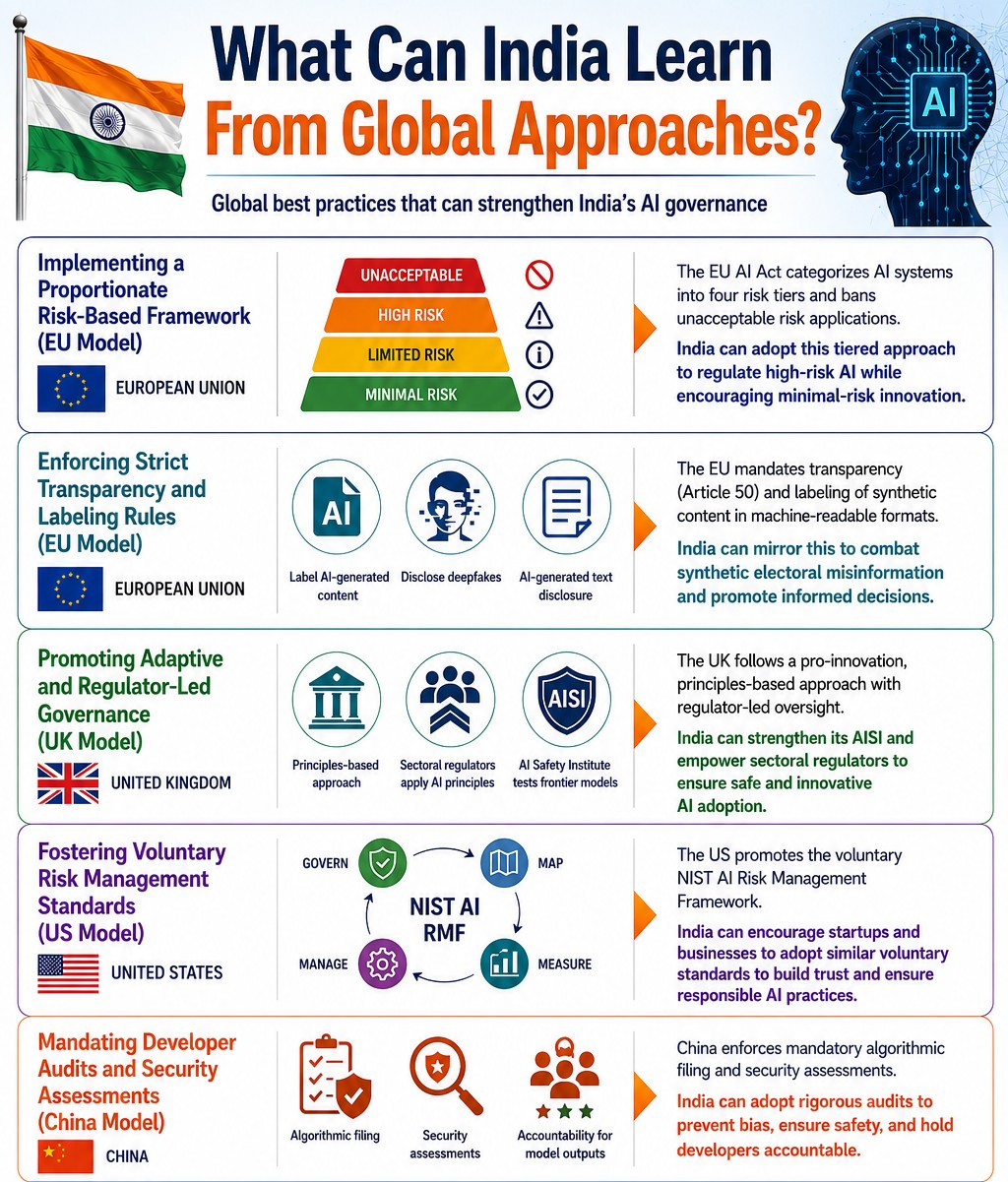 Conclusion
India must leverage AI for inclusive growth by democratizing digital infrastructure, nurturing local talent, and implementing adaptive governance that balances innovation with ethical safeguards.
Source: THEHINDU
|
PRACTICE QUESTION Q. "India's approach to AI governance is largely characterized as 'Enable, then regulate'." Critically analyze. 150 Words |
The IndiaAI Mission is a government initiative launched with an outlay of ₹10,371.92 crore to make India a global hub for AI. It aims to democratize AI access by building compute infrastructure, indigenous models, and high-quality datasets.
The mission is built on seven pillars: IndiaAI Compute Capacity, IndiaAI Innovation Centre, National Datasets Platform (AIKosh), Application Development Initiatives, FutureSkills, Startup Financing, and Safe & Trusted AI.
BharatGen AI is India's first government-funded, homegrown multimodal large language model (LLM) designed to support 22 Indian languages and capture the nation's linguistic and cultural diversity.
© 2026 iasgyan. All right reserved