The Nutrient Based Subsidy (NBS) scheme successfully diversified fertilizer options for farmers. However, achieving "Viksit Bharat" goals of sustainable, high-yield farming requires the government to correct the critical pricing imbalance between Urea and P&K fertilizers to ensure long-term agricultural sustainability.
Why In News?
The Union Cabinet approved a proposal of the Department of Fertilizers for fixing the Nutrient Based Subsidy (NBS) rates for KHARIF Season 2026 on Phosphatic and Potassic (P&K) fertilizers.
About Nutrient Based Subsidy (NBS) Scheme
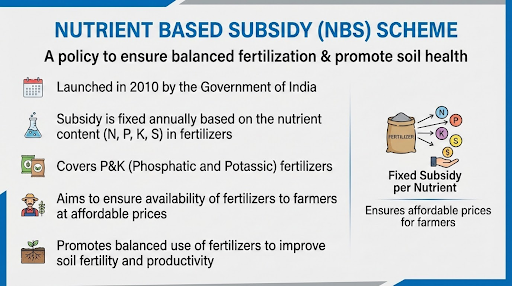
The Nutrient Based Subsidy (NBS) launched in 2010, is a Central Sector Scheme, implemented by the Department of Fertilizers.
Under this policy, a fixed amount of subsidy is decided on an annual or bi-annual basis for each nutrient—Nitrogen (N), Phosphate (P), Potash (K), and Sulphur (S)—contained in Phosphatic and Potassic (P&K) fertilizers.
Objectives
Ensuring Fertilizer Availability: To ensure that farmers have easy access to P&K fertilizers at regulated and affordable prices.
Balanced Soil Nutrition: To move away from the over-use of Urea and promote the ideal N:P:K ratio (4:2:1) to maintain soil health.
Promoting Indigenous Production: To incentivize domestic fertilizer companies to produce and innovate high-quality complex fertilizers.
Key Features
Nutrient-Specific Rates: Subsidy is not on the product (bag) but on the weight of the nutrient (per kg) present in the fertilizer.
Decontrolled Pricing: Unlike Urea, the Maximum Retail Price (MRP) of P&K fertilizers is decontrolled; companies set the price based on market dynamics, provided they remain reasonable.
Wide Coverage: It covers 25 grades of P&K fertilizers, including Diammonium Phosphate (DAP), Monoammonium Phosphate (MAP), Muriate of Potash (MOP), and various NPK complexes.
Secondary/Micronutrients: Additional subsidies are provided for fertilizers fortified with Zinc and Boron.
Significance
Agricultural Productivity: Balanced fertilization ensures better crop yields and prevents soil acidification or alkalinity.
Fiscal Planning: A fixed subsidy per nutrient helps the government predict and manage the subsidy budget regardless of international price spikes.
Environmental Protection: It discourages the excessive use of single nutrients, reducing groundwater contamination and greenhouse gas emissions from fields.
Challenges
Urea Distortion: Since Urea is outside NBS and remains extremely cheap, farmers continue to over-apply it, rendering the NBS goal of "balanced use" difficult to achieve.
Import Vulnerability: India imports nearly 100% of its Potash and a massive share of its Phosphatic requirements, making the scheme's costs highly sensitive to global supply shocks.
Ballooning Subsidy Bill: Geopolitical tensions often force the government to hike subsidy rates to keep farmer prices stable, leading to fiscal pressure.
Way Forward
Include Urea in NBS: Niti Aayog recommends bringing Urea under the NBS umbrella to eliminate price disparity and promote holistic soil health.
Nano-Fertilizer Expansion: Promoting Nano Urea and Nano DAP can reduce the physical volume of imports and lower the overall subsidy burden.
Direct Benefit Transfer (DBT): Transitioning to a system where the subsidy is paid directly into the farmer's account based on Soil Health Card recommendations.
Conclusion
While the Nutrient Based Subsidy scheme has successfully diversified fertilizer options, achieving the "Viksit Bharat" goal of sustainable, high-yield farming requires the government to correct the pricing imbalance between Urea and P&K fertilizers.
Source: PIB
|
PRACTICE QUESTION Q. With reference to the Nutrient Based Subsidy (NBS) scheme, consider the following statements:
Which of the statements given above is/are correct? A) 1 and 2 only B) 2 and 3 only C) 1 and 3 only D) 1, 2, and 3 Answer: A Explanation: Statement 1 is correct: The NBS scheme is implemented by the Department of Fertilizers under the Ministry of Chemicals and Fertilizers. Statement 2 is correct: The NBS scheme provides a fixed subsidy, reviewed annually or biannually, based on the nutrient content (N, P, K, S) of P&K fertilizers. Statement 3 is incorrect: Urea is not covered under the NBS scheme; it is under a separate maximum retail price (MRP) control system. The NBS primarily covers P&K fertilizers. |
Introduced in April 2010, the NBS scheme provides farmers with subsidized fertilizers at a fixed rate per kilogram for essential nutrients like Nitrogen (N), Phosphate (P), Potash (K), and Sulphur (S). It allows the Maximum Retail Price (MRP) of these Phosphatic and Potassic (P&K) fertilizers to be decided by the market while keeping them affordable through government subsidies.
India is highly dependent on imports for fertilizer raw materials. The country imports 100% of its Potash and nearly 90% of its Phosphates. As a result, global supply chain disruptions (like the Russia-Ukraine war) directly inflate India's domestic subsidy bill.
PM-PRANAM (PM Programme for Restoration, Awareness, Nourishment and Amelioration of Mother Earth) is a government initiative that incentivizes states to reduce their chemical fertilizer consumption. States that successfully shift toward organic alternatives are granted 50% of the resulting subsidy savings.


© 2026 iasgyan. All right reserved