Nano-fertilizers transform Indian agriculture by enhancing nutrient absorption efficiency through targeted delivery, reducing environmental pollution and the subsidy burden. Success hinges on integrating them into precision agriculture via PM-PRANAM while addressing farmer skepticism through robust soil management.
Why In News?
India is witnessing a sharp rise in Nano-fertilizer adoption, driven by government-led drone technology initiatives to enhance nutrient efficiency and transform traditional agricultural practices
What are Nano-Fertilizers?
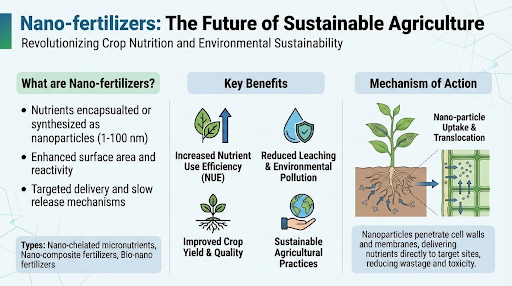
Nano-fertilizers are nutrient carriers synthesized using nanotechnology, where essential plant nutrients are encapsulated or delivered in particles sized between 1 and 100 nanometers.
Unlike conventional granular fertilizers (applied to soil), nano-fertilizers are liquid-based and applied via foliar spray (directly on leaves).
Due to their ultra-small size, they enter the plant through stomata (pores) or ion channels, ensuring high internal translocation.
India has commercially launched Nano Urea (Nitrogen) and Nano DAP (Diammonium Phosphate), becoming the first country globally to do so at scale.
Benefits of Nano-Fertilizers
Nutrient Use Efficiency (NUE): Conventional urea has an efficiency of only 30–50% (rest is lost to leaching or gas). Nano-fertilizers boast an NUE of over 80–90%. (Source: ICAR)
Environmental Sustainability: They prevent Nitrate Leaching (groundwater pollution) and Eutrophication (algal blooms in water bodies). They also reduce the emission of Nitrous Oxide, a potent greenhouse gas.
Economic Relief: A 500ml bottle of Nano Urea replaces a 45kg bag of conventional urea. This reduces the Fertilizer Subsidy Bill, which stood at approx. ₹1.71 lakh crore in the 2026-27 Budget.
Logistics & Storage: Replacing bulky bags with small bottles cuts down on transport, warehousing, and "last-mile" delivery costs for farmers
Increased Crop Yield: Field trials have shown an average yield increase of 8% due to better nutrient absorption. (Source: ICAR)
Steps Taken by Government to Promote Nano-Fertilizers
PM-PRANAM Scheme: Incentivizes States and UTs to promote "Alternative Fertilizers" and reduce chemical fertilizer consumption.
Namo Drone Didi Scheme: Training 15,000 Women Self-Help Groups (SHGs) to operate Kisan Drones for the precise foliar spray of nano-fertilizers (Source: PIB).
One Nation One Fertilizer: Standardizing all fertilizers under the "Bharat" brand to reduce cross-movement and improve accessibility.
PMKSK (Pradhan Mantri Kisan Samridhi Kendras): Converting 2.8 lakh retail shops into one-stop centers providing soil testing and nano-fertilizer advisory. (Source: PIB)
Fast-Track Approvals: The government included Nano Urea and Nano DAP in the Fertilizer Control Order (FCO) to expedite commercial production.
Challenges in Promoting Nano-Fertilizers in India
The Psychological Barrier: Farmers are traditionally concerned with the visible application of white granules; shifting to "invisible" liquid sprays requires intensive behavioral change.
Technical Skill Gap: Effective application requires specific concentration levels and timing. Incorrect foliar spraying can lead to leaf scorching or ineffective results.
Drone Infrastructure: While drones are being pushed, the rural infrastructure for battery charging, maintenance, and skilled pilots is still in the nascent stage.
Initial Cost of Equipment: The requirement for specialized sprayers or drone services can be an entry barrier for small and marginal farmers.
Way Forward
Expand Extension Services: Use Krishi Vigyan Kendras (KVKs) for massive on-field demonstrations to build farmer trust.
Digital Integration: Link nano-fertilizer application with Soil Health Cards to ensure farmers spray only what is required.
R&D Expansion: Beyond Nitrogen and Phosphorus, focus on Nano-Potash and Nano-Micronutrients (Zinc, Boron) to address multi-nutrient deficiencies in Indian soil.
Subsidizing Services, Not Just Products: Provide direct financial support for drone-spraying services to make the technology affordable for smallholders.
Conclusion
Nano-fertilizers drive Fiscal Prudence and Climate-Smart Agriculture by decoupling productivity from chemical overuse, addressing the food security and environmental "trilemma." This Nano-Revolution forms the bedrock for a sustainable, self-reliant agrarian economy as India targets Viksit Bharat @2047.
Source: DDNEWS
|
PRACTICE QUESTION Q. Analyze the multi-dimensional benefits of transitioning from conventional chemical fertilizers to nano-fertilizers in India. 150 words |
Nano-fertilizers are macronutrients scaled down to nanoscale dimensions (1-100 nanometres) for highly targeted delivery. Unlike conventional granular fertilizers applied to the soil (basal), nano-fertilizers are sprayed directly onto plant leaves (foliar), resulting in much higher nutrient absorption efficiency.
PM-PRANAM (PM Programme for Restoration, Awareness, Nourishment and Amelioration of Mother Earth) is a government initiative that incentivizes Indian states to adopt alternative agricultural inputs, like Nano Urea and Nano DAP, to decrease dependency on chemical fertilizers and reduce the national subsidy burden.
The 'Namo Drone Didi' scheme is an initiative that distributes agricultural drones to Women Self Help Groups (SHGs) in rural areas. It empowers women economically while providing a technological solution to the labor-intensive process of foliar spraying of nano-fertilizers over large tracts of farmland.



© 2026 iasgyan. All right reserved