Myanmar President Min Aung Hlaing's official visit to India in June 2026 highlighted renewed efforts to expedite the Kaladan Project and enhance cooperation on border security.
|
Read all about: India-Myanmar Relations Explained |
Evolution of India-Myanmar Relations
Colonial Roots & Early Idealism (1948–1962)
Post-independence, India and Myanmar solidified colonial-era ties through the 1951 Treaty of Peace and Friendship and early leadership in the Non-Aligned Movement (NAM).
Isolationist Era & Friction (1962–1990)
Following the 1962 coup, relations deteriorated due to Myanmar's isolationism and India's 1988 support for pro-democracy activists against the military junta.
Pragmatic Realism (1991–2020)
To counter Chinese influence and insurgency, India adopted the Look East Policy (later Act East Policy), prioritizing regional stability and security cooperation over ideology
Strategic Consolidation (2021–Present)
Despite the 2021 coup, India continues pragmatic engagement. During President Min Aung Hlaing's June 2026 visit, both nations agreed to utilize a Rupee-Kyat mechanism for trade and collaborate on critical minerals.
|
About Myanmar |
|
|
Geopolitical Location and Physical Geography |
|
|
Domestic Political Crisis and Internal Security |
|
Civil War Intensification
The 2021 military coup triggered a nationwide conflict. Ethnic Armed Organizations (EAOs), notably the Arakan Army, seized major territories like Rakhine State via Operation 1027.
Chinese Dependency
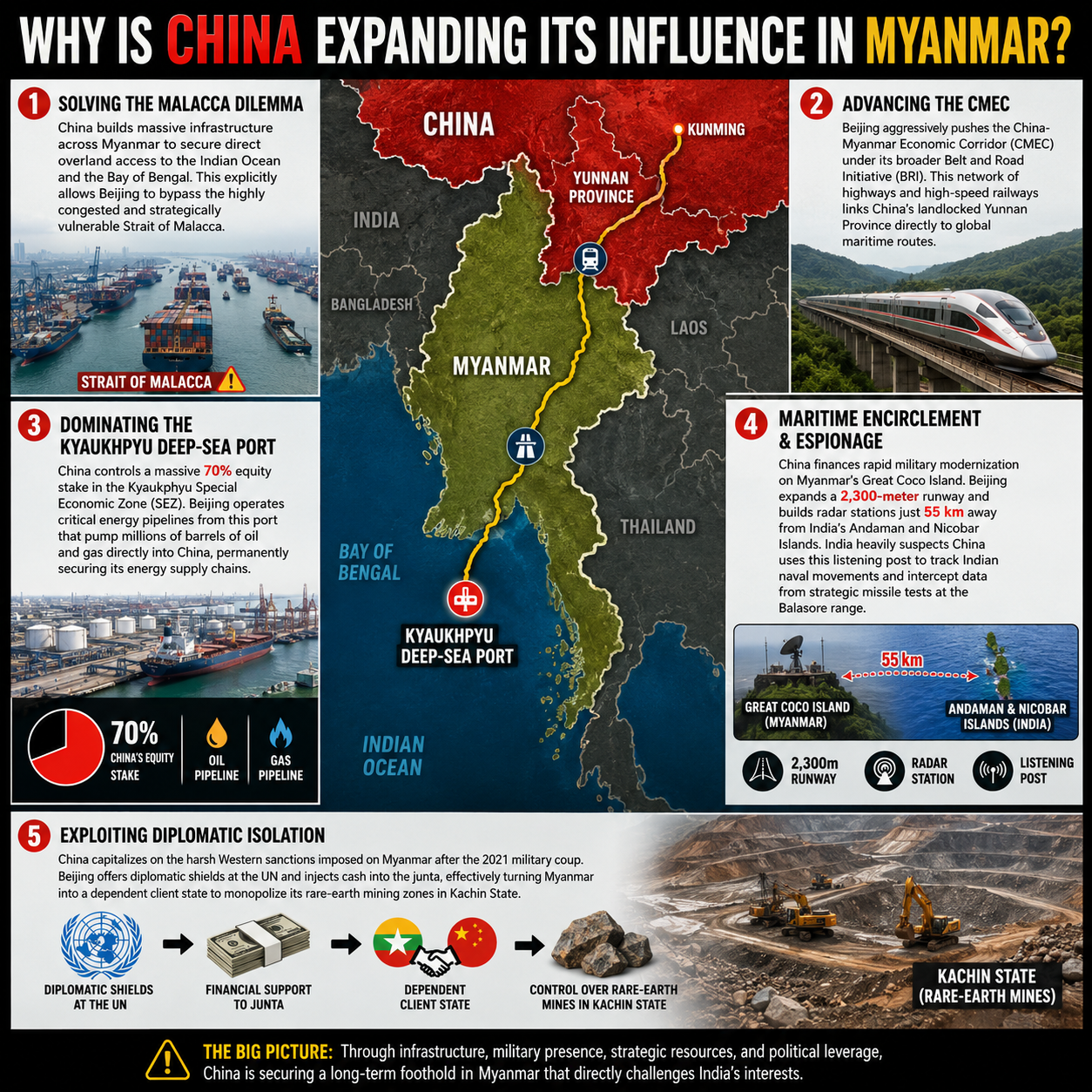
Global isolation forces the junta to rely on Beijing, which is fast-tracking the China-Myanmar Economic Corridor (CMEC) for Indian Ocean access.
Transnational Crime
Rule of law breakdown allows criminal syndicates to run cyber-scam compounds in border areas.
Resource Decentralization
The junta has lost control of key rare-earth mining zones in Kachin State to rebels, complicating official mineral agreements.
Refugee Influx & Demographic Tensions
Violence drives Chin refugees into Mizoram and Manipur, altering demographics and fueling ethnic conflict in Manipur.
Insurgency & Smuggling
Porous borders offer sanctuary to Indian Insurgent Groups (IIGs) and facilitate Golden Triangle narcotics and arms trafficking into the Northeast.
Suspension of the Free Movement Regime (FMR)
Citing severe internal security threats, India completely scraps the FMR in 2024, ending a decades-old policy that allowed indigenous tribes to travel 16 km across the border visa-free.
Stalled "Act East" Connectivity
Conflict repeatedly delays flagship projects like the Kaladan Multi-Modal Transit Transport Project (KMMTTP) and the India-Myanmar-Thailand Trilateral Highway.
Chinese Strategic Encirclement
China's Kyaukphyu Deep-Sea Port bypasses the Malacca Strait, while military expansion on Great Coco Island—55 km from the Andaman and Nicobar Islands—poses a maritime threat for India.
 What Are India's Strategic Interests In Myanmar?
Gateway to Southeast Asia
India views Myanmar as its exclusive land bridge to the ASEAN region. This geographic reality anchors India's Act East Policy, Neighbourhood First Policy, and MAHASAGAR vision.
Bypassing the Siliguri Corridor
India builds the Kaladan Multi-Modal Transit Transport Project (KMMTTP) to link Kolkata Port to Mizoram via Myanmar's Sittwe Port and Kaladan River, to slashes travel distances and mitigates India's reliance on the vulnerable Chicken's Neck.
Integrating Regional Supply Chains
India drives the India-Myanmar-Thailand Trilateral Highway, a 1,400-km corridor connecting Moreh (Manipur) to Mae Sot (Thailand), physically integrating Indian markets into lucrative Southeast Asian trade networks.
Crushing Cross-Border Insurgency
India requires Naypyidaw's active cooperation to eliminate Indian Insurgent Groups (IIGs) that exploit Myanmar's dense jungles as operational safe havens.
Securing Critical Minerals
India targets Myanmar’s heavy rare-earth element deposits—particularly dysprosium and terbium—to fuel domestic technology and defense sectors, aiming to break Chinese mineral monopolies.
Extracting Energy Resources
India invests directly in Myanmar's offshore Shwe gas field in the Bay of Bengal through state-owned entities like ONGC Videsh and GAIL.
De-Dollarizing Bilateral Trade
India operationalizes the Rupee-Kyat settlement mechanism to bypass Western banking restrictions and facilitate direct currency flows, pushing bilateral trade beyond $2.1 billion.
Counterbalancing Chinese Hegemony
India deepens ties with Naypyidaw to check China's aggressive maritime expansion into the Bay of Bengal and prevent Beijing from monopolizing Myanmar as a vassal state.
Lost Control to EAOs
The junta has lost strategic regions to groups like the Arakan Army (AA), who now occupy critical Kaladan Project nodes and rare-earth mines in Kachin, stalling bilateral agreements.
Infrastructure Delays
Armed hostilities have halted the KMMTTP and Trilateral Highway, pushing India’s completion target to 2027 due to security threats in Rakhine, Chin, and Sagaing.
Managing Refugee Influxes
Violence drives Chin refugees into Mizoram and Manipur, straining demographics and ethnic stability in Manipur.
FMR Suspension & Fencing
India scrapped the Free Movement Regime (FMR) to combat insurgency and trafficking, launching a ₹31,000 crore smart-fencing project along the 1,643 km border despite local protests.
Combating Transnational Crime
Instability fosters cyber-scam compounds, requiring India to rescue 2,400+ trafficked citizens. Power vacuums also increase Golden Triangle narcotics and arms smuggling.
Facing Chinese Encirclement
China advances the China-Myanmar Economic Corridor (CMEC), controls Kyaukphyu Port, and modernizes military assets on Great Coco Island. Located 55 km from India's Andaman Islands, this base likely serves to monitor Indian naval movements and missile tests.
Pragmatic Diplomacy
India should balance democratic ideals with the strategic necessity of engaging Myanmar's military to protect national security and infrastructure.
Modernized Border Control
Replace the Free Movement Regime (FMR) with smart-fencing (UAVs, sensors) to secure the frontier while maintaining formalized trade and indigenous cultural ties.
Expedite Connectivity
India must complete the Kaladan Project and Trilateral Highway to integrate the Northeast into ASEAN supply chains.
Counter China
Actively neutralize Beijing’s regional footprint through economic cooperation and securing critical minerals.
Economic Interdependence
Utilize the Rupee-Kyat mechanism to bypass restrictions and invest in Myanmar's energy and infrastructure.
Diplomacy & Soft Power
Facilitate Track-II dialogues for reconciliation and strengthen bonds via Ananda Temple restoration and Mekong Ganga scholarships.
India must execute a multidimensional strategy that combines strict strategic pragmatism, rapid infrastructure integration, and robust border security to protect its Indo-Pacific interests and foster lasting stability in Myanmar.
Source: INDIANEXPRESS
|
PRACTICE QUESTION Q. Examine the strategic significance of Myanmar in India's 'Act East' and 'Neighbourhood First' policies. 150 words |
India scrapped the FMR citing severe internal security concerns, including illegal immigration, arms smuggling by insurgent groups, narco-trafficking from the Golden Triangle, and demographic anxieties in border states like Manipur and Mizoram.
It is a sea-river-road transport corridor connecting Kolkata port to Sittwe port in Myanmar by sea, navigating inland via the Kaladan river to Paletwa, and connecting by road to Mizoram. It creates an alternative transit route to India's Northeast.
Myanmar serves as India's exclusive geographical land bridge to the ASEAN region. It is essential for regional land connectivity, supply chain integration, and countering Chinese maritime and economic dominance in Southeast Asia.
© 2026 iasgyan. All right reserved