The recent geopolitical crisis in the Middle East and disruptions in the Strait of Hormuz have exposed India's fossil fuel import dependency, prompting calls for energy austerity and structural reforms.
Energy Atmanirbharta refers to India's strategic pursuit of absolute energy self-reliance, marking a shift away from reactive crisis management toward integrated, long-term energy governance.
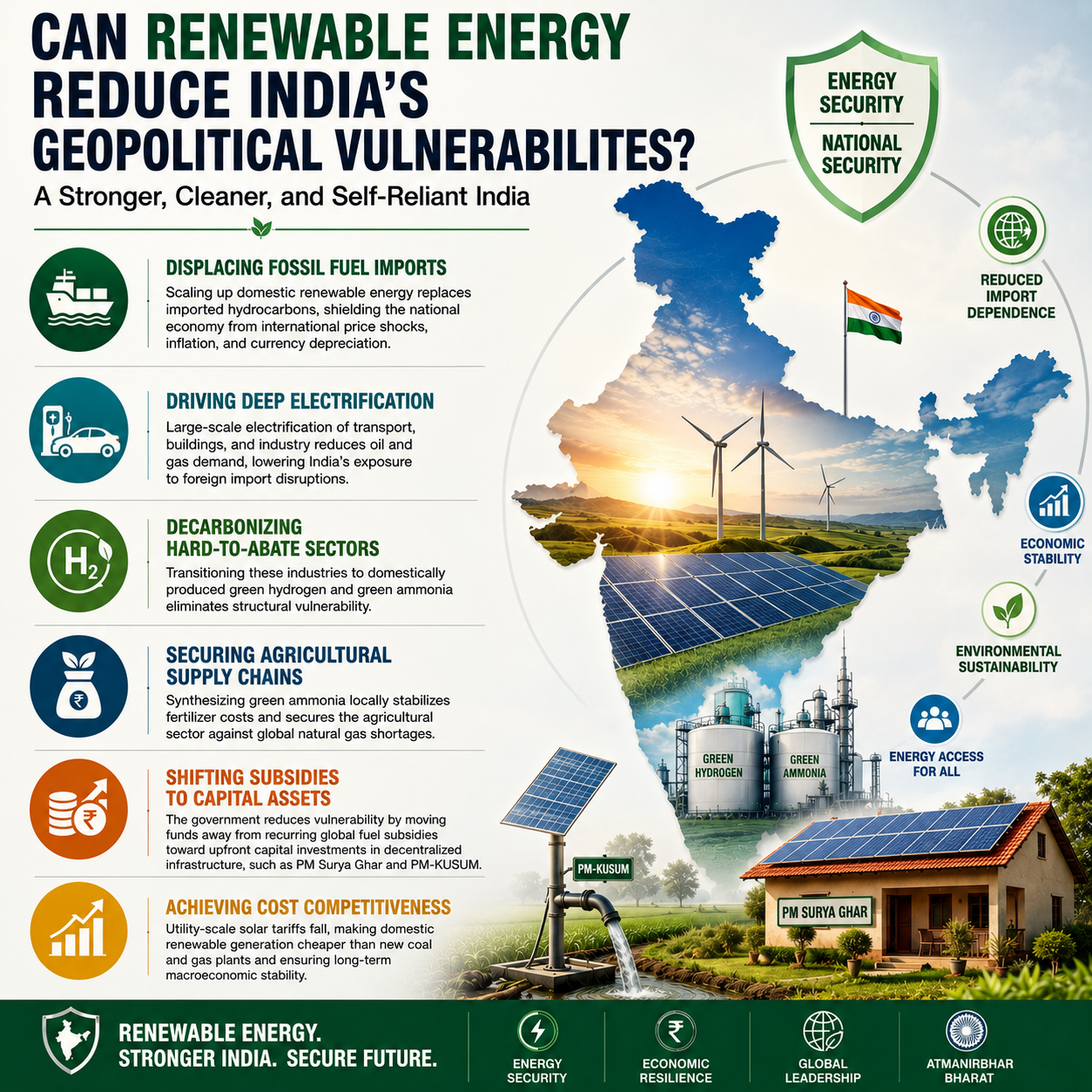
Displacing Fossil Fuel Imports: The strategy replaces imported hydrocarbons with domestically generated clean energy alternatives, focusing on solar power, wind power, green hydrogen, and green ammonia.
Mitigating Geopolitical Vulnerabilities
India currently imports approximately 85–90% of crude oil and 45–50% of natural gas requirements.
Global conflicts disrupt maritime chokepoints like the Strait of Hormuz, which directly threatens energy supply.
Ensuring Macroeconomic Stability
Fossil fuel dependence directly imports global price volatility into the Indian economy.
A mere $10 increase in global crude oil prices adds roughly $13 to $14 billion to the national import bill, which widens the current account deficit, depreciates the Rupee, and fuels inflation (Source: ICRA).
Relieving Massive Fiscal Burdens
To shield citizens from international price shocks, the government spends heavily on energy subsidies, which reached INR 4.3 lakh crore in FY 2025, equivalent to 2.3% of real GDP).
Achieving self-reliance frees up this massive fiscal space for critical infrastructure and public health investments.
Securing Agricultural Supply Chains
India relies heavily on imported natural gas to produce fertilizers, importing about 60% of the LNG used in urea manufacturing from Qatar. (Source: ORF)
Energy independence through domestic green ammonia synthesis stabilizes fertilizer costs, shielding the agricultural sector and ensuring national food security.
Driving Industrial Competitiveness
Hard-to-abate industrial sectors face deep strategic vulnerabilities; the primary steel industry relies on imported coking coal for over 95% of its needs (Source: Reuters).
Transitioning these sectors to green hydrogen eliminates exposure to volatile global supply chains and keeps domestic manufacturing globally competitive under the "Make in India" initiative.
Strengthening Foreign Policy Independence
Heavy reliance on energy imports limits India's diplomatic maneuverability.
By reducing structural dependence on foreign fuels, India insulates its foreign policy from supplier dictates and leverages centralized energy diplomacy to align international asset acquisitions firmly under national security framework.
Disrupts Global Energy Supply Chains
Regional conflicts, specifically in West Asia, disrupt approximately 20% of the global energy supply, directly threatening India's physical energy access.
Creates Chokepoint Vulnerabilities
Geopolitical tensions physically threaten critical maritime transit routes, particularly the Strait of Hormuz, forcing import-dependent nations to sacrifice long-term climate progress for immediate survival.
Triggers Emergency State Intervention
Geopolitical shocks force the government to implement domestic policies, such as invoking the Essential Commodities Act of 1955 to regulate and redistribute natural gas to priority sectors like mobility and fertilizers while cutting supply to non-essential industries.
Forces Shifts in Power Generation
When gas supplies become volatile during geopolitical crises, the government mandates domestic coal plants to operate at maximum capacity, reinforcing coal as a "shock absorber" at the expense of environmental goals.
|
Case Study: The Strait of Hormuz Crisis and Qatar Disruptions
|
Complicates Welfare Schemes
Over 330 million households and businesses rely on LPG, and schemes like Pradhan Mantri Ujjwala Yojana (PMUY) provide subsidized connections to over 100 million low-income households; this limits the government's ability to pass through rising global prices without hurting vulnerable populations.
Achieves Record Renewable Milestones
India surpassed the 50% non-fossil fuel capacity target in June 2025, reaching this milestone five years ahead of 2030 Paris Agreement goal, and expanded total renewable capacity to over 288 GW. (Source: PIB)
Shifts Subsidies to Capital Assets
Government funds decentralized clean energy infrastructure to replace recurring fuel subsidies, launching PM Surya Ghar to install rooftop solar in one crore households and driving the PM-KUSUM scheme to solarize agricultural pumps.
Boosts Domestic Solar Manufacturing
Through the Production Linked Incentive (PLI) Scheme, India scales indigenous solar module manufacturing capacity, reaching 144 GW per annum in 2025 to reduce reliance on imported solar equipment.
Drives Green Hydrogen and Ammonia Production
Government initiates the National Green Hydrogen Mission, allocating capital—including ₹2,239 Crore for Green Hydrogen and ₹1,534 Crore for Green Ammonia—to domestically decarbonize hard-to-abate sectors like steel and fertilizers.
Expands Private Nuclear Investment
SHANTI Act of 2025 opens the nuclear energy sector to private companies to standardize reactor designs, build local supply chains, and scale nuclear capacity to 100 GW by 2047.
Maintains Severe Import Dependence
The Indian economy structurally relies on foreign fossil fuels, importing 85–90% of its crude oil, roughly 45–50% of its natural gas, and over 95% of its coking coal for primary steel production.
Faces Declining Domestic Hydrocarbon Output
Domestic crude oil production declines from 36.94 million tonnes in 2015–16 to 28.7 million tonnes in 2024–25 because major assets like the Bombay High field reach maturity, and complex geology in the Northeast makes new exploration exceptionally expensive.
Suffers from Institutional Fragmentation
Energy governance remains divided across four independent cabinet ministries (Power, Petroleum, Coal, and New & Renewable Energy), which creates bureaucratic silos and prevents cohesive, whole-of-system energy planning.
Struggles with Financial Health of DisComs
State-owned electricity distribution companies (DisComs) operate under extreme financial stress, which triggers delayed payments, creates counter-party risks, and deters private investment in renewable energy projects.
Encounters Grid Integration and Storage Bottlenecks
The geographic concentration of renewable energy in few states (Gujarat, Rajasthan) creates severe transmission bottlenecks, and the national grid severely lacks the affordable, large-scale battery energy storage systems (BESS) required to balance intermittent solar and wind generation.
 Way Forward
Enacts Legislative Frameworks
Enacts a statutory Energy Responsibility and Security Act to define legally binding targets for energy efficiency, carbon intensity, and fuel diversification.
Establishes Centralized Governance
Creating a centralized Department of Energy Resources and Security (DERS) under the Prime Minister's Office to eliminate bureaucratic silos and orchestrate whole-of-system energy planning.
Shifts Fiscal Investments
Redirects public funds away from recurring fuel subsidies, and channels them into upfront capital assets like the PM Surya Ghar and PM-KUSUM clean energy schemes.
Decarbonizes Hard-to-Abate Industries
Transitions primary steel manufacturing—which currently relies on imports for over 95% of its coking coal—to domestic green hydrogen to eliminate exposure to volatile global supply chains.
Modernizes Grid Infrastructure
Construct long-distance Green Corridors and expand energy balancing areas from the state level to the regional level to handle high volumes of variable renewable energy.
Deploys Large-Scale Storage
Accelerates the deployment of utility-scale Battery Energy Storage Systems (BESS) to store intermittent solar and wind generation.
Implement Market Pricing Mechanisms
Introduce wholesale time-of-day pricing to send precise market signals that economically incentivize the deployment of peaking power, fast-ramping resources, and energy storage.
Reform DisCom Finances
Restructure the financial health of state electricity distribution companies (DisComs) to eliminate counter-party risks, ensure timely payments, and attract private renewable investments.
Unlock Low-Cost Global Capital
Enable cheaper foreign exchange hedging mechanisms and simplify capital restructuring to attract the billions of dollars in foreign debt required to fund massive solar and wind pipelines.
Prevent Fossil Fuel Lock-In
Halt the excessive expansion of capital-intensive, long-lived fossil gas infrastructure—like new LNG terminals and pipelines—to avoid creating stranded assets that undermine the long-term clean energy transition.
Explore Deepwater Frontier Basins
Accelerate offshore deepwater hydrocarbon exploration in frontier regions, such as the Andaman basin, to maximize domestic output while the broader renewable transition scales up.
Forge International R&D Partnerships
Creates inter-governmental energy forums, such as with the United States, to collaborate on joint R&D and technology transfers, focusing on solar efficiency and defense-sector energy conservation.
India could achieve absolute energy Atmanirbharta by shifting from reactive fossil-fuel imports to proactive, domestically anchored clean energy generation, supported by integrated governance, deep industrial decarbonization, and capital investments in grid resilience.
Source: INDIANEXPRESS
|
PRACTICE QUESTION Q. "India's deep dependence on imported fossil fuels acts as a primary transmitter of global volatility into the domestic economy." Analyze. 150 words |
India is highly vulnerable, importing roughly 85-90% of its crude oil, 45-50% of its natural gas, and over 90% of its LPG from the Middle East. This makes maritime chokepoints like the Strait of Hormuz vulnerable.
The Sustainable Harnessing and Advancement of Nuclear Energy for Transforming India (SHANTI) Act 2025 is a new law that opens India's nuclear sector to private participation, including power generation and equipment manufacturing, aiming to reach 100 GW of nuclear capacity by 2047.
PM Surya Ghar targets rooftop solar installations in one crore households. By generating local power, it reduces residential grid consumption and shifts the government's fiscal burden from recurring state power subsidies to upfront capital investments, shielding the economy from international fuel price shocks.
© 2026 iasgyan. All right reserved