India's "Viksit Bharat" vision cannot rely on economic expansion alone but must prioritize sustainable productivity growth.
Productivity, specifically Total Factor Productivity (TFP), measures the efficiency with which capital and labor inputs combine to generate economic output.
Prioritizing productivity-led growth directly drives higher incomes, better wages, global competitiveness, and efficient resource use by allowing society to produce more goods and services with the same level of resources.
India requires a sustained average annual growth rate of 7.8% over the next two decades to reach high-income status by 2047, which requires making sustainable productivity growth the core engine of value creation rather than relying solely on aggregate GDP expansion. (Source: World Bank)
India’s Strengths
India stands as the fastest-growing major economy, with real GDP projected to expand between 6.8% and 7.2% in FY27.
The expanding digital economy acts as a major catalyst, with Digital Public Infrastructure (DPI) projected to increase its GDP contribution from 0.9% in 2022 to 4.2% by 2030. (Source: NITI Aayog)
Infrastructure push sustains growth, with effective public capital expenditure reaching 4% of GDP.
Emerging Concerns
The current model produces jobless growth in formal sectors, leaving 42% of the workforce trapped in low-productivity agriculture. (Source: IMF)
Low manufacturing productivity hampers structural transformation, as the manufacturing sector added a mere 15 million jobs between 1995 and 2019. (Source: IMF)
High levels of informal employment and low innovation intensity prevent the economy from absorbing labor into high-paying, dynamic sectors.
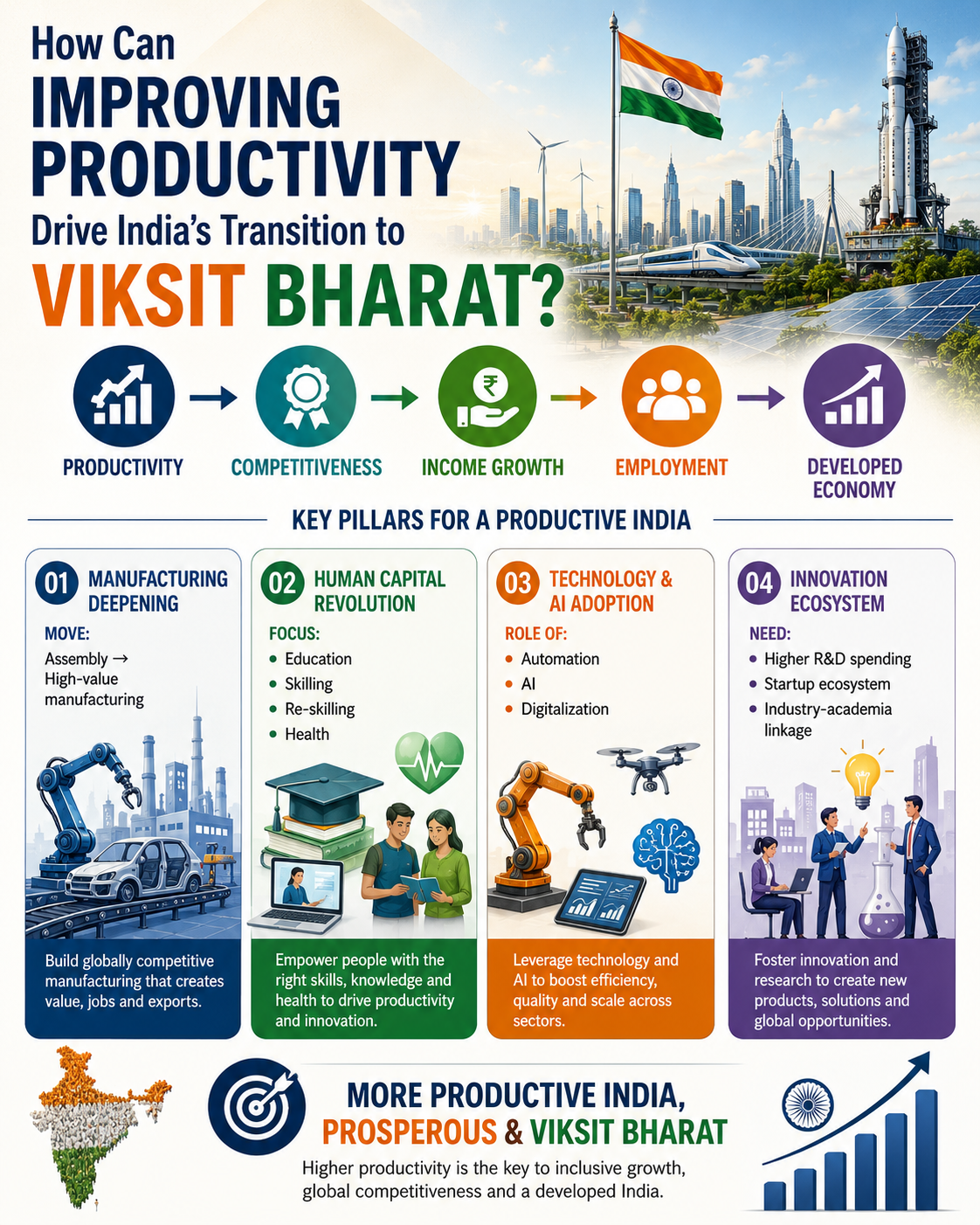 Why Productivity Becoming the Missing Link in India’s Development Story?
Dependence on Factor Accumulation
India drives economic growth primarily by accumulating capital and labor rather than improving Total Factor Productivity (TFP).
Output per worker grew by 4.71% annually (1990–2023), but TFP contributed a mere 1.19% points, proving growth remains heavily dependent on inputs rather than efficiency.
Incomplete Structural Transformation
The economy experiences premature deindustrialization, leaving a portion of the workforce trapped in low-yield sectors.
Agriculture employs 45% of the workforce but contributes only 15% to the national value added, which keeps overall labor productivity severely depressed.
The "Missing Middle" in Manufacturing
Industrial sector suffers from fragmentation, lacking mid-sized firms capable of scaling up for global exports.
Nearly 99% of manufacturing units operate as micro-enterprises, producing less than 20% of the output per worker compared to large enterprises. (Source: IMF)
These firms remain trapped in the informal sector, which restricts their access to formal credit, prevents modern technology adoption.
Weak Business Dynamism & Zombie Firms
Zombie companies are heavily indebted businesses that generate just enough cash to cover operating expenses and service the interest on their loans, but not enough to pay off the principal debt
These distressed entities consume nearly 20% to 25% of corporate debt, which stalls efficient resource reallocation and crowds out essential credit from productive, innovative enterprises.
Human Capital Deficits
The workforce faces skill mismatches, restricting ability to transition into high-paying, dynamic sectors.
According to the World Bank, only 68% of the population aged 25 and older holds at least a primary education.
Stagnant Innovation & R&D Investment
India faces innovation deficit, relying on technology adoption rather than creation.
Gross Expenditure on R&D (GERD) stagnates at roughly 0.64% of GDP, which falls far behind the 2.5% to 5% range of innovation-led economies like the US, China, and South Korea.
Regulatory and Trade Frictions
Complex compliance requirements and rigid labor regulations strongly disincentivize small firms from expanding their operations.
High import tariffs on intermediary inputs increase production costs, limiting India's integration into Global Value Chains (GVCs).
Labour Market Rigidity
Strict labour regulations cause misallocation of labour, forcing firms to substitute capital for labour in a labour-abundant economy.
Complex compliance requirements and rigid labour laws disincentivize small firms from scaling up, trapping them in low-productivity structures .
Land and Regulatory challenges
Fragmented approval systems across multiple state and central agencies create immense regulatory uncertainty and project delays.
Lack of real-time land bank portals and complex environmental clearances (such as Coastal Regulation Zone norms) restrict industrial expansion and drive up land acquisition costs.
Poor Logistics Increase Production Costs
High logistics costs, which accounted for 7.97% of GDP in FY24, hinder India's global competitiveness.
Insufficient cold chain infrastructure, lack of multimodal integration, and port congestion add transit time and freight costs to production and exports.
Labour (Skill development)
Align training with industry demands by scaling up apprenticeship programs and the Pradhan Mantri Kaushal Vikas Yojana (PMKVY) to bridge the massive education-employment gap.
Industry (Tech adoption)
Adopt Industry 4.0 technologies, artificial intelligence, and smart manufacturing to transition from low-tech assembly to high-efficiency production environments.
Education (Human capital)
Modernize curricula under the National Education Policy (NEP) 2020 and leverage phygital (physical + digital) learning to ensure students attain foundational literacy and highly employable skills.
Governance (Ease of doing business)
Simplify environmental clearances, implement single-window systems, and strengthen the Insolvency and Bankruptcy Code (IBC) to quickly dissolve economically unviable "zombie firms".
Manufacturing (Value addition)
Shift from passive assembly to deep component manufacturing by leveraging the Production-Linked Incentive (PLI) scheme and integrating domestic factories into Global Value Chains (GVCs).
Innovation (Higher R&D)
Boost private research spending through the Anusandhan National Research Foundation (ANRF) to elevate India's innovation metrics.
MSMEs (Formalization)
Transition of micro-enterprises into the formal economy by utilizing the Udyam portal, simplifying GST compliance, and expanding cash-flow-based lending..
High growth can make India bigger, but higher productivity will make India richer, more competitive, and truly developed.”
Source: THEHINDU
|
PRACTICE QUESTION Q. "To achieve the status of a developed nation by 2047, India must shift its macroeconomic focus from aggregate GDP expansion to productivity-led growth." Critically analyze. 150 words |
Viksit Bharat 2047 is the Government of India's ambitious vision to transform the nation into a developed, high-income economy by the centennial of its independence. Achieving this status requires India to sustain an average annual growth rate of 7.8% over the next two decades.
The Middle-Income Trap occurs when an emerging economy's growth stagnates after reaching a certain per capita income threshold, typically between USD 12,000 and USD 18,000 per capita. Avoiding this trap requires a structural shift from basic resource accumulation to productivity-led growth driven by innovation.
The "missing middle" refers to the structural imbalance where nearly 99% of manufacturing units operate as micro-enterprises (Source: International Monetary Fund). These extremely small firms lack the scale, technology, and formal credit access needed to integrate into Global Value Chains, limiting overall industrial productivity.
© 2026 iasgyan. All right reserved