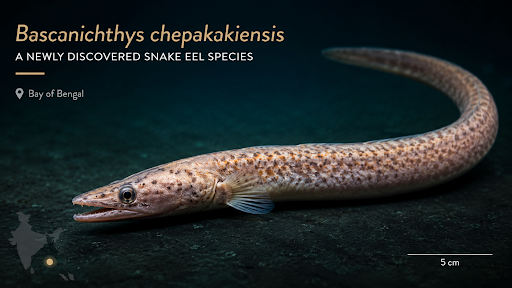
Bascanichthys chepakakiensis is a newly discovered snake eel species from the Bay of Bengal. Found near Kakinada, it represents only the second Bascanichthys species recorded in Indian waters and highlights the rich marine biodiversity of India's eastern coast.
Why In News?
Researchers identify a new species of snake eel, Bascanichthys chepakakiensis, at the Kakinada fishing harbour in Andhra Pradesh.
What is Bascanichthys chepakakiensis?
Bascanichthys chepakakiensis is a newly discovered species of snake eel belonging to the Ophichthidae (Snake Eel) family.
Scientists discovered it from fishing bycatch collected near Kakinada Fishing Harbour (Andhra Pradesh) and Arjyapalli coast (Odisha) in the Bay of Bengal.It becomes the 20th known species globally within the genus Bascanichthys, and only the second Bascanichthys species recorded from Indian waters after a gap of nearly six decades.
Physical Characteristics
About Snake Eels
These creatures belong to the family Ophichthidae, earning their name from their characteristic snake-like appearance.
Habitat Preferences: They primarily inhabit sandy substrates in shallow seas, though some species thrive at depths reaching 800 meters.
Global Distribution: These eels occupy both tropical and temperate waters across oceans worldwide.
Burrowing Behavior: The snake eel utilizes its tail to burrow backward into the sea bottom, effectively constructing a protective shelter.
Source: researchmatters
|
PRACTICE QUESTION Q. Consider the following statements:
Which statements are correct? A. 1 and 2 only B. 2 and 3 only C. 1 and 3 only D. 1, 2 and 3 Answer: A Explanation: Statement 1 is correct: Bascanichthys chepakakiensis was indeed discovered in the Bay of Bengal, specifically from accidental fishing bycatch near the Kakinada fishing harbour in Andhra Pradesh and the Arjyapalli landing centre in Odisha. Statement 2 is correct: The species belongs to the snake eel family (Ophichthidae). Statement 3 is incorrect: It is not the first species of its genus discovered in India, but the second. The first species recorded in Indian waters was Bascanichthys deraniyagalai. |
Bascanichthys chepakakiensis is a newly identified species of long, slender snake eel characterized by a unique bicoloured body, a noticeably short snout, specific tooth arrangements, and nearly invisible, flap-like pectoral fins.
Marine scientists discovered the primary specimen at the Kakinada Fishing Harbour in Andhra Pradesh, with a secondary specimen subsequently identified at the Arjyapalli fish landing centre along the coast of Odisha.
Uncovering new species is vital because it maps hidden marine biodiversity, enhances our fundamental understanding of evolutionary trees, and establishes critical baselines for implementing targeted marine conservation policies.
Fishing bycatch is the accidental capture of non-targeted marine animals—such as dolphins, sea turtles, seabirds, or unstudied fish species—that get trapped in commercial nets and longlines during routine harvesting operations.





© 2026 iasgyan. All right reserved