

Copyright infringement not intended
Picture Courtesy: THE HINDU
Developing nations, despite minimal contribution to historical emissions, are now the hardest hit by the global climate crisis, yet they are emerging as leaders in mitigation, adaptation, and the global pursuit of climate justice.
|
Read all about: CLIMATE CHANGE IS AMPLIFYING FLOODS l INDIA'S GLOBAL LEADERSHIP ON CLIMATE CHANGE |
The Common But Differentiated Responsibilities and Respective Capabilities (CBDR-RC) principle.
The 2015 Paris Agreement reaffirms CBDR-RC, requiring all countries to set Nationally Determined Contributions (NDCs), but expects developed nations to lead with more ambitious targets and provide financial and technological support to developing countries.
 Why are developing countries Central to Climate Solutions?
Developing countries suffer disproportionately from climate impacts, which threaten their economic stability, food security, and very existence.
Emerging economies like India and China are leading the global clean energy transition, expanding renewable capacity and dominating clean-tech supply chains.
|
Parameter |
India |
China |
|
Climate Pledges (NDCs) |
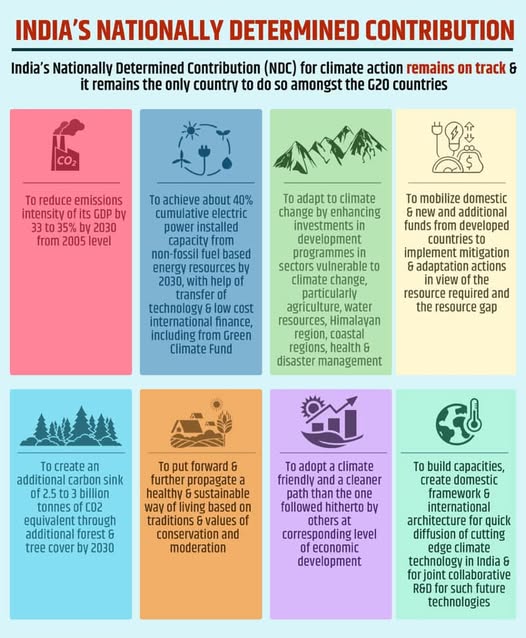
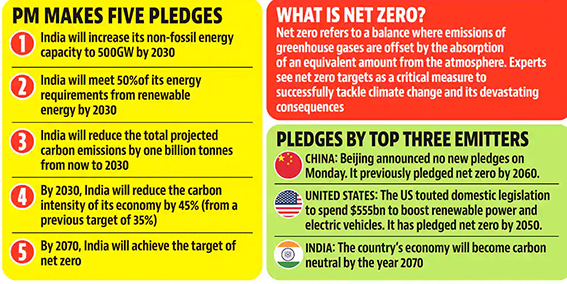
Net-zero by 2070. "Panchamrita" goals include 500 GW non-fossil capacity and 50% energy from renewables by 2030. |
Peak CO2 emissions before 2030 and carbon neutrality before 2060. |
|
Renewable Energy Status |
Total renewable capacity reached 220 GW as of April 2025. Achieved its NDC target of over 50% installed capacity from non-fossil sources ahead of the 2030 deadline. (Source: PIB) |
Combined wind and solar capacity exceeded 1,400 GW in 2024, surpassing its 2030 target. Added more renewable capacity in 2023 than the rest of the world combined. (Source: International Energy Agency) |
|
Key Initiatives |
|
|
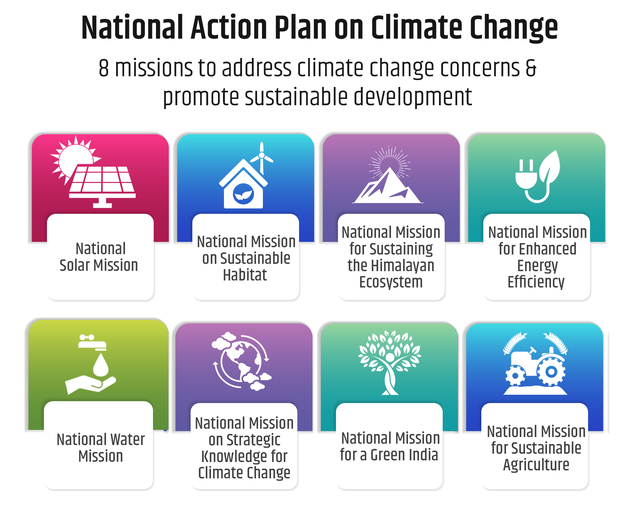
Developing nations are adopting practical climate adaptation solutions to protect people and economies.
 Developing nations are influencing the global climate agenda through collective action and leadership.
Finance Gap
The adaptation finance needs of developing countries are estimated at $215 billion to $387 billion per year this decade. However, international public finance flows in 2023 were only $26 billion, leaving a huge gap. (Source: UNEP Adaptation Gap Report).
 Technology Transfer Barriers
Developing nations face limited access to essential green technologies, such as green hydrogen and battery storage, due to the high cost of Intellectual Property Rights (IPRs).
They advocate for IPR waivers or increased collaborative R&D, asserting that climate solutions should be treated as a global public good.
Developing countries are essential, evolving partners in the global response to climate change, moving from victims to key advocates and innovators.
Leverage public finance to mobilize private capital using concessional financing and policy reforms to create investment-friendly environments for sustainable businesses.
Countries need to incorporate climate risk into all levels of governance, from urban planning and infrastructure development to social safety nets.
The discussion and outcome at COP30 in Belém, Brazil, must be more science-based, and cover economy-wide emissions reductions targets for all greenhouse gases.
A successful and equitable climate transition requires the international community to translate promises into action by providing financial, technological, and capacity-building support.
Source: THE HINDU
|
PRACTICE QUESTION Q. Analyze the dilemma faced by developing countries in balancing their developmental aspirations with their commitments to climate action under the Paris Agreement. 150 words |
Developing countries are crucial for global climate action; while developed nations have historically emitted more GHGs, developing nations now account for most current emissions due to rapid growth. They also offer significant potential for adopting cleaner technologies ("leapfrogging") and implementing global-benefit nature-based solutions.
Central to the UNFCCC and Paris Agreement, this principle dictates that all nations share climate responsibility, but developed countries must lead due to their historical emissions and greater financial and technological capacity.
Key challenges include limited financial resources, inadequate access to clean technology, knowledge and data gaps, institutional constraints, high levels of debt, and extreme vulnerability to climate impacts despite minimal historical contributions to the problem.
© 2026 iasgyan. All right reserved