Nature-based Solutions involve using ecosystems such as forests, wetlands, mangroves, grasslands, rivers, and urban green spaces to address climate change, biodiversity loss, disasters, and livelihood challenges. They are increasingly recognised as central to India’s climate and development strategy because they provide carbon storage, flood control, water security, food security, and job creation while being cost-effective. However, challenges such as inadequate finance, policy gaps, land conflicts, weak monitoring, and risks of greenwashing remain. Global initiatives such as ENACT aim to accelerate and scale up Nature-based Solutions worldwide, helping countries integrate them into climate policies, mobilise funds, and promote community participation for a resilient and sustainable future.

Copyright infringement not intended
Picture Courtesy: The Hindu
Nature-based solutions (like restoring forests, protecting wetlands, and conserving ecosystems) are no longer optional climate ideas, they are becoming central to global policy and corporate decision-making.
|
Must Read: PLATFORM FOR URBAN NATURE-BASED SOLUTIONS | COALITION FOR NATURE | |
Nature-based solutions refer to actions that conserve, restore, or sustainably manage natural ecosystems in order to address societal challenges such as climate change, disaster risks, food security, water security, and human well-being, while simultaneously protecting biodiversity and supporting sustainable development.
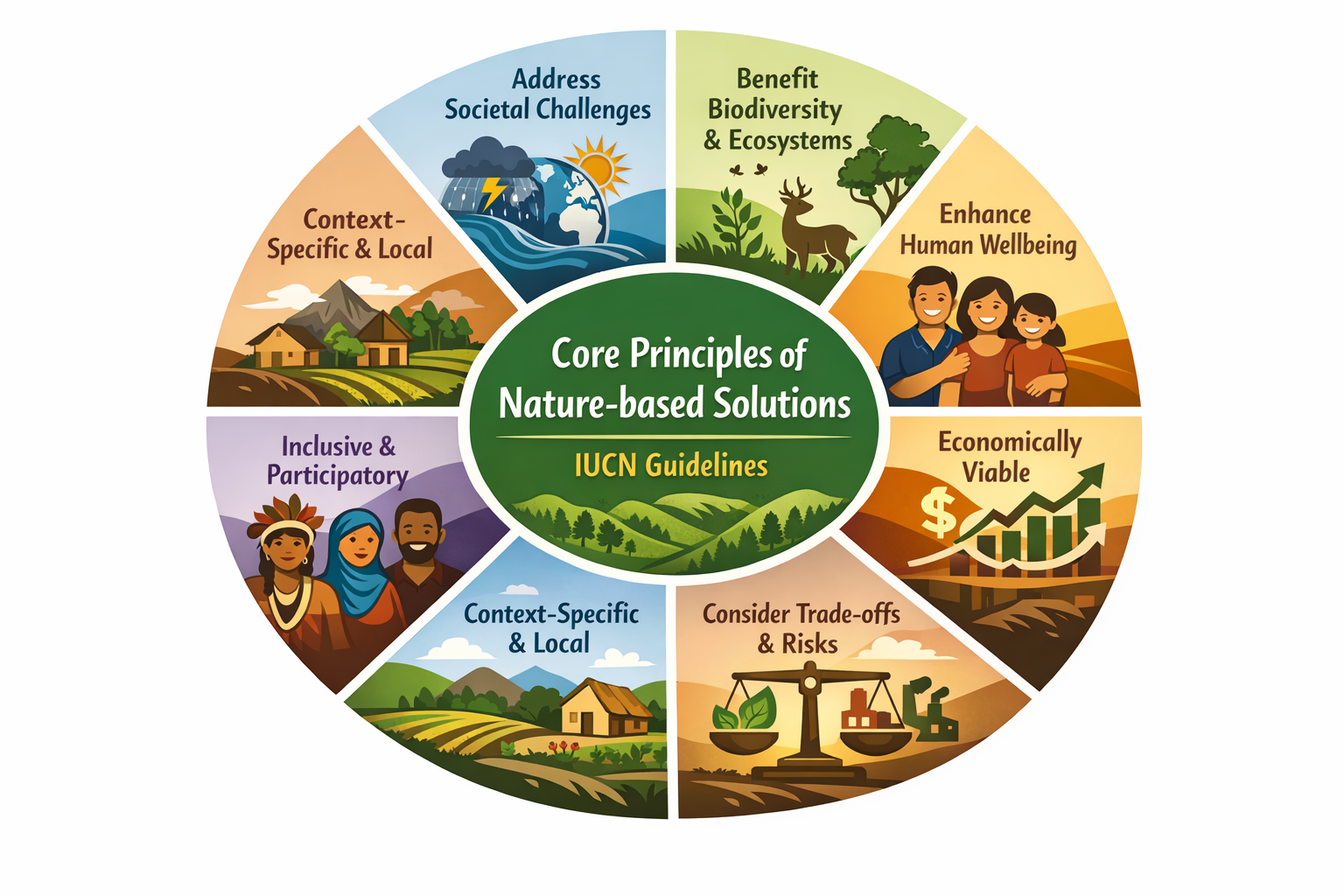
According to the International Union for Conservation of Nature (IUCN), nature-based solutions (NbS) are grounded in a set of core principles that ensure they work effectively for both people and nature.
Effectively address societal challenges: Nature-based solutions must be capable of tackling real problems such as climate change, disaster risk, water and food insecurity, and environmental degradation in a meaningful way.
Benefit biodiversity and ecosystems: They should protect and enhance biodiversity and ecosystem integrity rather than harming nature in the process.
Generate benefits for human wellbeing: NbS should contribute to the health, livelihoods and resilience of communities, ensuring social and economic advantages alongside environmental gains.
Be economically viable and sustainable: They should be cost-effective and feasible over the long term, with clear potential to be maintained and scaled up.
Be context-specific and locally appropriate: NbS must be designed to fit local ecological and cultural contexts, recognising that solutions that work in one region may not be suitable in another.
Inclusive, equitable and participatory: They require engagement of stakeholders, especially local communities, Indigenous peoples and vulnerable groups, ensuring decisions are fair and locally owned.
Consider trade-offs and risks: Good NbS design anticipates potential negative impacts and trade-offs, striving to minimise harm and balance different interests.
Use adaptive management: Nature-based solutions should be monitored and adjusted over time, learning from experience so that they remain effective under changing conditions.
Restoration-based Nature-based Solutions: This type focuses on bringing back degraded ecosystems to a healthy state so they can again provide services like carbon storage, flood control, and habitat protection.
Examples include restoring degraded forests to increase carbon absorption, rejuvenating wetlands to control floods, replanting mangroves to protect coasts, and reviving degraded grasslands and river ecosystems.
Conservation-based Nature-based Solutions: This type focuses on protecting existing healthy ecosystems so that they do not get degraded or destroyed and continue to benefit people and biodiversity.
Examples include protecting natural forests through national parks, conserving coral reefs to support fisheries and tourism, establishing wildlife sanctuaries, and preserving natural watersheds to secure drinking-water supply.
Sustainable management of ecosystems: This type focuses on using natural resources in a careful, long-term way so that the ecosystem is not damaged while people still benefit from it.
Examples include sustainable forestry where trees are harvested without degrading forests, eco-friendly farming that conserves soil and water, community-managed fisheries that prevent overfishing, and watershed management to balance water use and recharge.
Urban nature-based solutions: This type uses nature inside cities to solve urban problems such as heat, pollution, flooding, and lack of green spaces.
Examples include creating urban forests and parks to reduce heat islands, developing green roofs and green walls on buildings, restoring urban lakes to manage floods, and creating rain gardens to improve groundwater recharge.
Climate adaptation Nature-based Solutions: These solutions help people adapt to climate change impacts like floods, storms, droughts, and heatwaves by using natural barriers and ecosystems.
Examples include mangroves acting as natural shields against cyclones, sand dunes and coral reefs protecting coasts from erosion, wetlands reducing flood intensity, and restoring catchments to manage drought.
Climate mitigation Nature-based Solutions: These solutions absorb or store greenhouse gases and reduce global warming by using natural carbon sinks.
Examples include afforestation and reforestation projects, peatland restoration to store large amounts of carbon, soil carbon management through organic farming, and preserving natural forests that act as major carbon sinks.
Hybrid or engineered nature-based solutions: These combine natural systems with built infrastructure to improve resilience and reduce disaster risks.
Examples include combining mangrove belts with seawalls for coastal protection, integrating wetlands with storm-water drainage systems, and creating floodplains alongside embankments to manage river floods.
Climate change mitigation and adaptation: Nature-based Solutions are crucial for India because they help the country both reduce greenhouse gas emissions and adapt to climate impacts such as heatwaves, floods, cyclones, and droughts, as restored forests, wetlands, mangroves, and grasslands act as natural carbon sinks and climate buffers.
Disaster risk reduction: NbS are important because India is highly vulnerable to disasters, and ecosystems such as mangroves, sand dunes, wetlands, and floodplains naturally reduce cyclone impact, storm surges, landslides, and urban flooding, thereby lowering economic losses and human casualties.
Water security and river health: They are vital for India’s water-stressed regions because watershed restoration, wetland rejuvenation, and groundwater recharge through nature-based solutions improve river flows, enhance drinking-water availability, support agriculture, and reduce conflicts over scarce water.
Food and nutritional security: Nature-based Solutions support India’s large farming population because practices like agroforestry, organic farming, soil-moisture conservation, and pollinator protection improve crop yields, soil fertility, and resilience to climate shocks, while reducing dependence on chemical inputs.
Biodiversity conservation: NbS are central to India’s rich but threatened biodiversity because they restore habitats, protect wildlife corridors, reduce human–wildlife conflict, and revive degraded forests, grasslands, coastal ecosystems, and wetlands that support thousands of plant and animal species.
Urban resilience and better quality of life: NbS are essential for rapidly growing Indian cities because urban forests, green roofs, lake restoration, and permeable landscapes lower air pollution, reduce heat islands, prevent waterlogging, improve mental health, and create greener, more liveable cities.
Lack of adequate financing: Nature-based Solutions face a major challenge because long-term, large-scale funding is insufficient, private sector investment remains low, and many projects struggle to secure continuous financial support beyond the initial pilot phase.
Treating nature as a “free resource”: Implementation is difficult because economic systems still undervalue ecosystems, do not price ecosystem services correctly, and fail to recognise the true economic cost of degrading forests, wetlands, soils, and oceans.
Policy and institutional gaps: NbS projects often suffer because environmental, climate, agriculture, water, and urban policies work in silos, coordination among departments is weak, and there is no single unified framework in many countries for planning and evaluating nature-based approaches.
Measurement and monitoring difficulties: There are challenges because the benefits of NbS, such as carbon storage, biodiversity improvement, or resilience gains, are complex to quantify, require long-term monitoring, and lack standardized indicators in many regions.
Risk of “greenwashing”: A serious challenge arises when companies or governments label simple tree-planting or plantation drives as NbS without improving native ecosystems, leading to monoculture plantations, displacement of communities, or projects that provide little climate or biodiversity benefit.
Limited community participation: NbS projects sometimes fail because they overlook local and indigenous knowledge, ignore livelihood needs, or impose top-down decisions, which reduces local ownership and long-term sustainability of restored ecosystems.
Strengthening policy integration and mainstreaming: India needs to integrate Nature-based Solutions into national and state development planning, by aligning climate, forest, water, agriculture, and urban policies, and initiatives such as the National Action Plan on Climate Change, State Action Plans on Climate Change, and the National Biodiversity Action Plan already provide a framework that can explicitly mainstream NbS across sectors.
Expanding large-scale ecosystem restoration programmes: India must scale up restoration of forests, wetlands, grasslands, and degraded lands, and programmes such as the National Mission for Green India, Compensatory Afforestation Fund Management and Planning Authority, Nagar Van Yojana, and the Bonn Challenge commitments on restoring 26 million hectares by 2030 can act as major vehicles for promoting NbS-based landscape restoration.
Protecting and restoring rivers, wetlands, and watersheds: Nature-based Solutions require stronger conservation of aquatic ecosystems, and initiatives such as the National Plan for Conservation of Aquatic Ecosystems, Namami Gange Mission, Atal Bhujal Yojana, and Amrit Sarovar Mission can help rejuvenate wetlands, improve groundwater recharge, restore floodplains, and strengthen watershed-based natural infrastructure.
Enhancing coastal and marine resilience: India needs to prioritise mangrove and coastal ecosystem protection as natural buffers against cyclones and sea-level rise, and initiatives such as the Mangrove Initiative for Shoreline NHabitats and Tangible Incomes, the National Coastal Mission, and Integrated Coastal Zone Management Project promote mangrove restoration, dune conservation, and sustainable coastal livelihoods.
Promoting sustainable agriculture and agro-ecological practices: Strengthening NbS requires transforming agriculture towards soil and water-conserving systems, and programmes such as Paramparagat Krishi Vikas Yojana, Mission Organic Value Chain Development for North East Region, National Mission on Sustainable Agriculture, and Pradhan Mantri Krishi Sinchai Yojana promote organic farming, agroforestry, micro-irrigation, and watershed-based approaches that enhance ecosystem services.
Greening Indian cities and improving urban resilience: Urban India must adopt nature-based drainage, lake rejuvenation, urban forests, and green roofs to combat heat and flooding, and initiatives such as AMRUT 2.0, Smart Cities Mission, National Lake Conservation Plan, and Nagar Van Yojana are important platforms for integrating NbS into urban planning and blue-green infrastructure.
|
Enhancing Nature-based Solutions for an Accelerated Climate Transformation (ENACT) Enhancing Nature-based Solutions for an Accelerated Climate Transformation (ENACT) is a global initiative that aims to scale up Nature-based Solutions around the world in order to address climate change, biodiversity loss, land degradation, and sustainable development together rather than separately. ENACT was launched at a United Nations climate conference as a joint initiative led by the Government of Egypt and the International Union for Conservation of Nature (IUCN), with participation from multiple countries, UN agencies, and international organisations. The main objective of ENACT is to accelerate the implementation of Nature-based Solutions at the national and local level, ensuring that climate action, ecosystem restoration, and community development progress together in an integrated manner. ENACT supports countries in including Nature-based Solutions in their Nationally Determined Contributions (NDCs), National Adaptation Plans, and climate finance strategies, helping bridge the gap between commitments and on-ground implementation. ENACT focuses on expanding ecosystem restoration on land and in oceans, improving climate resilience of vulnerable communities, strengthening food and water security through nature-based measures, and integrating NbS into national climate plans and adaptation strategies. |
Nature-based Solutions are shifting from optional ideas to core strategies for climate and development, and initiatives like ENACT aim to scale them up globally. By investing in healthy ecosystems, restoring degraded landscapes, and involving communities, countries can simultaneously tackle climate change, biodiversity loss, and livelihood challenges, making NbS a practical pathway for a resilient and sustainable future.
Source: Nature
|
Practice Question Q. What is the Enhancing Nature-based Solutions for an Accelerated Climate Transformation (ENACT) initiative? Critically analyse how such global initiatives can help mainstream Nature-based Solutions into national climate policies. (250 words) |
Nature-based Solutions are actions that protect, restore, or sustainably manage ecosystems to solve problems like climate change, floods, droughts, and biodiversity loss while benefiting people and nature.
Traditional engineering relies mainly on grey infrastructure like dams and seawalls, whereas NbS use natural systems such as mangroves, wetlands, forests, and floodplains, often at lower cost and with multiple co-benefits.
Examples include mangrove restoration in Sundarbans for cyclone protection, wetland rejuvenation under Namami Gange, watershed management in Rajasthan, and urban lake restoration in Bengaluru and Hyderabad.



© 2026 iasgyan. All right reserved