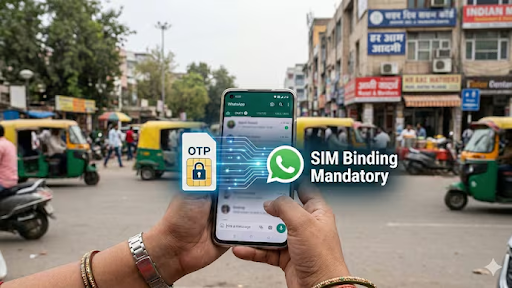
New telecommunications rules require SIM-based binding for WhatsApp accounts to improve traceability and curb cyber fraud. While aimed at boosting security, critics warn of user inconvenience, privacy risks, and potential state surveillance, intensifying the debate between safety and individual freedoms.
Copyright infringement not intended
Picture Courtesy: INDIATODAY
Context
The Indian government is making SIM binding compulsory for WhatsApp users to combat rising cybercrime and digital arrests.
Mandatory SIM Binding for OTT Apps
The Department of Telecommunications (DoT) has mandated SIM binding for Over-the-Top (OTT) messaging applications like WhatsApp, Telegram, and Signal, effective from March 1, 2026.
This directive, issued under the Telecommunications (Telecom Cyber Security) Rules, 2024, to enhance national security and combat rising cyber fraud by creating a link between a user's account and their KYC-verified SIM card.
What is SIM Binding?
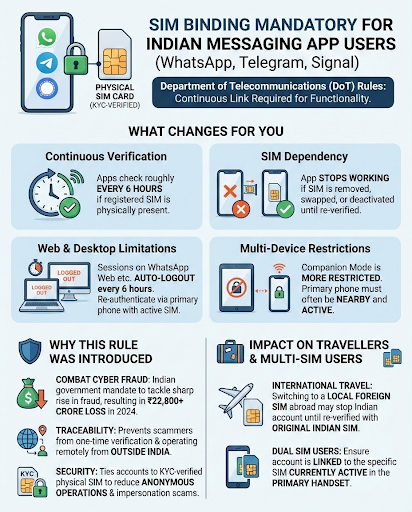
SIM binding is a security measure that requires an application to continuously verify that the registered SIM card is physically present and active in the user's primary device.
Current Model ("Verify-Once"): Users verify their number once with an OTP during setup. The app continues to work on the primary device and linked devices (like laptops) even if the SIM card is removed.
New Mandate ("Continuous Verification"): The app must constantly check for the presence of the registered SIM. If the SIM is removed or deactivated, the service will be suspended until the original SIM is re-inserted and verified.
Why did the Government introduce this Change?
To Combat Cyber Fraud: India is facing an epidemic of online financial fraud, with losses exceeding ₹22,845 crore in 2024 alone (Source: Ministry of Home Affairs).
To Enhance Traceability & Accountability: By linking every account to a physically present, KYC-verified SIM, law enforcement agencies can more effectively trace and identify perpetrators.
Case Study - The 'FedEx' Scam: Fraudsters posing as officials on WhatsApp video calls using Indian numbers. They intimidate victims into transferring large sums of money.
What are the Broader Implications of this Policy?
The SIM binding directive has far-reaching consequences across various sectors, creating a classic debate between security and individual liberty.
Socio-Economic
Positive
Aims to reduce financial fraud, protecting vulnerable citizens and enhancing trust in the digital economy. Complements initiatives like the Sanchar Saathi portal.
Negative
Causes inconvenience for legitimate users, especially professionals and gig workers who rely on multi-device functionality for productivity. A recent survey showed low consumer support for the move (Source: LocalCircles).
Governance
Strengthened Security
Enhances the state's ability to monitor and regulate digital communications for national security purposes, as recommended by parliamentary committees on Home Affairs Report.
Surveillance Concerns
Critics and digital rights advocates argue it could enable mass surveillance and undermine the anonymity of journalists, activists, and whistle-blowers.
Technological & Privacy
Implementation Challenges
Tech industry bodies like the Broadband India Forum (BIF) argue that this places the burden of telecom regulation on app developers, not operators, and question its technical feasibility.
Right to Privacy
The mandate directly engages with the fundamental Right to Privacy (K.S. Puttaswamy case). For the law to be valid, it must pass the proportionality test—proving it is the least intrusive means to achieve its goal and that its benefits outweigh the infringement on privacy.
Way Forward
The SIM binding mandate is a decisive step to address cyber fraud, however, its success depends on a balanced and thoughtful implementation.
Stakeholder Collaboration: Continuous dialogue between the government, tech companies, and civil society is crucial to address technical hurdles and refine the policy.
Public Awareness: A widespread campaign is needed to educate users about the changes and prevent disruption for legitimate activities.
Robust Data Protection: To mitigate surveillance fears, strong data protection laws and independent oversight are essential to govern law enforcement's access to user data.
Conclusion
The policy must curb crime without creating an architecture of excessive state control, thereby upholding the constitutional balance between security and liberty established in the Puttaswamy judgment.
Source: INDIATODAY
|
PRACTICE QUESTION Q. Critically analyze the government's decision to mandate SIM binding for Over-the-Top (OTT) communication platforms. 150 words |
SIM binding is a security measure mandated by the Indian government that links a WhatsApp account directly to the physical SIM card associated with your phone number. The platform will continuously check if the SIM is present in your primary phone for the account to remain active.
The government's primary motivations are to enhance national security and curb the massive rise in cyber and financial fraud. By ensuring an active account is tied to a physical, KYC-verified SIM in India, it becomes easier for law enforcement agencies to trace and hold fraudsters accountable.
Critics argue that this move could strengthen state surveillance capabilities. The constant verification process creates a detailed log of a SIM's active status linked to an account, which could be misused or breached. It raises concerns about potential infringement on the fundamental Right to Privacy.



© 2026 iasgyan. All right reserved