The discovery of Gitchak nakana, a blind aquifer fish in Assam’s Indo-Burma hotspot, reveals a fragile subterranean ecosystem. As a bio-indicator of groundwater health, it exposes risks from over-extraction and pollution.
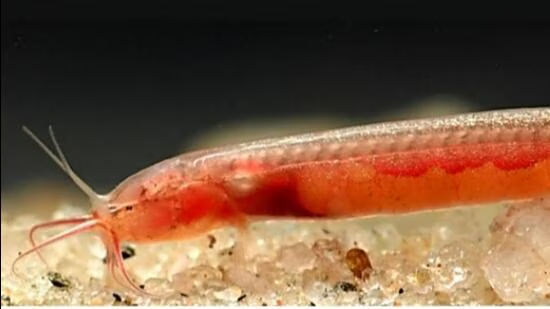
Copyright infringement not intended
Picture Courtesy: HINDUSTANTIMES
Context
The discovery of Gitchak nakana, the first-ever fish species known to live exclusively in aquifers (phreatobitic) in Northeast India, is published in the Nature Portfolio journal Scientific Reports.
What is Gitchak nakana?
Gitchak nakana, discovered in Assam's Goalpara district, is the first aquifer-dwelling (phreatobitic) fish ever recorded from Northeast India and the wider Eastern Himalayan region.
Scientific Status: It represents both a new species and a new genus within the family Cobitidae (loaches)
Unique Anatomy: It is scientifically extraordinary for its complete lack of a skull roof, leaving the brain covered only by skin.
Subterranean Adaptations (Troglomorphies):
Etymology: The name is derived from the Garo language: "Gitchak" means red, and "nakana" (from na·tok and kana) means blind fish.
Rare Habitat: Unlike most subterranean fish that inhabit caves, this species lives in groundwater aquifers, a habitat used by fewer than 10% of known subterranean fish species.
IUCN Status: Gitchak nakana is a newly discovered species, and its IUCN status has not yet been formally assessed.
Ecological Significance
Bio-indicator of Aquifer Health: As a highly specialized organism, its presence indicates a healthy, stable, and unpolluted groundwater system. It acts as a natural marker for the quality of aquifers.
Provides Evolutionary Insights: Subterranean species are natural laboratories for studying evolution. This fish offers a unique opportunity to study regressive evolution (the loss of traits like eyes) and adaptation to extreme environments.
Source: HINDUSTANTIMES
|
PRACTICE QUESTION Q. Consider the following statements regarding the discovery of Gitchak nakana: 1. It was discovered in a dug-out well in the state of Meghalaya. 2. It represents the first record of an aquifer-dwelling fish from Northeast India. 3. While most subterranean fish live in caves, this species lives in groundwater aquifers. Which of the statements given above are correct? A) 1 and 2 only B) 2 and 3 only C) 1 and 3 only D) 1, 2, and 3 Answer: B Explanation: Statement 1 is incorrect: Although the fish was discovered in a dug-out well, the well is located in the Goalpara district of Assam, not in Meghalaya. While the discovery occurred in a Garo village near the Meghalaya border, the geographic location is officially within Assam. Statement 2 is correct: Gitchak nakana represents the first record of an aquifer-dwelling (phreatobitic) fish from Northeast India. Statement 3 is correct: While approximately 1% of fish species live underground and the vast majority of these inhabit caves, Gitchak nakana is rare because it lives specifically in groundwater aquifers. |
Gitchak nakana is the first-ever aquifer-dwelling (phreatobitic) fish discovered in Northeast India. It is a miniature, blind, and pigmentless loach with unique adaptations to living in permanent darkness, including a striking blood-red color and the absence of a skull roof.
A phreatobitic species is an organism that lives exclusively in aquifers—the underground layers of rock, sand, and soil that hold groundwater. This habitat is distinct from caves, and species adapted to it are extremely rare.



© 2026 iasgyan. All right reserved