The State Innovation Mission launched in Tripura is a decentralized innovation at the district level, extending the Atal Innovation Mission. It promotes grassroots ideas, MSMEs, and startups, advancing cooperative federalism and improving India’s Global Innovation Index standing despite funding and skill challenges.
Copyright infringement not intended
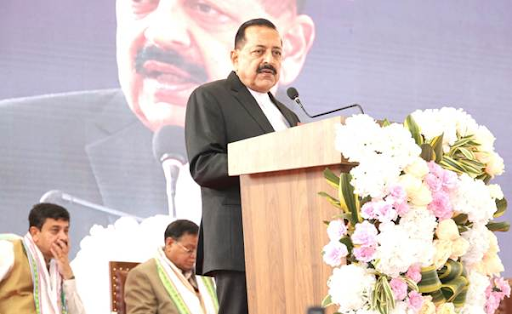
Picture Courtesy: PIB
Context
India’s first State Innovation Mission (SIM) was launched in Tripura to empower grassroots innovators and local startups.
What is the State Innovation Mission (SIM)?
It is a state-level initiative launched by NITI Aayog's Atal Innovation Mission (AIM) in February 2026 to create a formal, structured, and long-term innovation ecosystem at the state and district levels.
It focuses on supporting local innovators, startups, and MSMEs by promoting "context-specific" solutions (e.g."Make from Tripura") and providing access to infrastructure, mentorship, and funding.
Key Objectives of the State Innovation Mission (SIM)
Institutionalize Innovation
Create a formal framework that provides structured support to ideas and innovations originating from remote and rural areas.
Decentralize Opportunity
Democratize access to technology, funding, and mentorship by shifting the focus from major cities to smaller towns and districts.
Commercialize Local Ideas
Assist local innovators in transforming their concepts into viable, scalable, and commercially successful business ventures.
Strengthen Local Economies
Boost local job creation and economic growth by supporting Micro, Small, and Medium Enterprises (MSMEs) and startups. For example, the mission in Tripura aims to support over 3.13 lakh registered MSMEs. (Source: PIB)
How does SIM Align with the National Innovation Strategy?
Logical Extension of AIM
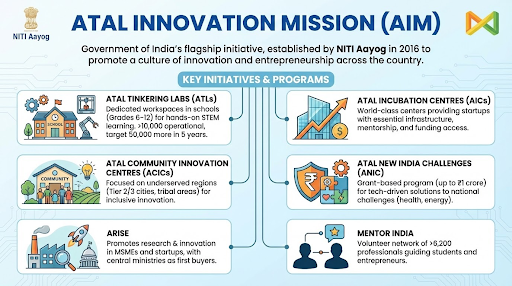
It builds upon the foundation laid by the Atal Innovation Mission (AIM). The recent decision to expand Atal Tinkering Labs (ATLs) from 10,000 to 50,000 will further strengthen this grassroots movement. (Source: PIB)
Financial Support for R&D
The mission is backed by national funds, including a Rs 1 lakh crore Research, Development, and Innovation (RDI) Fund and a Rs 10,000 crore Fund of Funds for deep-tech startups. (Source: PIB)
Promoting Equity and Ease of Living
It aligns with national priorities like Digital India, aiming to use technology like AI to ensure development reaches the most underserved sections of society.
Promoting a Risk-Taking Culture
Policy changes, such as relaxing sustainability conditions for startups backed by the Council of Scientific and Industrial Research (CSIR), signal a move towards encouraging greater risk-taking, which is vital for breakthrough innovations.
What are the Potential Challenges for SIM's Implementation?
Financial Sustainability: Ensuring consistent funding at the state and district levels and avoiding over-reliance on government grants is a major hurdle.
Academia-Industry Linkages: Bridging the gap between academic research and its practical commercial application remains a persistent challenge in India.
Grassroots Skill Gaps: Addressing the disparity in skilled "knowledge workers" across states, as highlighted by the India Innovation Index, will be critical.
Regulatory Hurdles: Complex compliance and administrative procedures at the state level can stifle the growth of startups.
Market Access: Connecting grassroots innovators with viable domestic and international markets is essential for their long-term success.
Way Forward
Measurable Outcome Focus: The strategy must shift from basic infrastructure to "Improving Throughput" (startup success rates) and "Enhancing Output" (creating higher-quality jobs and products).
Bridge the R&D Investment Gap: India currently spends only 0.65% to 0.7% of its GDP on R&D, compared to 2.4% in China and 4.8% in South Korea.
Decentralise Beyond Metros: Expanding the District Innovator Fellowships (DIF) and establishing Innovation Centres in every district—as seen in the Tripura model—is essential to tap into grassroots and tribal talent.
Learn from Global Best Practices
States can adopt principles from successful international innovation models to refine the SIM's implementation.
|
Feature |
Germany (Fraunhofer-Gesellschaft Model) |
Israel (Israel Innovation Authority) |
|
Funding Model |
A public-private partnership with partial government funding, supplemented by contract research for industry, ensuring market relevance. |
Offers conditional grants (no equity) to high-risk startups, repaid as royalties upon success, thus de-risking innovation. |
|
Role of Government |
Acts as a facilitator, providing base funding and a framework that incentivizes applied, market-oriented research. |
Plays a proactive role by sharing the initial risk with entrepreneurs and actively promoting international R&D collaborations. |
Conclusion
The State Innovation Mission is a crucial step towards a decentralized innovation ecosystem, requiring collaborative state-specific strategies focused on job creation and a culture of entrepreneurship.
Source: PIB
|
PRACTICE QUESTION Q. While policies like the State Innovation Mission (SIM) aim to foster a bottom-up approach to innovation, success depends on addressing systemic issues like academia-industry linkages and market access. Discuss. 150 words |
The State Innovation Mission (SIM) is a state-level initiative designed to create a formal, structured innovation ecosystem at the district level. It aims to support local innovators, startups, and MSMEs by decentralizing access to resources and helping to commercialize grassroots ideas.
SIM is envisioned as a natural and logical progression of the national-level Atal Innovation Mission. While AIM has been successful in fostering a national innovation culture through initiatives like Atal Tinkering Labs, SIM aims to deepen this impact by taking the framework down to the state and district levels.
The key challenges include ensuring consistent funding at the state and district levels, bridging the gap between academia and industry, addressing skill gaps at the grassroots, overcoming regulatory hurdles for startups, and providing market access for local products.


© 2026 iasgyan. All right reserved