

Copyright infringement not intended
Picture Courtesy: THE DIPLOMAT
The deep-rooted partnership between India and Bangladesh, a model for regional cooperation and key to India's foreign policy, is currently being tested by unresolved issues and new geopolitical factors.
India-Bangladesh relations are undergoing a pragmatic recalibration following the Bangladesh Nationalist Party (BNP) victory in the February 2026 general election, leading to a diplomatic "reset" after a period of strained ties.
Diplomatic Relation
Government Transition
Following the victory of the BNP in February 2026, Prime Minister Narendra Modi congratulated Tarique Rahman, signaling India's readiness to engage with the new administration despite past tensions.
Visa Services Restoration
India has assured Bangladesh of a gradual full restoration of visa services, which were restricted for nearly 18 months, with medical and double-entry business visas currently prioritized.
Economic Cooperation
Bilateral Trade
Bangladesh remains India's largest trading partner in South Asia, with total trade reaching approximately USD 13.51 billion in FY25. (Source: IBEF)
CEPA Negotiations
Both nations are moving toward a Comprehensive Economic Partnership Agreement (CEPA), aimed at maintaining duty-free access as Bangladesh prepares to graduate from Least Developed Country (LDC) status in late 2026.
Trade Logistics
Major land ports like Petrapole-Benapole, which handles nearly 50% of bilateral trade, remain operational despite recent fluctuations in import/export restrictions.
Connectivity & Energy Infrastructure
Energy Integration: India currently exports 1,160 MW of power to Bangladesh. Key projects include:
Transport Links
Several cross-border rail links, such as Agartala-Akhaura, are central to India's "Act East" policy, although some infrastructure work faced temporary suspensions during the 2024–2025 political unrest.
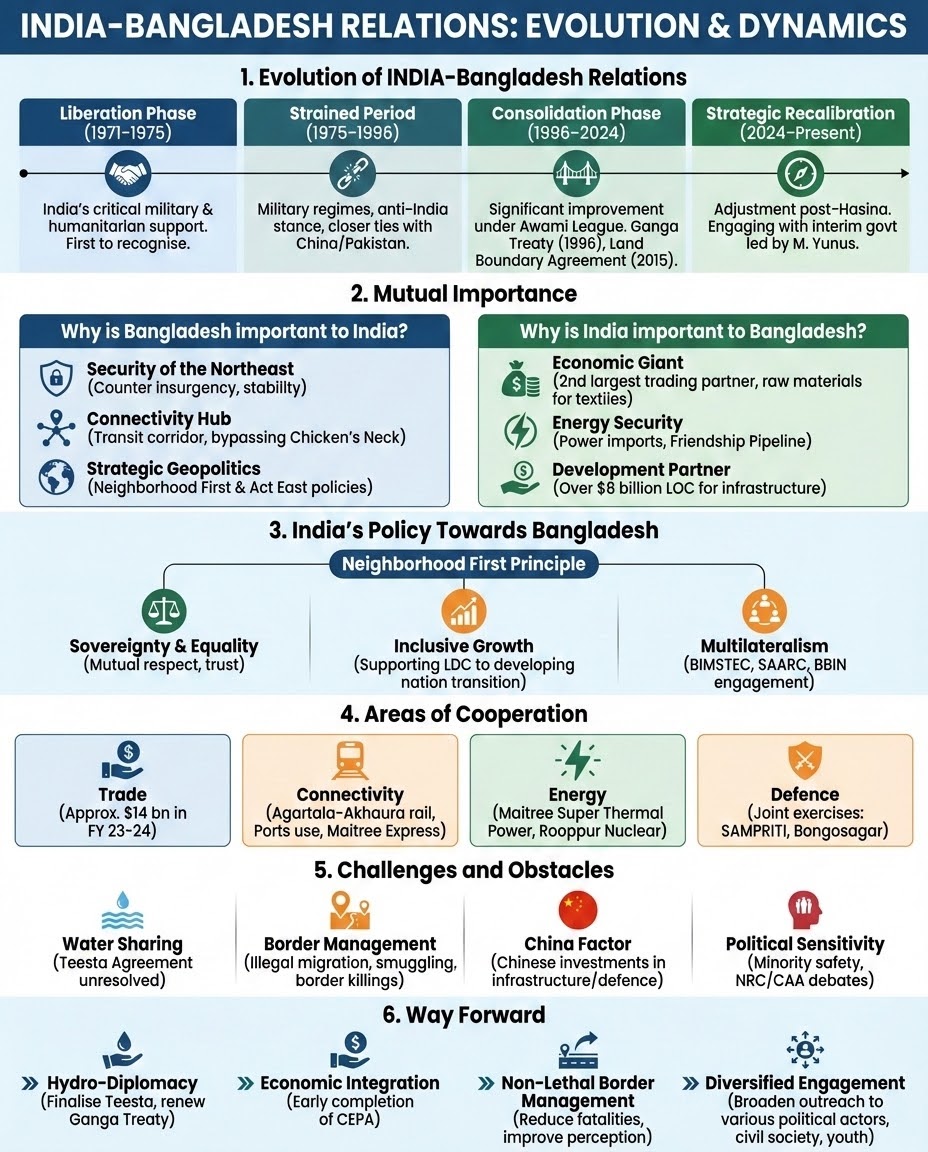 What are the Major Challenges in India-Bangladesh Bilateral Ties?
Diplomatic Friction
The "Hasina" Factor
Former PM Sheikh Hasina's asylum in India since August 2024 is causing major tension. Dhaka's new administration and the BNP consider her presence a "hostile act" and are seeking her extradition to face trial for "crimes against humanity."
Minority Security
India has expressed serious concern over "recurring patterns" of targeted violence against Hindu minorities in Bangladesh following the 2024 political transition, which Dhaka often counters as exaggerated or politicised.
Soft Power & Sport Diplomacy
Cultural relations soured in early 2026 when the BCCI forced an IPL team to release a Bangladeshi pacer, leading Dhaka to ask the ICC to move T20 World Cup matches from India citing security issues.
Security Concerns
Border Killings
Civilian deaths at the border region remain a major source of public anger and a persistent diplomatic strain between the two nations.
Illegal Migration & "Push-ins"
India's domestic narratives surrounding the National Register of Citizens (NRC) and Citizenship Amendment Act (CAA) create anxiety in Bangladesh.
Resource & Trade Disputes
Water Sharing
The Teesta water dispute complicates India-Bangladesh relations as the 1996 Ganga Water Treaty nears its December 2026 expiration.
Tit-for-Tat Trade Restrictions: In 2025, both nations imposed trade barriers:
The China Factor
Bangladesh’s move to seek $1 billion in Chinese funding for the Teesta River project and increased defense ties with Pakistan are viewed by New Delhi as strategic threats.
Connectivity and the Northeast
Bangladesh is the vital link between mainland India and its eight northeastern states (the "Seven Sisters").
Internal and Regional Security
Cooperation with Dhaka is essential for maintaining peace in border regions.
Geopolitical and Maritime Strategy
Bangladesh is a major actor in the Bay of Bengal and the broader Indo-Pacific region.
Inclusive Political & Diplomatic Engagement
Engage All Stakeholders: Communicate with all political parties, civil society, and youth groups in Bangladesh to avoid being seen as favoring one faction.
Track II Diplomacy: Intensify dialogues involving think tanks and academic institutions to counter misinformation and build long-term societal bridges.
Cooperative Federalism: Establish a formal mechanism like a "Bangladesh Engagement Forum" involving Chief Ministers of bordering states (West Bengal, Assam, Tripura) to align regional interests with national foreign policy.
Strategic Water & Resource Management
Ganga Water Treaty (2026): Technical and political talks must be finalized well before the treaty's expiry in December 2026. India may seek a shorter, 10–15 year renewal to maintain flexibility for its own developmental needs.
Teesta River Solution: Pursue creative diplomatic solutions for the Teesta water-sharing agreement through consensus with West Bengal. This includes adopting basin-wide management and joint hydrological data sharing.
Economic & Connectivity Deepening
Comprehensive Economic Partnership Agreement (CEPA): Early conclusion of CEPA negotiations is targeted for 2026 to reduce trade deficits and non-tariff barriers.
Multimodal Infrastructure: Accelerate the BBIN Motor Vehicle Agreement and finalize pending protocols to boost sub-regional trade and transit.
Digital & Green Partnerships: Leverage emerging technologies through the Shared Vision for India-Bangladesh Digital Partnership to drive innovation and climate-resilient development.
Security & Human-Centric Border Management
Smart Border Management: Implement Comprehensive Integrated Border Management Systems (CIBMS) for real-time surveillance to stop drug trafficking and illegal migration.
Non-Lethal Practices: Adopt humane border management to reduce civilian casualties.
Consular Ease: Expand e-medical visa facilities and streamline general visa processes to maintain strong people-to-people ties.
Managing External Influence
To compete with China's "String of Pearls" and Belt and Road Initiative, India must prioritize transparent, sustainable, and debt-free infrastructure support through the "Neighbourhood First" and "Act East" policies.
India's future with Bangladesh depends on transitioning from a government-centric relationship to a people-centric partnership that prioritizes water-sharing resolutions, seamless connectivity, and mutual security to ensure regional stability.
Source: THEDIPLOMAT
|
PRACTICE QUESTION Q. China's growing economic and strategic footprint in Bangladesh presents a significant challenge to India's interests in the region. Examine. 150 words |
The failure to sign the Teesta water-sharing treaty remains the biggest irritant. A draft agreement finalized in 2011 to share the river's water has been stalled due to opposition from India's West Bengal state government, fueling anti-India sentiment in Bangladesh.
China has become a major economic and strategic partner for Bangladesh, funding numerous infrastructure projects under its Belt and Road Initiative (BRI) and deepening defence cooperation. This expanding footprint in India's immediate neighborhood is a significant strategic concern for New Delhi.
Bangladesh provides crucial land and sea connectivity for India's landlocked Northeast, making it a gateway for the 'Act East' policy. A cooperative Bangladesh is also vital for managing security and counter-insurgency operations in the region.
© 2026 iasgyan. All right reserved