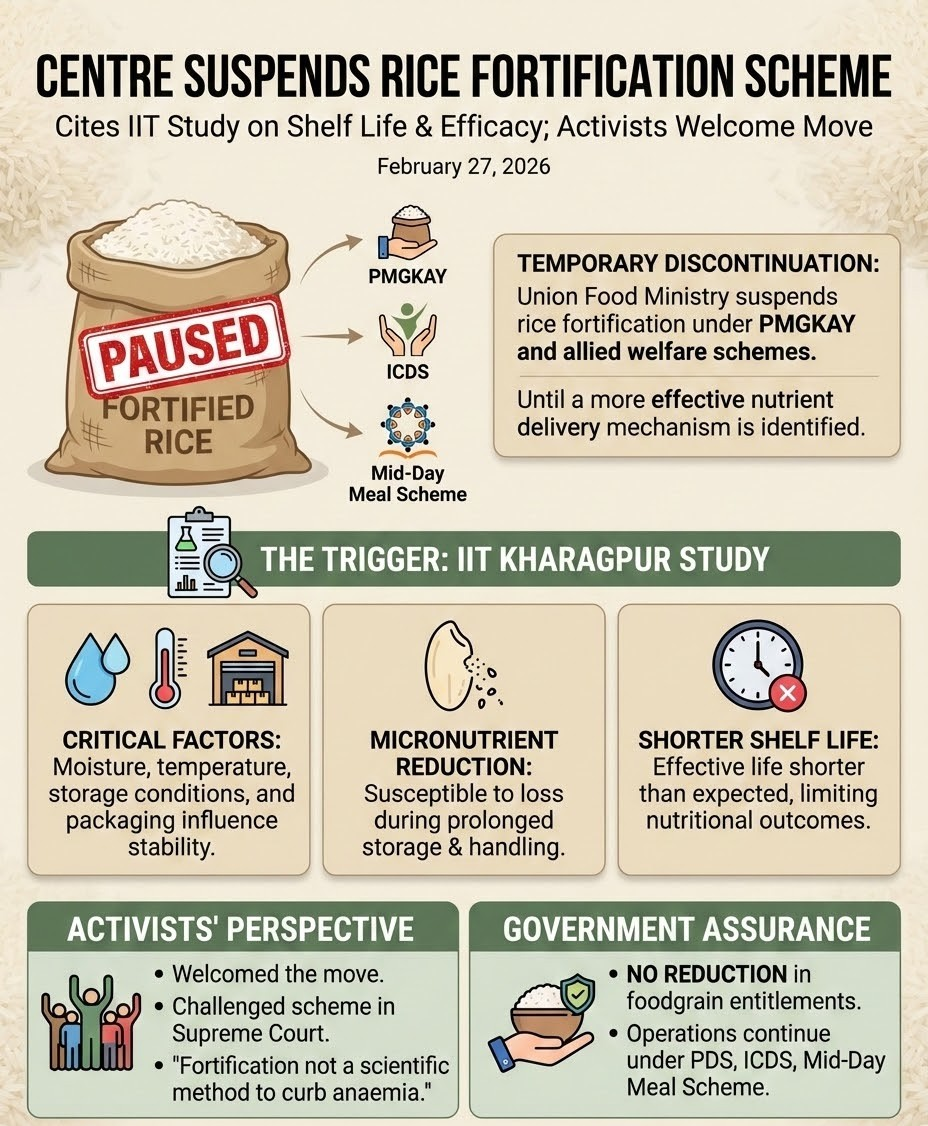
The government has paused the rice fortification scheme after an IIT Kharagpur study found nutrient loss during storage. Critics say universal fortification ignores anemia’s complex causes, risks groups like Thalassemia patients, and sidelines dietary diversity. The pause enables targeted, evidence-based, and nutrition-focused interventions.
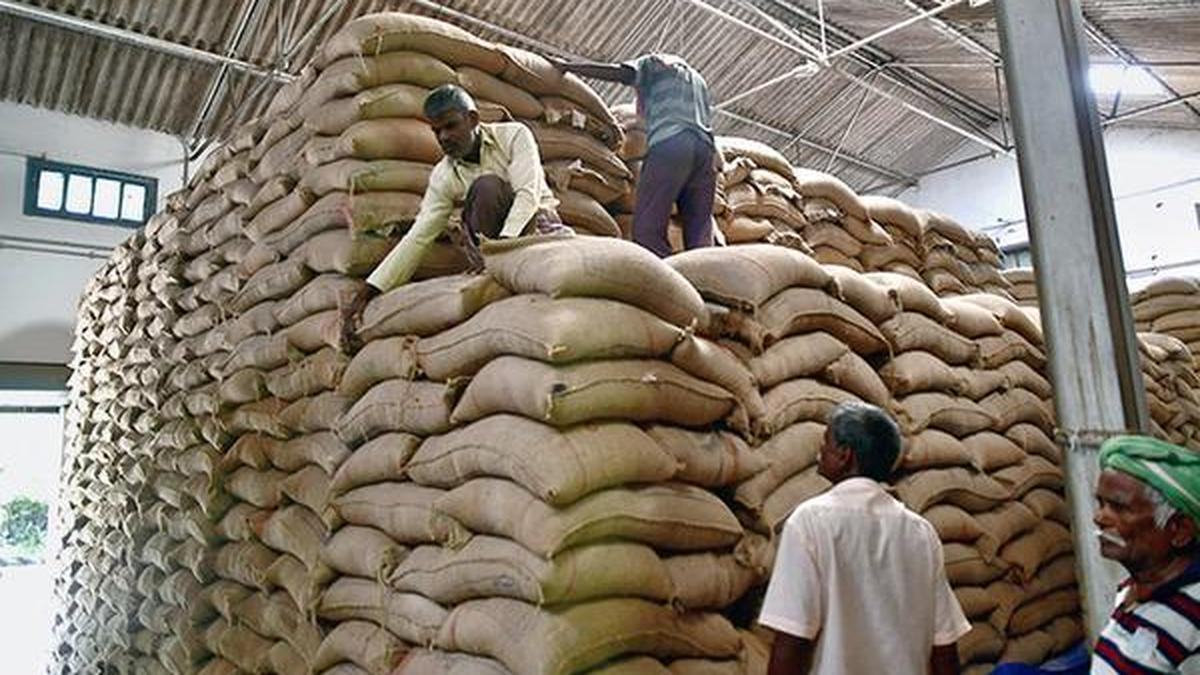
Copyright infringement not intended
Picture Courtesy: THEHINDU
Context
The Government of India announced the temporary suspension of rice fortification under the Pradhan Mantri Garib Kalyan Anna Yojana (PMGKAY) and allied welfare schemes.
What is the Rice Fortification Scheme?
Rice fortification is the process of enhancing the nutritional value of rice by adding essential micronutrients. This is achieved through the following steps:
Why was the Scheme Suspended?
The suspension was a direct result of an IIT Kharagpur study, commissioned by the government, that evaluated the stability of nutrients in fortified rice under real-world storage conditions.
Key Findings of the IIT Kharagpur Report
Nutrient Degradation: The stability of micronutrients was found to be highly susceptible to environmental factors like moisture, temperature, and humidity.
Reduced Shelf Life: Prolonged storage periods in government warehouses and routine handling led to loss of micronutrients.
Limited Nutritional Benefits: Due to the degradation, the fortified rice was failing to deliver the intended health benefits to the beneficiaries by the time of consumption.
What are the Concerns Raised Against Fortification?
The scheme has faced opposition from public health experts and activists on several grounds, which were also highlighted in a Public Interest Litigation (PIL) in the Supreme Court.
Anemia is Multifactorial: Critics argue that not all anemia is caused by iron deficiency. It can also stem from deficiencies of Vitamin B12 and folate, chronic infections, and genetic conditions.
Health Risks for Vulnerable Groups: Universal iron fortification poses health risk to individuals with conditions like Thalassemia and Sickle Cell Anemia, which are prevalent in tribal populations. For them, excess iron is toxic and can lead to organ failure.
Neglect of Dietary Diversity: A technology-driven approach like fortification diverts focus from more sustainable solutions like promoting a balanced diet rich in local vegetables, millets, and pulses.
High Cost and Dependency: The scheme is an expensive intervention that promotes dependency on a limited number of corporations producing FRK.
Way Forward
The temporary suspension offers an opportunity to redesign strategy to combat malnutrition with a more holistic and scientific approach.
Adopt a "Test and Treat" Approach
Instead of universal fortification, strengthen health systems to screen for anemia, identify its specific cause (e.g., iron, B12, or folate deficiency), and then provide targeted treatment.
Promote Dietary Diversity
Invest in programs that improve access to diverse and nutritious foods. This includes supporting local food systems and promoting the consumption of millets, pulses, and local vegetables under schemes like POSHAN Abhiyan.
Strengthen Research and Monitoring
Ensure that any large-scale nutritional intervention is preceded by independent, long-term research on its impact and safety.
Targeted Interventions
If fortification is reconsidered, it should be limited to specific, high-prevalence areas where iron deficiency is confirmed as the primary cause of anemia, rather than a mandatory, one-size-fits-all approach.
Learn Lessons from Global Best Practices
While the rice fortification scheme faced issues, food fortification has been successful globally. The key is choosing the right nutrient and the right food vehicle based on solid evidence.
|
Program |
Nutrient |
Primary Objective |
Key Success Factor |
|
Salt Iodization |
Iodine |
Prevent goiter and iodine deficiency disorders. |
Salt is a universally consumed food item, making it an ideal vehicle for a widespread deficiency. |
|
Flour Fortification |
Folic Acid, Iron |
Reduce neural tube defects and maternal anemia. |
Flour is a staple food in many countries, ensuring wide reach for targeted nutrient delivery. |
The lesson for India is that interventions must be context-specific and based on rigorous, independent evidence, which was arguably lacking in the universal rollout of fortified rice.
Conclusion
The suspension of the rice fortification scheme is a chance to move from a single-nutrient, technology-centric solution to a comprehensive food-systems approach focusing on dietary diversity and public health infrastructure for long-term nutritional security.
Source: THEHINDU
|
PRACTICE QUESTION Q. "While food fortification can be a potent tool, its success is context-dependent and a one-size-fits-all approach can be counterproductive." Discuss. 150 words |
The scheme was suspended based on a study by IIT Kharagpur which found that the micronutrients (iron, folic acid, vitamin B12) in the fortified rice degrade significantly during prolonged storage in government warehouses. This degradation reduces the nutritional benefits for the intended beneficiaries.
Rice fortification is the process of adding essential micronutrients to rice. It is done by producing Fortified Rice Kernels (FRK) through an extrusion process, where a dough of rice flour and a vitamin-mineral premix is shaped into kernels. These FRKs are then blended with regular rice, usually in a 1:100 ratio.
This distinction is crucial for UPSC Mains:


© 2026 iasgyan. All right reserved