India has the world’s third-largest Rare Earth Element reserves but produces little due to complex geology, skewed mineral composition, and weak processing capacity. Through the National Critical Mineral Mission, policy reforms, incentives, recycling, and overseas partnerships, India aims to build a full domestic REE value chain.
Copyright infringement not intended
Picture Courtesy: DDNEWS
The Government is developing a complete domestic value chain for Rare Earth Elements (REEs) to utilize resources, decrease reliance on imports, and achieve self-reliance in the global high-tech industry.
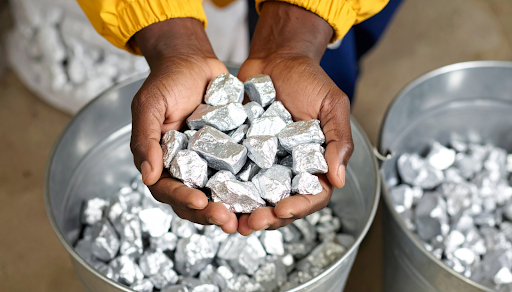
They are a group of 17 metallic elements that are critical for modern high-tech industries. Despite their name, they are relatively abundant in the Earth's crust.
They are called "rare" because they are rarely found in concentrated, economically viable deposits and are difficult to separate from surrounding materials.
The 17 Rare Earth Elements
The group consists of the 15 lanthanides plus scandium and yttrium.
Significance
India holds the world's third largest rare earth resources. (Source: PIB)
|
Source Type |
Estimated Resources |
Key Locations |
|
Monazite Beach Sands |
Approximately 7.23 million tonnes of REE oxides within 13.15 million tonnes of monazite. (Source: Rajya Sabha Reply by Union Minister) |
Kerala, Tamil Nadu, Odisha, Andhra Pradesh, Maharashtra, Gujarat, Jharkhand, West Bengal. |
|
Hard Rock Terrains |
1.29 million tonnes of in-situ Rare Earth Oxides (REO). (Source: Rajya Sabha Reply by Union Minister) |
Ambadungar (Gujarat), Balotra district (Rajasthan). |
|
Riverine Placer Deposits |
Around 2,000 tonnes of heavy mineral concentrates containing xenotime. (Source: Rajya Sabha Reply by Union Minister) |
Chhattisgarh, Jharkhand. |
Despite large reserves, India contributes less than 1% to global REE production due to structural value chain gaps.
Complex Extraction
A major portion of India's REEs is found in monazite, which contains radioactive thorium. This makes extraction technologically complex, capital-intensive, and subject to strict safety regulations.
Imbalance in REE Types
Indian reserves are rich in Light Rare Earth Elements (LREEs). The more valuable and strategically important Heavy Rare Earth Elements (HREEs) are not found in economically viable quantities.
Missing Value Chain
India has upstream capabilities (mining and separation) but lacks midstream (alloy making) and downstream (magnet manufacturing) industries at scale. This forces India to export raw materials and import finished products like permanent magnets, mainly from China.
Policy Framework: National Critical Mineral Mission (NCMM)
Launched in January 2025, the NCMM is the central pillar of India's REE strategy.
Objective: To develop a complete value chain and ensure a sustainable supply of critical minerals.
Timeline & Budget: A seven-year mission (FY 2024-25 to 2030-31) with a proposed government expenditure of ₹16,300 crore.
Boosting Exploration and Production
Legislative Reforms: The Mines and Minerals (Development and Regulation) Act, 1957 was amended in 2025 to empower the Central Government to exclusively auction critical mineral blocks, encouraging private sector participation.
Auctioning Blocks: 46 critical mineral blocks, including 7 for REEs, and 7 exploration licenses (2 for REEs) have been auctioned (Source: Rajya Sabha Reply by Union Minister).
Faster Clearances: Mining projects for critical minerals are now exempt from public consultation under the EIA notification 2006 to fast-track approvals.
Building the Midstream and Downstream Value Chain
Scheme for Rare Earth Permanent Magnets (REPM): The Union Cabinet approved a ₹7,280 crore scheme in November 2025, to promote domestic manufacturing of sintered REPMs.
Target: To establish 6,000 Metric Tons Per Annum (MTPA) of integrated manufacturing capacity, from oxides to finished magnets.
Indigenous Production Plant: A Rare Earth Permanent Magnet Plant is being set up in Vizag to produce Samarium-Cobalt (Sm-Co) magnets for strategic sectors like atomic energy and defence.
Technology Development and Strategic Sourcing
India is focusing on indigenous technology and securing overseas assets to build a resilient supply chain.
|
Global Strategies & India's Hybrid Approach |
|
|
China's Model (Dominance through Integration) |
Australia's Model (Reliable Upstream Supplier) |
|
State-led investment in the entire value chain, from mining and separation to alloy and magnet manufacturing. This integrated ecosystem gives it a massive cost and strategic advantage. |
Focuses on diversifying the global supply chain by being a stable upstream supplier. For example, Lynas Corporation operates the largest non-Chinese processing facility. |
|
India's Hybrid Approach: India aims for both domestic self-sufficiency (like China) by building the entire value chain and forming strategic international partnerships (like Australia) to ensure a secure supply of raw materials. |
|
Encouraging Private Sector Expertise
Creating an attractive ecosystem for private investment and technology transfer in the complex midstream and downstream sectors.
Investing in R&D
Prioritizing research to develop cost-effective and green technologies for processing India's monazite resources.
Skill Development
Building a skilled workforce capable of operating advanced processing and manufacturing facilities.
Strengthening International Partnerships
Collaborating with like-minded nations to access technology, facilitate joint ventures, and create diversified global supply chains.
India aims to transform untapped resource potential into a competitive global ecosystem by implementing the comprehensive rare earth roadmap, ensuring long-term economic security and technological autonomy.
Source: PIB
|
PRACTICE QUESTION Q. Consider the following statements regarding Rare Earth Elements (REEs):
Which of the statements given above is/are correct? a) 1 and 2 only b) 2 and 3 only c) 3 only d) 1, 2 and 3 Answer: b Explanation: Statement 1 is incorrect: REEs are not actually rare in terms of their abundance in the Earth's crust. They are called "rare" because they were originally difficult to extract from their oxide forms (historically called "earths") and they occur in low concentrations dispersed across the crust rather than in concentrated, easily mineable seams. Statement 2 is correct: Rare Earth Elements (REEs) are a set of 17 chemical elements. These include the 15 lanthanides (lanthanum to lutetium) plus scandium and yttrium. Scandium and yttrium are included because they tend to occur in the same ore deposits as lanthanides and exhibit similar chemical properties. Statement 3 is correct: REEs are highly valued for their unique magnetic, luminescent (or fluorescent), and electrochemical properties. These characteristics make them essential for high-tech applications, such as permanent magnets in electric vehicles, phosphors in screens, and catalysts in refining. |
REEs are vital for India's economic and strategic autonomy as they are essential components in high-tech industries, including defence equipment, electronics, telecommunications, and green energy technologies like electric vehicles and wind turbines. Securing a domestic supply chain reduces dependence on other nations, particularly China.
India's inability to capitalize on its reserves stems from several factors: the complex and costly technology required to extract REEs from radioactive monazite ore, a lack of economically viable deposits of more valuable Heavy REEs, and a near-complete absence of mid-stream (alloy making) and downstream (magnet manufacturing) industries.
The NCMM is a comprehensive, seven-year government mission launched in 2025 to develop a self-reliant value chain for critical minerals, including REEs. It focuses on boosting exploration, production, processing, recycling, and R&D to ensure a sustainable supply for India's domestic industries.




© 2026 iasgyan. All right reserved