NITI Aayog’s Fiscal Health Index 2026 assesses states’ finances, grouping them as Achievers or Aspirational. It warns that weak revenue mobilisation, rising committed expenditure, and poor transparency threaten stability. Examples like Odisha’s improvement and Punjab’s stress highlight the need for fiscal discipline and FRBM adherence.
Copyright infringement not intended
Picture Courtesy: PIB
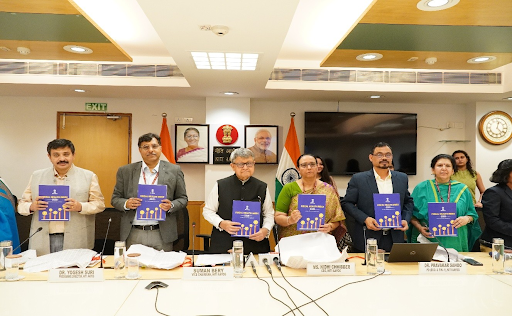
NITI Aayog has released the second edition of the Fiscal Health Index (FHI) 2026, which evaluates and benchmarks the fiscal performance of states based on data from FY 2014-15 to FY 2023-24.
Scope Expansion: For the first time, the 2026 edition includes a separate ranking for 10 North-Eastern and Himalayan states to address their unique fiscal challenges.
Key Highlights of the FHI 2026 Report
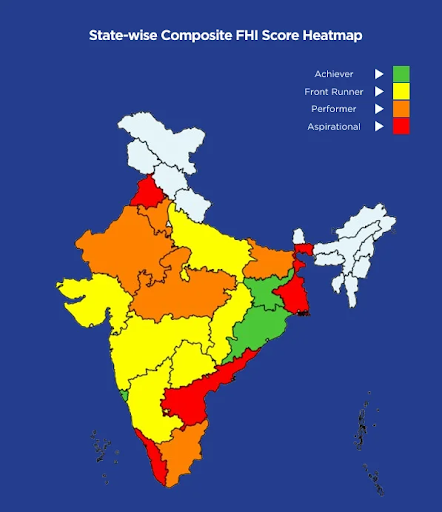
The report classifies states into four categories: Achievers, Front-Runners, Performers, and Aspirational, to rank fiscal management across India.
|
Ranking of 18 Major States |
||
|
Category |
States |
Key Characteristics |
|
Achievers (Top Performers) |
Odisha, Goa, Jharkhand |
Strong fiscal discipline; own-tax revenue shares above 60%, capital outlay of 4–5% of GSDP, fiscal deficits below 3% of GSDP, debt levels under 25% of GSDP. |
|
Front-Runners |
Gujarat, Maharashtra, Chhattisgarh, Telangana, Uttar Pradesh, Karnataka |
Maintain sound finances but lag the top tier on certain indicators. |
|
Performers |
Madhya Pradesh, Haryana, Bihar, Tamil Nadu, Rajasthan |
Show mixed results. Bihar has shown improvement while Karnataka and Tamil Nadu have slipped in rankings. |
|
Aspirational (Bottom Performers) |
West Bengal, Kerala, Andhra Pradesh, Punjab |
High debt-to-GSDP ratios (35-45%); Committed expenditure (salaries, pensions, interest) consumes 50-60% of revenue receipts; Interest payments exceed 15-20% of revenues, constraining development spending. |
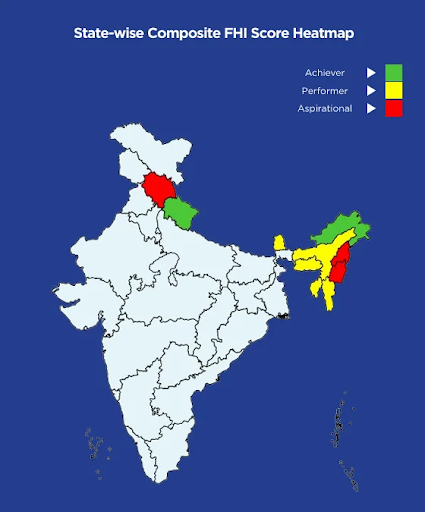
Ranking of North-Eastern & Himalayan States
Achievers: Arunachal Pradesh and Uttarakhand.
Aspirational: Himachal Pradesh, Manipur, and Nagaland. These states struggle with weak revenue bases and high debt levels of around 40-50% of GSDP.
Revenue Mobilisation Challenges
Many states have low own-tax revenue generation and depend heavily on central transfers, making them vulnerable to fund fluctuations.
Unsustainable Expenditure
A major problem is rising "committed expenditure" (salaries, pensions, interest payments), often worsened by populist spending on non-merit subsidies and freebies, which crowds out essential capital spending.
Lack of Transparency
The practice of off-budget borrowings by some states hides their true liabilities, undermining transparent fiscal management. The 16th Finance Commission has recommended discontinuing this practice.
|
Case Studies: Odisha vs Punjab Odisha (Positive Case Study): Odisha enacted its FRBM Act in 2005 and, through disciplined spending and improved revenue, transformed from a fiscally stressed state into a model of fiscal prudence with a consistent revenue surplus and reduced debt. Punjab (Negative Case Study): Punjab's severe fiscal challenges, stemming from power subsidies, pension costs, and high interest payments, are limiting developmental investment, with debt about ₹4.17 lakh crore in March 2026. |
Boost Revenue Mobilisation
Broaden the GST base, improve tax compliance, and strengthen the collection of own-tax revenues like property and motor vehicle taxes.
Rationalise Expenditure
Control committed expenditure and reduce non-essential subsidies, especially unconditional cash transfers.
Enhance Spending Effectiveness
Prioritize capital expenditure to create long-term assets. The Centre's scheme for Special Assistance to States for Capital Investment (50-year interest-free loans) is a key enabler.
Improve Fiscal Frameworks
Strictly adhere to FRBM targets. The N.K. Singh Committee recommended a combined debt-to-GDP ratio of 60% (40% for the Centre, 20% for states) and a fiscal deficit target of 3% for states.
Strengthen Transparency
Eliminate off-budget borrowings and ensure all financial data is audited by the CAG for greater credibility.
The Fiscal Health Index is a key diagnostic tool for states, driving reforms essential for India's macroeconomic stability and achieving "Viksit Bharat @2047." It promotes fiscal discipline, boosts revenue, prioritizes productive spending, narrows regional gaps, and strengthens cooperative federalism.
Source: PIB
|
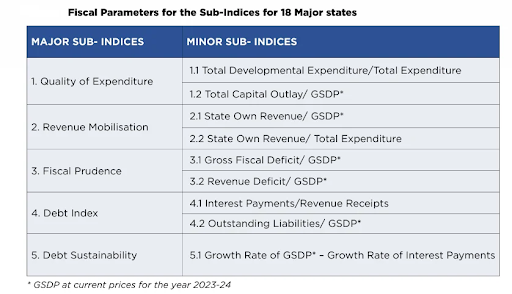
PRACTICE QUESTION Q. With reference to the Fiscal Health Index (FHI), recently in the news, consider the following statements: 1. It is published annually by the Department of Economic Affairs, Ministry of Finance. 2. The index ranks states based on five pillars. 3. The index exclusively uses data provided by the Reserve Bank of India (RBI) State Finances Report. How many of the statements given above are correct? (a) Only one (b) Only two (c) All three (d) None Answer: a Explanation: Statement 1 is incorrect: The Fiscal Health Index is published by NITI Aayog, not the Department of Economic Affairs or the Ministry of Finance. It was launched to provide a data-driven framework to evaluate the fiscal performance of states. Statement 2 is correct: The index evaluates states based on five key sub-indices (pillars): Quality of Expenditure, Revenue Mobilisation, Fiscal Prudence, Debt Index, and Debt Sustainability. Statement 3 is incorrect: The index primarily uses data sourced from the Comptroller and Auditor General of India (CAG), rather than exclusively relying on the RBI State Finances Report. |
The Fiscal Health Index is a tool developed by NITI Aayog to assess and compare the fiscal performance of Indian states. It uses CAG-verified data to evaluate states on five key pillars: Quality of Expenditure, Revenue Mobilisation, Fiscal Prudence, Debt Index, and Debt Sustainability.
Among the 18 major states, Odisha, Goa, and Jharkhand are ranked as 'Achievers' (top performers). Among the North-Eastern and Himalayan states, Arunachal Pradesh and Uttarakhand are the 'Achievers'.
The primary causes include low own-tax revenue generation, high dependency on central transfers, ballooning 'committed expenditure' (salaries, pensions, interest), populist spending on non-merit subsidies, and a lack of transparency through off-budget borrowings.





© 2026 iasgyan. All right reserved