India’s quick commerce boom, led by Blinkit and Zepto, depends on gig workers facing insecure pay, no social security, and algorithmic pressure. Though the Code on Social Security offers safeguards, delays persist. Rajasthan Platform Based Gig Workers Act shows a way forward, demanding strong laws, algorithmic accountability, and consumer awareness.
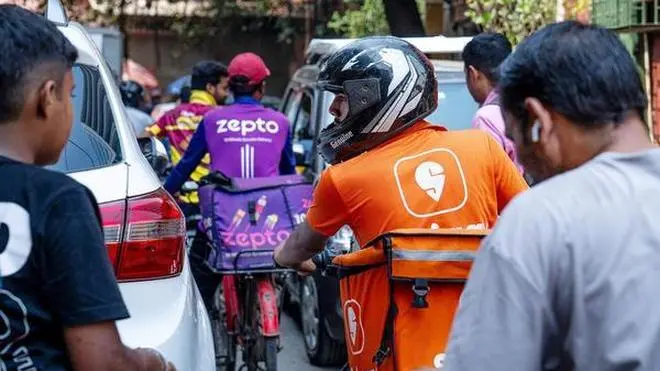
Copyright infringement not intended
Picture Courtesy: THEHINDUBUSINESSLINE
The rapid expansion of "quick commerce" platforms like Blinkit, Zepto, and Swiggy Instamart, promising deliveries in 10-15 minutes, has intensified the debate around the working conditions of gig workers.
|
Read all about: GIG AND PLATFORM WORKERS DATA GAP l GIG ECONOMY l GIG WORK AND ITS SKEWED TERMS l DELIVERY WORKERS |
Quick Commerce (Q-commerce) is a next-generation e-commerce model focused on the ultra-fast delivery of small quantities of essential goods—within 10 to 30 minutes.
Unlike traditional e-commerce, which relies on large, centralized warehouses and 1–7 day delivery timelines, Q-commerce uses a hyperlocal model to meet immediate or impulse consumer needs.
How Quick Commerce Works
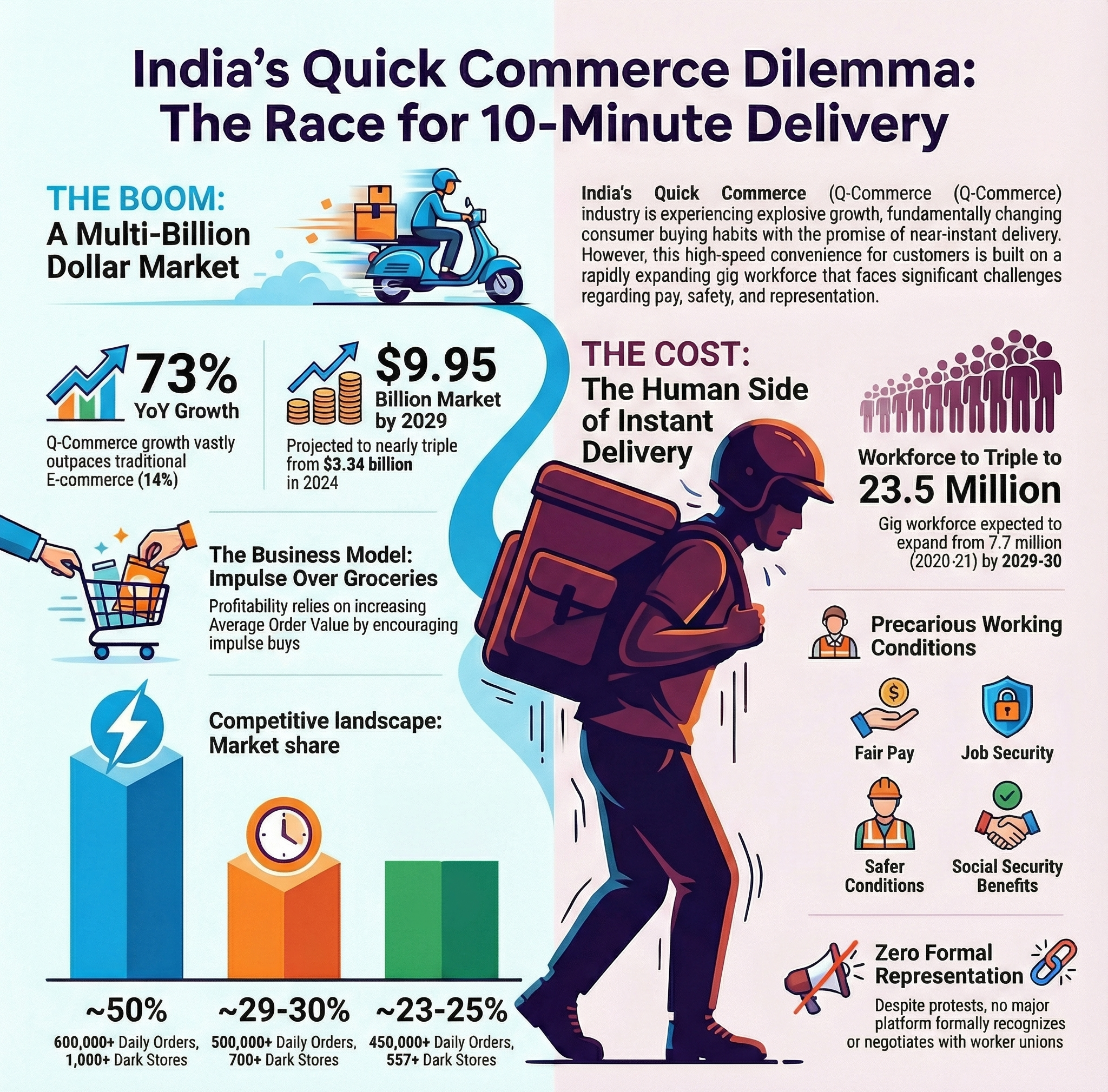
Q-commerce uses "dark stores"—small, local warehouses—for ultra-fast delivery, relying entirely on gig-worker delivery personnel.
India's gig workforce is one of the fastest-growing globally, projected to reach 23.5 million by 2029-30 (Source: NITI Aayog, 2022).
Lack of Social Security: Workers lack a safety net, including health insurance, accident cover, pensions, or sick leave, making them highly vulnerable to economic shocks from illness or injury.
Precarious and Low Pay: Earnings are often unpredictable and fall below the minimum wage after deducting operational costs like fuel, vehicle maintenance, and internet data.
Intense Work Pressure & Safety Risks: The pressure for speed directly compromises worker safety. Reports indicate a high incidence of fatigue, stress, and road accidents among delivery workers.
Absence of Grievance Redressal: Gig workers often lack access to a formal, effective, and impartial system to address disputes related to pay, account deactivation, or unfair ratings.
 Policy Framework for Gig Workers
It formally recognizes "gig workers" and "platform workers" for the first time. Its key provisions include:
Rajasthan Platform Based Gig Workers Act, 2023
Rajasthan is the first state in India to enact a dedicated law to protect the rights of gig workers. This Act serves as a potential model for other states.
|
Feature |
Description |
|
Welfare Board |
Establishes a tripartite "Platform Based Gig Workers Welfare Board" with representatives from the government, aggregators, and worker unions. |
|
Registration |
Mandates the registration of all gig workers and aggregators operating in the state, creating a central database. |
|
Welfare Fund & Cess |
Creates a dedicated social security and welfare fund financed by a welfare cess levied on each transaction made on the platform. |
|
Grievance Redressal |
Provides a formal, time-bound grievance redressal mechanism for workers to raise and resolve disputes. |
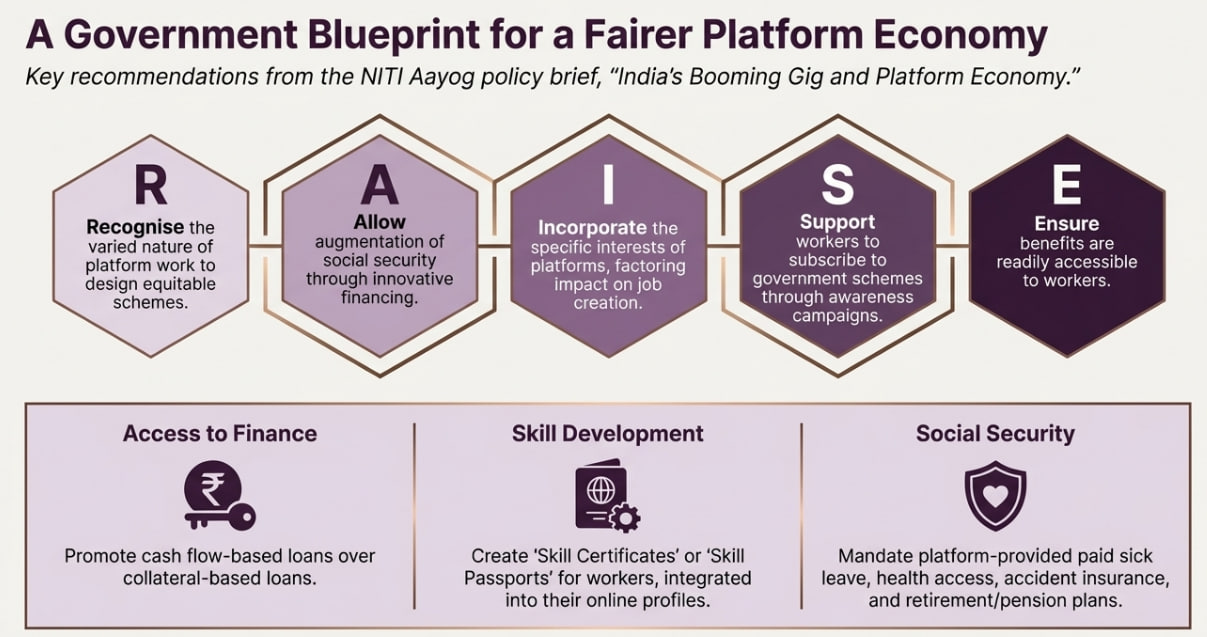 Way Forward
Expedite Implementation of Codes: The central and state governments must work together to strictly implement the Code on Social Security, 2020.
Promote State-Level Legislation: Other states should emulate Rajasthan's model to create localized welfare and protection mechanisms for gig workers.
Regulate Algorithmic Management: Regulations must mandate algorithmic transparency, covering pay structure clarity and a fair, human-reviewed deactivation appeal process.
Recognize Worker Representation: Platforms must be encouraged to engage in social dialogue with worker unions to negotiate fair contracts and working conditions.
Consumer Awareness: Consumers can support higher-rated Fairwork platforms and be more patient with delivery times, recognizing the human element.
|
Fairwork India Ratings: An annual report by the Centre for IT and Public Policy (CITAPP), IIIT Bangalore, that scores platforms on five principles of fair work. In the 2023 ratings;
|
Gig economy offers flexibility but raises ethical and legal issues regarding worker rights and social security. The challenge is balancing convenience with fundamental workforce rights. An equitable future needs strong laws, transparent platform practices, and informed consumer choices.
Source: THEHINDUBUSINESSLINE
|
PRACTICE QUESTION Q. "The gig economy in India is a double-edged sword that offers flexibility but lacks social security." Critically analyze. 150 words |
A labor market characterized by short-term, flexible, or freelance jobs often facilitated by digital platforms.
A worker whose work arrangement is mediated through an online platform (e.g., Zomato, Uber, Urban Company).
This model is problematic because it places immense pressure on delivery workers to prioritize speed over safety. To meet tight deadlines, workers are often forced to speed, violate traffic rules, and work under high stress, leading to an increased risk of accidents and hazardous working conditions, as highlighted by various surveys and workers' unions.






© 2026 iasgyan. All right reserved