A Super El Niño is a strong warming of the central and eastern Pacific Ocean. It occurs when sea-surface temperatures rise above average, causing extreme global weather shifts, including severe floods, catastrophic droughts, and record-breaking heat across continents.
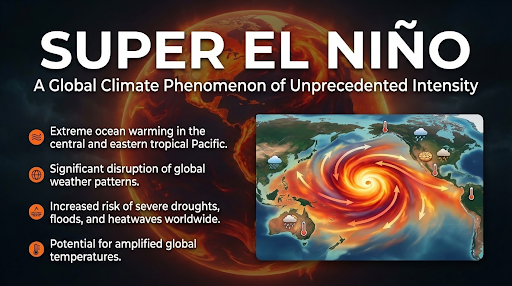
A developing "Super El Niño" in 2026, with temperatures projected to exceed 2°C above average, poses a high risk of below-normal monsoon rainfall for India.
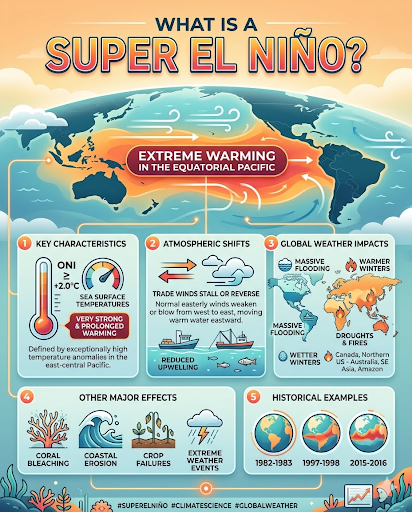
While El Niño is the "warm phase" of the El Niño-Southern Oscillation (ENSO), a Super El Niño is defined by its intensity.
Rarity: Standard El Niño events occur every 2–7 years, but "Super" events are rare, with only three recorded in the last 40 years: 1982-83, 1997-98, and 2015-16.
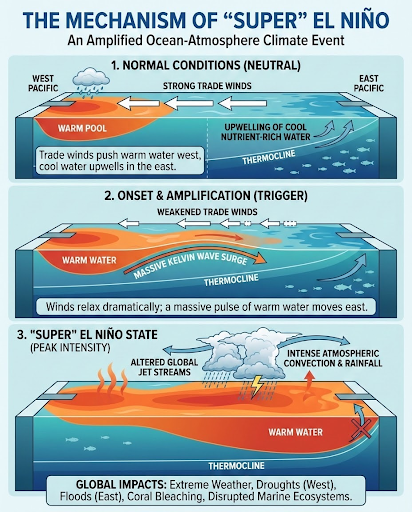
Phase 1: The Collapse of Trade Winds
Phase 2: The Kelvin Wave Surge
Phase 3: Thermocline Deepening
Recent studies suggest that while the frequency of El Niño might not change, the intensity of "Extreme" or "Super" events is likely to increase due to global warming. The warming of the Pacific is becoming more non-uniform, making climate prediction models more complex.
Source: DOWNTOEARTH
|
PRACTICE QUESTION Q. A Super El Niño is not merely a meteorological event but a major socio-economic challenge for India. Examine. 150 words |
A Super El Niño is a severe phase of the El Niño Southern Oscillation (ENSO) cycle where Sea Surface Temperature (SST) anomalies in the central and eastern equatorial Pacific cross 2°C above the long-term average, causing extreme global weather disruptions.
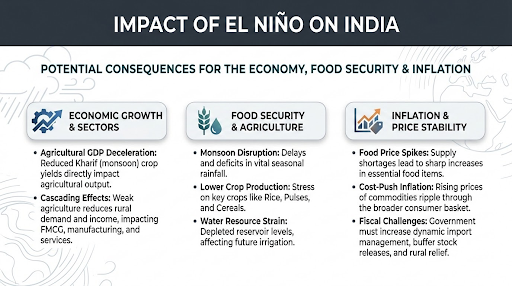
El Niño typically suppresses the southwest monsoon, which provides over 70% of India's annual rainfall, leading to potential droughts and agricultural deficit. Conversely, it often intensifies the northeast monsoon, which can cause unseasonal flooding in coastal areas like Tamil Nadu.
A Climate Regime Shift is an abrupt, persistent, and long-term transition between alternative stable states in the climate system. Extreme meteorological events like a Super El Niño can act as catalysts for CRS, causing irreversible changes in regional soil moisture, temperatures, and ecosystems.


© 2026 iasgyan. All right reserved