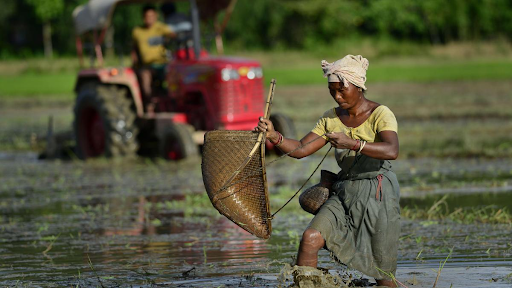
Feminisation of agriculture reflects rising female participation in farming, but women remain largely invisible due to poor land ownership and limited access to credit, insurance, and subsidies. Strengthening land rights, inclusive policies, and gender-friendly technologies is essential for empowerment, nutrition security, and rural development.
Copyright infringement not intended
Picture Courtesy: THEHINDU
Context
Recognizing the rights and contributions of women farmers is essential, given their increasing involvement in agriculture.
What is 'Feminisation of Agriculture'?
The 'Feminisation of Agriculture' refers to the increasing participation of women in the agricultural workforce.
This trend is primarily driven by the migration of rural men to urban areas for non-farm jobs, leaving women to manage farming operations, cultivation, and household food security.
Despite their growing role, women farmers face systemic challenges that prevent their full empowerment.
|
Indicator |
Details |
Source |
|
Rural Female Workers in Agriculture |
76.2% of all female workers in rural areas are engaged in agriculture. |
Periodic Labour Force Survey (PLFS), 2022-23 |
|
Women's Operational Landholdings |
Women operate only 13.96% of agricultural landholdings. |
Agriculture Census, 2015-16 |
Challenges Faced by Women Farmers
Deep-rooted social, legal, and administrative barriers prevent institutional frameworks from formally recognizing women farmers.
Lack of Land Ownership: Despite laws like the Hindu Succession Act, 2005, which grants equal inheritance rights, implementation remains weak.
Systemic Exclusion from Entitlements: Without land ownership documents, women are barred from accessing support systems. They face hurdles in:
What are the Consequences of Increasing Feminisation of Agriculture?
Intensified Workload and Drudgery
Women manage demanding farm labour alongside traditional household and childcare responsibilities. This 'dual burden’ leads to immense physical and mental stress.
Silent Nutritional Crisis
Paradox exists where the primary food producers suffer from malnutrition. The heavy workload contributes to poor health, with 57% of women being anaemic. (Source: NFHS-5, 2019-21)
Intergenerational Impact
Maternal malnutrition and anemia perpetuate a cycle of poor health across generations, causing low birth weight, childhood stunting, and poor cognitive development.
Way Forward
A multi-dimensional approach is needed to bridge the gap between rights and reality for women farmers. Key recommendations are drawn from experts like the M.S. Swaminathan Research Foundation (MSSRF) and the World Food Programme (WFP).
Ensure Visibility in Law, Data, and Policy
Adopt an Inclusive Definition of 'Farmer'
All government schemes must use the comprehensive definition from the National Policy for Farmers (2007). This policy defines a farmer by their activity (cultivators, labourers, sharecroppers), not by land ownership.
Collect Gender-Disaggregated Data
Systematic collection of data on women in agriculture is crucial for creating targeted, evidence-based policies.
Strengthen Rights to Land and Productive Resources
Implement Inheritance Laws
State governments must ensure proactive implementation of equal inheritance laws through legal awareness campaigns.
Promote Joint Land Titles
Encouraging joint spousal titles for property is a powerful tool for empowerment. Odisha's 'Mission Shakti' is a successful model where integrating women into Self-Help Groups (SHGs) improved their access to land leasing and credit.
Align Food Systems with Nutritional Goals
Diversify Public Procurement
Government procurement should expand beyond rice and wheat to include nutrient-dense crops like millets and pulses.
Strengthen Distribution Channels
Procured food should be distributed through the Public Distribution System (PDS), Anganwadi centers, and Mid-Day Meal schemes.
Promote Community Nutrition Gardens
Supporting initiatives like kitchen gardens and women-led seed banks can improve household dietary diversity.
Enhance Access to Technology and Extension Services
Provide Gender-Friendly Tools
Access to ergonomically designed, labour-saving farm tools is vital to reduce physical drudgery.
Expand Extension Services
Agricultural advisory services must be reformed to cater specifically to women by recruiting more female extension workers. The 'Krishi Sakhi' program, which trains local women as para-extension workers, is a powerful model for doorstep guidance.
Conclusion
Empowering women farmers with legal recognition, secure land rights, technology, and central roles in food policy is an economic, nutritional, and social imperative for India to build a resilient, prosperous nation and achieve sustainable development goals.
Source: THEHINDU
|
PRACTICE QUESTION Q. Examine the key policy interventions required to address the systemic marginalization of women farmers in India. 150 words |
The feminisation of agriculture refers to the increasing participation of women in the agricultural workforce and activities, largely driven by the migration of men from rural to urban areas for non-agricultural jobs.
Without land titles, women farmers are systematically excluded from essential resources. They cannot access institutional credit, crop insurance, government subsidies (like PM-KISAN), and other agricultural support systems that are linked to asset ownership.
The National Policy for Farmers (2007), chaired by Prof. M.S. Swaminathan, provides an inclusive definition of a 'farmer' based on their activities rather than land ownership. It includes cultivators, agricultural labourers, sharecroppers, and forest gatherers.

© 2026 iasgyan. All right reserved