India advances its ethanol transition with draft rules for E85 and E100 fuels. This shift promotes flex-fuel vehicles, aims to reduce crude oil imports, boosts farmers' income, and ensures energy security, despite significant infrastructural and technical challenges ahead.
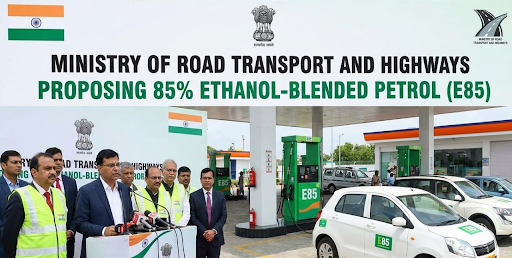
The Ministry of Road Transport and Highways has issued a draft notification proposing amendments to the Central Motor Vehicles Rules to formally include E85.
|
Read all about: ETHANOL-BLENDED PETROL IN INDIA |
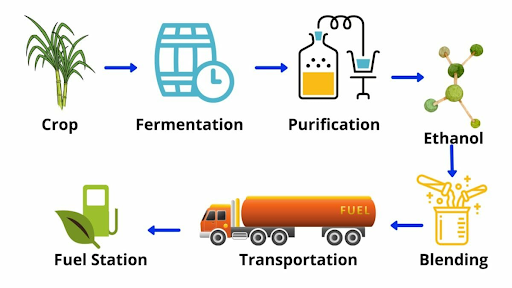
E85 is a fuel consisting of 85% ethanol and 15% petrol. The ethanol used in this fuel is a renewable biofuel derived domestically from agricultural biomass, including sugarcane molasses, maize, and damaged grains.
E85 powers Flex-Fuel Vehicles (FFVs) equipped with sensors that adjust engine parameters based on the fuel mix.
Energy Security: India imports 85-90% of its crude oil; homegrown alternatives are essential to counter geopolitical volatility.
Import Savings: Domestic ethanol from sugarcane and grains is more cost-effective than refined petroleum, reducing the import burden.
Environmental Commitments: Ethanol blending supports India's goal of net-zero emissions by 2070 and 50% renewable energy use.
Boosting Farmer Incomes: Utilizing agricultural surplus for fuel provides sugarcane and maize farmers a reliable, profitable market.
Foreign Exchange Savings: Adopting high-ethanol blends reduces crude oil imports, preserving vital foreign exchange reserves.
Lower Fuel Prices: E85's lower production costs compared to refined oil are expected to provide cheaper retail prices for consumers.
Carbon Reductions: Flex-fuel vehicles using high ethanol blends can cut lifecycle carbon emissions by up to 90%, mitigating urban pollution.
Rural Benefits: Demand for feedstocks like sweet sorghum and sugarcane will promote profitable miller-farmer partnerships.
Industry Growth: The shift will trigger infrastructure investment, benefiting equipment suppliers and engineering contractors.
Capital Expenditure: Public sector oil marketing companies (IOC, BPCL, HPCL) need to invest ₹12,000–₹15,000 crore in ethanol-compatible infrastructure.
Legacy Engine Risks: Using E85 in E10/E20 vehicles causes corrosion, moisture buildup, and permanent fuel system damage.
Mileage Reduction: Low energy density in ethanol is expected to drop fuel efficiency by 27%–30%.
Price Barriers: Advanced sensors and materials increase the initial purchase price of flex-fuel vehicles.
Sustainability Concerns: Relying on water-heavy rice is unsustainable; a shift to drought-resistant millets is needed.
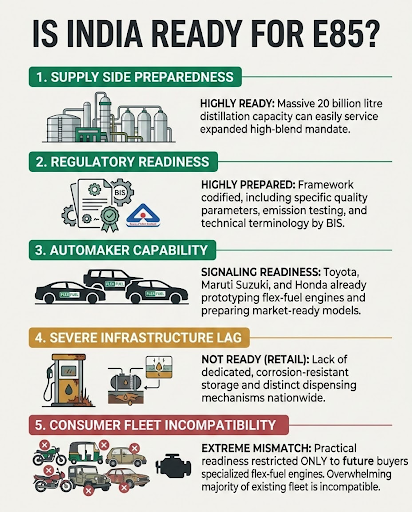
Regulations: Draft Central Motor Vehicles Rules amendments propose officially recognizing E85 and E100 fuels.
Standards: Bureau of Indian Standards (BIS) established quality norms (IS 16634:2017) for refineries and blenders.
Global Alignment: Domestic Biofuel initiatives align with the Global Biofuel Alliance for technology transfer and international standards.
Incentives: Interest subvention schemes support distilleries in expanding ethanol production capacity.
Strategy: A phased rollout builds on the early achievement of nationwide E20 implementation to prepare for higher blends.
Brazil's Flex-Fuel Model: India can adopt insights from Brazil’s 2003 flex-fuel program, which normalized E100-capable vehicles.
Production Scaling: By studying the USA and Brazil—co-producers of 80% of global ethanol—India can optimize biomass management and scaling.
Strategic Choice: International experience shows that offering multiple fuel grades simultaneously at pumps facilitates smoother consumer transitions to flex-fuels.
Proven Emissions Impact: E85 and E100 networks can reduce lifecycle carbon emissions by nearly 90%, supporting India’s climate targets.
Global Collaboration: Joining the Global Biofuel Alliance enables India to implement proven international policies, technical standards, and market practices.
Expedite Infrastructure Investment: State-owned oil firms must fund and execute retrofitting fuel depots and stations with E85 dispensing systems.
Offer Consumer Incentives: Introduce tax breaks to lower flex-fuel vehicle prices, driving market adoption of these costlier models.
Prioritize Sustainable Feedstocks: To ensure sustainability, agricultural policy should transition ethanol production from water-intensive rice to high-yielding, resilient crops like millets and sweet sorghum.
Consumer Education: Launch awareness campaigns to prevent standard vehicle owners from using E85, which can damage non-compatible fuel systems.
Accelerate Production: Manufacturers must quickly move from prototypes to mass-market flex-fuel vehicles to satisfy and stimulate consumer demand.
India's transition to E85 and E100 depends on a massive, capital-intensive overhaul of retail distribution infrastructure and the creation of price parity for flex-fuel vehicles to ensure that domestic energy security goals translate into mass-market consumer adoption.
Source: INDIANEXPRESS
|
PRACTICE QUESTION Q. "India's transition towards E85 and E100 ethanol blends is a crucial tool for energy security and rural economic empowerment." Discuss. (150 words) |
E85 is a blended automotive fuel comprising 85% ethanol and 15% petrol, designed to reduce carbon emissions and dependency on crude oil imports.
It lowers India's reliance on imported crude oil, saving billions in foreign exchange, while simultaneously boosting the agricultural sector by providing a steady income to sugarcane and maize farmers.
The GBA is a multilateral, India-led forum launched at the G20 summit involving 30 countries. It aims to accelerate the worldwide adoption of sustainable biofuels and the development of related technological competencies.




© 2026 iasgyan. All right reserved