Addressing forest fires in India requires bridging the policy-implementation gap through advanced monitoring, increased funding, and proactive risk reduction, while placing local communities at the core of conservation to ensure forest resilience against escalating climate-driven threats.
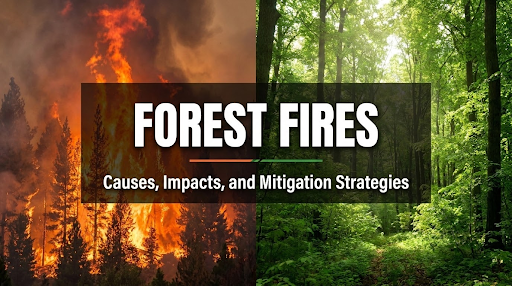
The forest fire situation across India has escalated with extreme heatwaves and dry conditions fueling blazes in multiple states.
A forest fire, also known as a wildfire or bushfire, is an uncontrolled and rapidly spreading fire that burns in an area of combustible vegetation like forests, grasslands, or scrublands.
Though fire naturally occurs in certain ecosystems, human activity and climate change have increased its frequency and scale, endangering the environment, society, and economy.
Human-Caused (Anthropogenic) Fires
Accounting for over 90% of forest fires in India. (Source: Forest Survey of India)
Natural Causes
Climate change serves as a "threat multiplier," making forests more flammable and fires harder to manage. This triggers a feedback loop: increased fires release more CO2, further driving climate change.
The consequences of large-scale forest fires are severe and wide-ranging, affecting the environment, economy, and human well-being.
|
Category |
Specific Impacts |
|
Environmental |
|
|
Economic |
|
|
Social |
|
Vulnerability: According to the Forest Survey of India (FSI), over 36% of India's forest cover is prone to frequent fires. About 4% are extremely prone, and 6% are very highly prone.
Recent Trends: In the first two months of 2026 (January 1 to February 28), India recorded 28,727 forest fire incidents, which is an 80% increase compared to the same period in 2014. (Source: Down To Earth).
Hotspot States: Highly affected states include Uttarakhand and Himachal Pradesh in the Himalayas, plus Odisha, Madhya Pradesh, Chhattisgarh, and Maharashtra in central and eastern India.
National Action Plan on Forest Fires (NAPFF), 2018: A MoEFCC initiative aimed at reducing forest fires by empowering local communities and strengthening forest department capacities.
Forest Fire Prevention and Management Scheme (FFPMS): A central scheme providing states with financial aid for fire lines, equipment, and awareness programs.
Use of Technology:
Community Involvement: Encouraging participation of Joint Forest Management Committees (JFMCs), Eco-Development Committees (EDCs), and local communities in fire prevention and control.
Capacity Building: Training forest personnel and local communities in modern firefighting techniques and creating a specialized cadre of firefighters within disaster response forces.
Inadequate Funding: The Forest Fire Prevention and Management Scheme (FFPMS) faces inconsistent and insufficient budget allocations, which hampers long-term planning and on-ground implementation.
Technological Gaps: Current alert systems sometimes struggle to differentiate between forest fires and other fires (like crop burning), leading to delayed ground validation.
Lack of Manpower and Equipment: State forest departments suffer from a shortage of trained personnel and modern firefighting equipment.
Limited Community Participation: Despite policies, the involvement of local communities remains weak in many areas due to a lack of awareness, training, and incentives.
Poor Inter-Agency Coordination: A lack of seamless coordination between the Forest Department, Disaster Management Authorities, and other relevant agencies slows down response times.
Data and Research Gaps: Need for more comprehensive data and research on fire behavior in different forest ecosystems to develop area-specific management plans.
Recognize Forest Fires as a Disaster: Formally recognizing large-scale forest fires as a natural disaster under the National Disaster Management Act, 2005 would ensure better funding, planning, and a more structured response mechanism.
Strengthen Community Engagement: Empower and incentivize local communities through formal programs. Models like Nepal's Community Forest User Groups can be adapted to the Indian context.
Focus on Prevention and Preparedness: Shift the focus from a purely post-disaster response to proactive risk reduction. This includes creating and maintaining fire breaks, promoting controlled burning where ecologically appropriate, and managing fuel load.
Capacity Building at Local Levels: Train and equip forest-fringe communities and local body members as the first line of defense against fires.
Dedicated Funding and Infrastructure: Ensure consistent and adequate financial allocation for fire management. Establish well-equipped forest fire control rooms in all vulnerable districts.
Integrate Technology: Deploy AI-based predictive models and drone surveillance (with thermal imaging) for early detection and real-time monitoring, similar to California’s ALERTCalifornia system.
India's forest fires have surged by 80% in early 2026, driven by climate-linked droughts and anthropogenic causes. Over 36% of forest cover is now prone. Integrate AI-driven early warning systems, empower local communities, and promote biomass utilization (e.g., pine needles) to reduce fuel loads and improve resilience.
Source: THEHINDU
|
PRACTICE QUESTION Q. Climate change acts as a threat multiplier for forest fires, creating a dangerous positive feedback loop. Elucidate. 150 words |
Forest fires are categorized into three main types: Surface fires (which burn leaves, twigs, and low vegetation on the forest floor), Crown fires (which burn the top canopy of trees and spread rapidly via wind), and Ground fires (which burn sub-surface organic matter like peatlands and can smolder undetected for weeks).
Forest fires emit massive amounts of black carbon (soot). When this soot settles on the Himalayan glaciers, it reduces their albedo (reflectivity). As a result, the glaciers absorb more heat, accelerating ice melt and threatening the perennial river systems of Northern India.
Cultural burning is an indigenous practice from Australia where First Nations people light low-intensity, controlled fires during the cooler months. This practice safely clears dry underbrush and dead vegetation, removing the "fuel" that would otherwise feed massive, uncontrollable mega-fires during the hot, dry summer months.


© 2026 iasgyan. All right reserved