India is transitioning to climate-resilient agriculture to ensure food security and mitigate climate risks. Initiatives like NMSA, NICRA, and the Digital Agriculture Mission promote sustainable practices, micro-irrigation, and crop diversification, driving India's vision of Viksit Bharat and Net Zero.
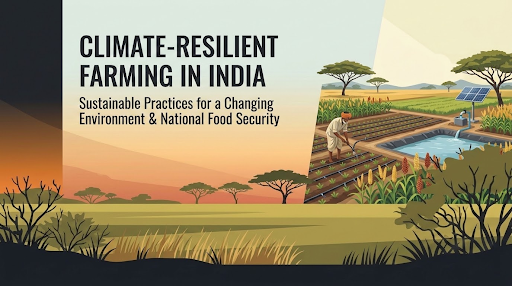
The National Mission for Sustainable Agriculture (NMSA) is driving climate-resilient farming by releasing nearly 3,000 stress-tolerant crop varieties and expanding micro-irrigation to 109 lakh hectares to secure long-term food and livelihood security.
It is a holistic agricultural approach that integrates ecology, technology, and policy to build adaptive capacity against climate shocks while simultaneously enhancing agricultural productivity, stabilizing farmer livelihoods, and mitigating greenhouse gas (GHG) emissions.
What are its major components?
Integrated Farming Systems (IFS): Multi-cropping, livestock rearing, and fisheries to diversify climate risks and optimize farm income.
Sustainable Yield Intensification: Stress-tolerant, high-yielding crop varieties and precision nutrient management to bridge crop yield gaps without degrading the environment.
Resource-Efficient Rice Cultivation: Water-saving techniques like Alternate Wetting and Drying (AWD), Direct Seeded Rice (DSR), and the System of Rice Intensification (SRI) to cut methane emissions.
Precision Water Management: Micro-irrigation technologies (drip and sprinkler systems) through the Per Drop More Crop initiative to maximize water-use efficiency at the farm level.
Conservation Agriculture: Zero tillage, crop residue retention, and mechanized sowing to boost soil organic carbon and reduce fossil fuel usage.
High Vulnerability of Rainfed Regions: Nearly 60% of India's net sown area operates as rainfed agriculture, making it susceptible to droughts, floods, and monsoon irregularities. (Source: PIB)
Mapped Climate Risks: The National Innovations in Climate Resilient Agriculture (NICRA) project assessed 651 agricultural districts and identified 310 districts as highly vulnerable to climate change.
GHG Emissions: Agriculture sector generates about 13.44% to 14% of India’s total Greenhouse Gas emissions, primarily through enteric fermentation in livestock, flooded rice cultivation, and synthetic fertilizer application. (Source: NITI Aayog)
Socio-Economic Threats to Farmers: A 1°C temperature rise increases poor rural households' dependence on agriculture by 53% while eroding their non-farm income by 33%, weakening their economic adaptive capacity. (Source: FAO)
National Mission for Sustainable Agriculture (NMSA): Promotes Integrated Farming Systems through the Rainfed Area Development (RAD) component and provides Soil Health Cards to correct nutrient imbalances.
Seed and Village Resilience: Indian Council of Agricultural Research (ICAR) established 448 model Climate Resilient Villages and developed 2,996 climate-resilient crop varieties between 2014 and 2025 to withstand extreme weather.
Expanding Micro-Irrigation: Authorities covered 109 lakh hectares under the Per Drop More Crop (PDMC) scheme and set a target to bring an additional 100 lakh hectares under micro-irrigation by 2029-30.
Digital Integration: The Union Cabinet launched the Digital Agriculture Mission, introducing AgriStack and the Krishi Decision Support System to deliver real-time, satellite-backed climate and pest advisories to farmers.
Financial Risk Mitigation: The Pradhan Mantri Fasal Bima Yojana (PMFBY) provides comprehensive financial buffers against localized weather calamities.
Innovative Research Partnerships: Through joint research, Indian Council of Agricultural Research (ICAR) and the International Maize and Wheat Improvement Center (CIMMYT) are leading Biological Nitrification Inhibition (BNI) and conservation agriculture efforts.
Affordability and Infrastructure Hurdles: Financial limitations hinder small farmers from accessing clean mechanization and precision tech.
Energy and Emission Challenges: Deepening groundwater tables increase diesel and grid reliance, creating fossil fuel lock-ins that complicate green transitions.
Market and Behavioral Resistance: Farmers prefer familiar, input-intensive crops like rice and wheat due to assured procurement markets, hindering the transition to resilient varieties.
Institutional Fragmentation: Fragmented governance makes it difficult to reconcile competing goals involving water conservation, food security, and renewable energy across different ministries.
Drive Strategic Crop Diversification: Incentivize a phased transition from water-guzzling rice toward climate-hardy nutri-cereals (millets), pulses, and oilseeds, integrating them into the Public Distribution System (PDS) to guarantee market demand.
Scale Chemical-Free Farming Locally: Expand the National Mission on Natural Farming (NMNF) by utilizing grassroots community networks like Self-Help Groups (SHGs) and Farmer Producer Organizations (FPOs) to deliver peer-led, localized training.
Adopt an "Efficiency-First" Energy Policy: Mandate water-saving micro-irrigation techniques before subsidizing solar pumps to prevent groundwater depletion, and shift farm machinery to electric or Compressed Biogas (CBG) models.
Implement Integrated Agri-Food Systems: Construct data-driven Integrated Assessment Models (IAMs) that harmonize agricultural policies across land, energy, food, and water sectors, eliminating policy silos.
India must institutionalize climate-resilient farming to decouple agricultural growth from ecological harm, protecting food security and smallholder livelihoods.
Source: PIB
|
PRACTICE QUESTION Q. Evaluate the performance and persistent challenges of the Pradhan Mantri Fasal Bima Yojana (PMFBY) as a risk mitigation tool for Indian farmers. 150 words |
NICRA is a project implemented by the Indian Council of Agricultural Research (ICAR) to study climate change impacts on agriculture and promote future-ready technologies. It has assessed 651 districts, identifying 310 as vulnerable, and established 448 Climate Resilient Villages.
Approved in 2024 with an outlay of Rs. 2,817 Crore, it is an umbrella scheme designed to support digital agriculture initiatives. Its foundational pillars are AgriStack and the Krishi Decision Support System, aiming to improve service delivery and access to schemes for farmers.
AgriStack is a farmer-centric Digital Public Infrastructure (DPI) designed to streamline service delivery. It includes three key components: a Farmers' Registry (featuring a 'Farmer ID'), Geo-referenced village maps, and a Crop Sown Registry.




© 2026 iasgyan. All right reserved