Climate change threatens Indian agriculture, with a 1°C warming reducing average national crop yields by approximately 8%. To protect rural livelihoods and food security, adopting climate-resilient strategies like early sowing, conservation agriculture, and stress-tolerant genetically modified crops is essential
Why In News?
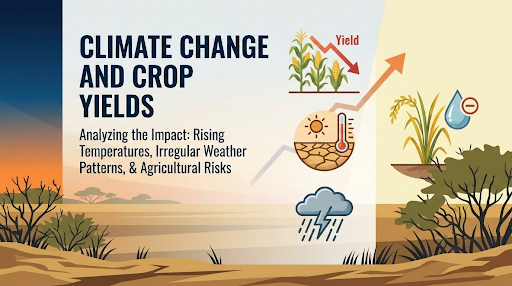
The study, titled “Climate Change and Crop Yields in India”, reveals that just 1°C of warming slashes India's average crop yields by 8%.
Highlights of the “Climate Change and Crop Yields in India” Study
It is a joint study by the Centre for Study of Science, Technology, and Policy, the Centre for Social and Economic Progress, and Monash University analyzing climate impacts on Indian agriculture.
Impact on Crop Yields
National Yield Reduction: Every 1°C temperature increase slashes the national average crop yield across India by approximately 8%.
Rice Production: Rainfed rice yields face a projected reduction of 20% by 2050 and 47% by 2080. Irrigated rice faces yield reductions of 3.5% by 2050 and 5% by 2080.
Wheat Vulnerability: Rising temperatures will cause wheat yields to decline by 19.3% by 2050 and up to 40% by 2080.
Coarse Cereals: A 1°C warming damages coarse grains, dropping pearl millet yields by 19.1% and maize yields by 16.2%.
Regional Threats: A Punjab Agricultural University (PAU) study predicts that climate change will shrink maize, cotton, wheat, and potato yields in Punjab by 1% to 13% by 2050, and these losses will potentially double to 24% by 2080.
Loss of Progress: Climate shocks erase years of agricultural progress; just a 1°C warming nullifies about four years of productivity gains for rice and wheat.
Environmental and Ecological Consequences
Soil Degradation: Rising temperatures and erratic rainfall deplete soil organic carbon, accelerate organic matter decomposition, and compromise long-term soil fertility.
Water Scarcity: Altered monsoon behaviors and prolonged droughts reduce groundwater recharge, dry up surface water, and escalate competition across agricultural and industrial sectors.
Per Capita Water Drop: Projections show India's per capita water availability will decline to a severe scarcity level of 1,140 cubic meters per year by 2050.
Pest and Disease Outbreaks: Warmer climates expand the geographic ranges of pests. This increases the incidence of major crop pests (like Spodoptera litura and Helicoverpa armigera), forcing farmers to increase their reliance on chemical pesticides.
Economic and Socio-Economic Impacts
Income Loss and Poverty: Declining crop yields directly reduce farm incomes, exacerbate rural poverty, and threaten national food security.
Inflationary Pressures: Widespread yield losses artificially inflate food prices, which erodes purchasing power and disproportionately harms low-income households.
Escalating Input Costs: Farmers must spend more money on advanced technologies, irrigation systems, and drought-resistant seeds to combat extreme weather, escalating their overall production costs.
Distress Leasing: Unpredictable monsoons force many farmers to abandon rainfed agriculture. They resort to distress leasing, surrendering prime agricultural land to utility-scale solar parks, and migrating to urban centers for wage labor.
Farmer Suicides: National Crime Records Bureau (NCRB) reported over 10,500 farm sector suicides in 2024. Shockingly, agricultural labourers account for the majority (56%) of these tragedies.
Vulnerable Populations: Marginalized groups, including smallholder farmers, women, and tribal communities, lack access to credit and technology, making them the most vulnerable to climate-induced economic shocks.
Government Initiatives and Policy Frameworks
National Innovations in Climate Resilient Agriculture (NICRA): Indian Council of Agricultural Research (ICAR) conducts strategic research, executes technology demonstrations in 100 highly vulnerable districts, and builds institutional capacity.
National Action Plan on Climate Change (NAPCC): Provides a policy framework to ensure ecological sustainability.
National Mission for Sustainable Agriculture (NMSA): Implements localized strategies under NAPCC, promoting integrated nutrient management and soil health restoration.
Pradhan Mantri Krishi Sinchayee Yojana (PMKSY): Drives the "Per Drop More Crop" mandate to expand micro-irrigation and elevate water productivity.
Pradhan Mantri Fasal Bima Yojana (PMFBY): Delivers a comprehensive crop insurance safety net, offering financial support to farmers who suffer crop losses from unforeseen natural disasters.
Gramin Krishi Mausum Seva (GKMS): India Meteorological Department (IMD) partners with ICAR to distribute biweekly Agro-Met Advisory Services (AAS), giving farmers an early warning system for heat waves and storms.
Agronomic Adaptation and Mitigation Strategies
Early Sowing: Farmers advance sowing dates by 7-10 days to help winter crops (like wheat) escape terminal heat stress during the critical grain-filling stage.
Conservation Agriculture (CA): Farmers implement zero tillage and crop residue retention to improve soil moisture, regulate soil temperature, and boost yields under drought conditions.
Micro-Irrigation: Expanding drip and sprinkler irrigation systems enhances water-use efficiency and reduces dependence on erratic rainfall.
Agroforestry: Integrating trees with crops moderates extreme microclimates, enhances water-holding capacity, and diversifies rural income through timber and fruit production.
Methane Reduction: Shifting from flooded paddy fields to Direct-Seeded Rice (DSR) or Alternate Wetting and Drying (AWD) reduces methane (CH₄) emissions from the agricultural sector.
Source: DOWNTOEARTH.
|
PRACTICE QUESTION Q. Evaluate the socio-economic consequences of climate change on marginalized farming communities and agricultural labourers. 150 words |
A mere 1°C warming slashes the national average crop yield by about 8%, effectively erasing four years of productivity gains for critical staples like rice and wheat.
Rainfed rice, wheat, maize, and pearl millet exhibit extreme vulnerability. Projections indicate wheat yields may plummet by up to 40% by 2080, while pearl millet yields drop by 19.1% under a 1°C warming scenario.
Climate change actively escalates production costs, triggers frequent crop failures, and reduces farm incomes. These pressures force marginalized farmers and agricultural labourers into severe debt, distress land leasing, and contribute to rising farmer suicide rates.




© 2026 iasgyan. All right reserved