India's agrarian crisis is driven by severe rural indebtedness, erratic climate change, and unstable markets. Despite government schemes, farmer suicides persist, disproportionately impacting marginalized groups and women farmers. Making Minimum Support Price (MSP) a legal right remains fiercely debated.
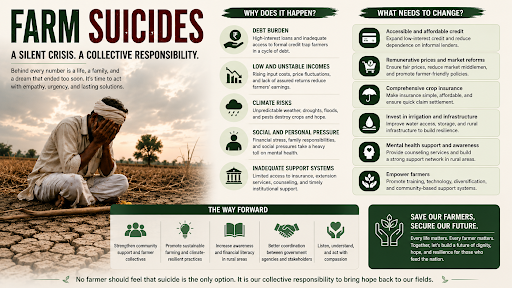
The National Crime Records Bureau (NCRB) report shows that at least one person in the farm sector dies by suicide every hour, even though the overall numbers dipped marginally in 2024.
Farm suicides represent agrarian distress where farmers and agricultural laborers end their lives due to unbearable socio-economic, psychological, and environmental pressures.
What Are the Major Causes Behind Farm Suicides?
Indebtedness and the Debt Trap: Inability to repay loans, fueled by exorbitant interest rates from informal moneylenders => Primary driver of the farm suicide crisis.
Crop Failure and Climate Stress: Vulnerability to erratic monsoons, prolonged droughts, pest attacks, and climate change devastates yields and livelihoods.
Market Volatility and Poor Price Realization: Absence of assured procurement and exposure to global market fluctuations often push selling prices far below the cost of production.
Rising Input Costs: Escalating costs of commercial seeds, chemical fertilizers, and pesticides outpace the Minimum Support Price (MSP).
Inadequate Institutional Support: Small and marginal farmers face severe barriers to accessing institutional credit, effective crop insurance, and timely government compensation.
Social and Cultural Pressures: Social obligations, such as wedding expenses and dowry demands, force farmers into multi-generational debt servitude.
High Mortality: NCRB recorded 10,786 agricultural sector suicides in 2023, and 10,546 deaths in 2024.
Daily Tragedies: Despite marginal dips, approximately 28 farmers and agricultural laborers end their lives every single day. (Source: NCRB)
Vulnerability of Agricultural Laborers: Deaths among landless agricultural laborers outnumber cultivators, accounting for 56% of farm suicides in 2024. (Source: NCRB)
Regional Hotspots: Concentrated in Southern and Western India, with Maharashtra, Karnataka, Andhra Pradesh, Telangana, and Madhya Pradesh accounting for over 70% of all cases. (Source: NCRB)
Disproportionate Risk: Suicide rate among the farming community is higher—nearly 20% higher than the national average for all professions. (Source: NCRB)
Statistical Erasure of Women: Women farmers are underrepresented in official data, frequently misclassified as "housewives" simply because they lack formal land titles. (Source: NCRB)
Pradhan Mantri Fasal Bima Yojana (PMFBY): Crop insurance scheme introduced to mitigate financial distress from crop losses caused by natural calamities and pests.
PM-KISAN (Pradhan Mantri Kisan Samman Nidhi): Direct benefit transfer program providing basic income support of ₹6,000 annually to small and marginal farmers.
Kisan Credit Card (KCC) Scheme: Offer short-term agricultural credit at subsidized interest rates, reducing dependency on exploitative informal lenders.
Debt Waiver Packages: Periodic implementations of large-scale agricultural debt waivers, such as the 2008 package that wrote off ₹60,000 crore for millions of farmers.
MGNREGA (Mahatma Gandhi National Rural Employment Guarantee Act): Provides up to 100 days of guaranteed wage employment to rural households, offering alternative income during droughts and off-seasons.
State-Level Investment Support: Regional programs like Rythu Bandhu in Telangana and Krishak Bandhu in West Bengal that offer direct investment assistance for cultivation.
Comprehensive Debt Relief and Credit Reform: Institutionalize debt relief programs while expanding accessible institutional credit through cooperatives.
Legal Guarantee for MSP: Grant statutory backing to the Minimum Support Price (MSP) to shield farmers from market volatility and assure remunerative procurement.
Secure Women's Land Rights: Recognize women as farmers by establishing joint or independent land titles, ensuring their access to credit, subsidies, and compensation.
Promote Agroecology and Crop Diversification: Shift from chemical-heavy mono-cropping toward sustainable, climate-resilient agriculture by incentivizing the cultivation of millets, pulses, and oilseeds.
Revamp Crop Insurance: Overhaul the PMFBY to ensure simplified enrollment, transparent assessments, and rapid claim settlements that align with actual production costs.
Invest in Agricultural Infrastructure: Improve rural infrastructure through scientific watershed development, cold storage networks, and efficient micro-irrigation systems, to increase farmer’s income and boost rural development.
Overcoming agrarian crisis demands transitioning from temporary relief to systemic, gender-just transformations that ensure ecological sustainability, equitable resource distribution, and guaranteed livelihood security for all farming communities.
Source: DOWNTOEARTH
|
PRACTICE QUESTION Q. Discuss the root causes of the farmer suicide crisis in India. How do factors like rural indebtedness and extreme climate change exacerbate this tragedy? 250 words |
Severe indebtedness and the debt trap are the primary causes, heavily exacerbated by reliance on informal moneylenders who charge exorbitant interest rates.
Despite comprising 77% of the rural female workforce in agriculture, women hold only 15% of operational landholdings. This patriarchal exclusion denies them access to institutional credit, subsidies, and relief compensation.
A legally binding Minimum Support Price (MSP) would guarantee a fixed price floor, protecting farmers from market fluctuations, middlemen exploitation, and ruinous distress sales.




© 2026 iasgyan. All right reserved