Based on 28 years of National Crime Records Bureau data, India’s agrarian crisis has taken over 394,000 lives, resurging in 2023, especially in Maharashtra and Karnataka. Distress now hits landless labourers harder. Debt, costly inputs, and policy gaps persist. Relief like MGNREGA helped briefly; durable solutions need Swaminathan Commission reforms, climate resilience, and stronger markets.
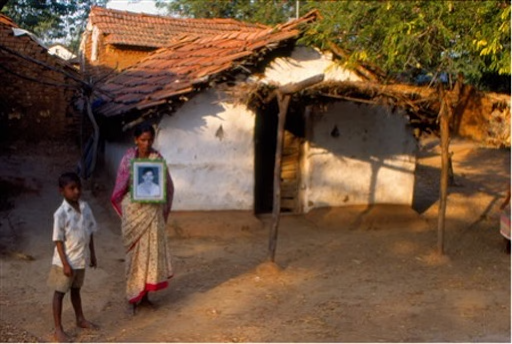
Copyright infringement not intended
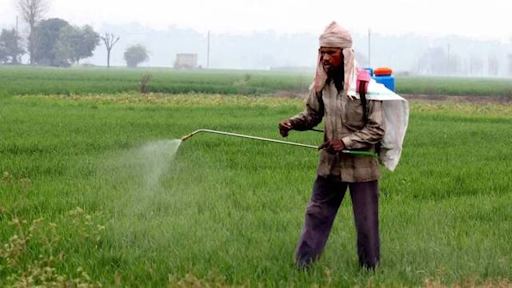
Picture Courtesy: DOWNTOEARTH
Maharashtra and Karnataka have been the consistent epicenters of farmer suicides for over two decades, according to a 28-year analysis of National Crime Records Bureau (NCRB) data.
Farmer suicide in India is a persistent, complex socio-economic crisis. Thousands of farmers and laborers take their lives yearly due to economic distress, environmental shocks, and inadequate policies.
Key Data and Recent Trends
Based on the analysis of National Crime Records Bureau (NCRB) data from 1995 to 2023, Maharashtra and Karnataka are the primary epicenters of India's agrarian crisis.
State-Specific Statistics (2023)
Key Drivers of the Crisis
National Trends and Shifts
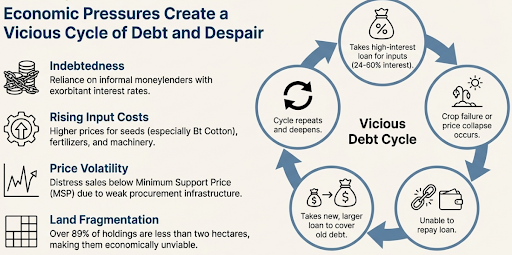
Economic Factors
Environmental Factors
Social and Policy Factors
Kisan Credit Card (KCC) Limit Hike: Enabling farmers to secure cheap institutional credit (4% with timely repayment) for higher operational costs and decrease reliance on informal moneylenders.
PM-KISAN: The scheme provides ₹6,000 annually directly to farmers in 3 equal installments.
Viksit Bharat-G RAM G Act, 2025
The government replaced MGNREGA with the Viksit Bharat-Guarantee for Rozgar and Ajeevika Mission (Gramin) Act, 2025, a statutory change to address rural distress and drought-driven migration.
PM Dhan-Dhaanya Krishi Yojanaa: A new scheme targets 100 low-productivity (often drought-prone) districts to boost yield via site-specific interventions, improved irrigation, and crop diversification.
National Mission on Natural Farming (NMNF): The mission launched to promote chemical-free farming to lower costs, boost soil water retention, and improve climate resilience.
Pradhan Mantri Fasal Bima Yojana (PMFBY): Subsidized crop insurance scheme that provides financial support to farmers against crop loss due to natural calamities, pests, diseases, and wild animal attacks.
Implementation Gaps: Many well-intentioned schemes suffer from poor last-mile delivery, corruption, and bureaucratic delays, preventing benefits from reaching the most vulnerable.
Lack of Awareness: Many farmers, especially small and marginal ones, don't know about or how to use the available schemes.
Inadequate Insurance Penetration: Despite PMFBY, a large number of farmers remain outside the insurance net, and claim settlements are often delayed.
Social Obligations: High expenditures on social ceremonies, medical emergencies, and education further drive families into debt cycles that the agricultural income cannot cover.
Structural Issues: Problems like land fragmentation, poor irrigation, and weak market linkages are yet to be fully addressed.
Mental Health Stigma: Chronic distress is often compounded by the social shame of bankruptcy and the lack of accessible mental health services in rural areas.
Strengthening Institutional Credit: Ensuring timely and adequate access to formal credit for all farmers, especially small and marginal ones, through simplified procedures.
Income Diversification: Promoting allied activities like dairy farming, poultry, horticulture, and agro-forestry to reduce sole dependency on crop cultivation and provide alternative income streams.
Ensuring Remunerative Prices: Strengthening the MSP regime with a robust procurement mechanism and reforming agricultural markets to ensure farmers get a fair price for their produce.
Mental Health Support: Expanding access to mental health counseling and creating community-based support systems to destigmatize mental health issues in rural India.
Implement Swaminathan Commission Report: The core recommendation of providing an MSP of at least 50% above the comprehensive cost of production (C2) needs to be addressed to ensure farming is profitable. Other recommendations on land reforms, credit, and irrigation also need urgent attention.
Strengthen Agricultural Markets: As suggested by the Ashok Dalwai Committee on Doubling Farmers' Income, reforms should focus on:
Build Climate Resilience: Increase public investment in micro-irrigation (drip and sprinkler), watershed management, and rainwater harvesting. Promote research and adoption of drought-resistant crop varieties.
Learn from International Best Practice
To end the crisis of farmer suicides in India, a holistic solution is needed, combining government safety nets with systemic changes to address agrarian distress, ensure fair income, build climate resilience, and provide accessible mental health support.
Source: DOWNTOEARTH
|
PRACTICE QUESTION Q. The crisis of farmer suicides in India is more a result of policy paralysis than natural calamities. Critically analyze. 250 words |
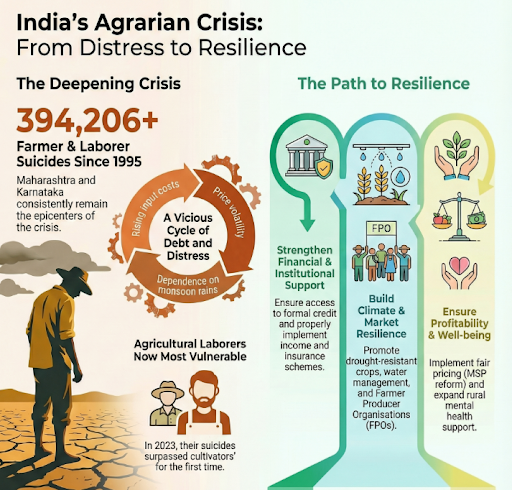
Analysis of official National Crime Records Bureau (NCRB) data reveals that between 1995 and 2023, more than 394,206 farmers and agricultural labourers in India died by suicide, highlighting a severe and persistent crisis in the agricultural sector.
The crisis is heavily concentrated in Southern and Western India, which account for nearly 72.5% of all farmer suicides. Maharashtra and Karnataka are the consistent epicentres, with suicide rates about 2.5 times the national average.
The primary drivers are chronic indebtedness due to rising input costs and volatile prices, dependence on high-cost technologies like Bt cotton, market and price failures, inadequate irrigation, and ineffective implementation of policies like crop insurance.



© 2026 iasgyan. All right reserved