The proposed VB-G RAM G Bill seeks to replace MGNREGA, raising workdays to 125 but shifting from a rights-based, demand-driven scheme to a budget-capped model. Greater central control, higher state cost sharing and work-pause provisions risk centralisation and dilution of the rural poor’s right to work.
Copyright infringement not intended
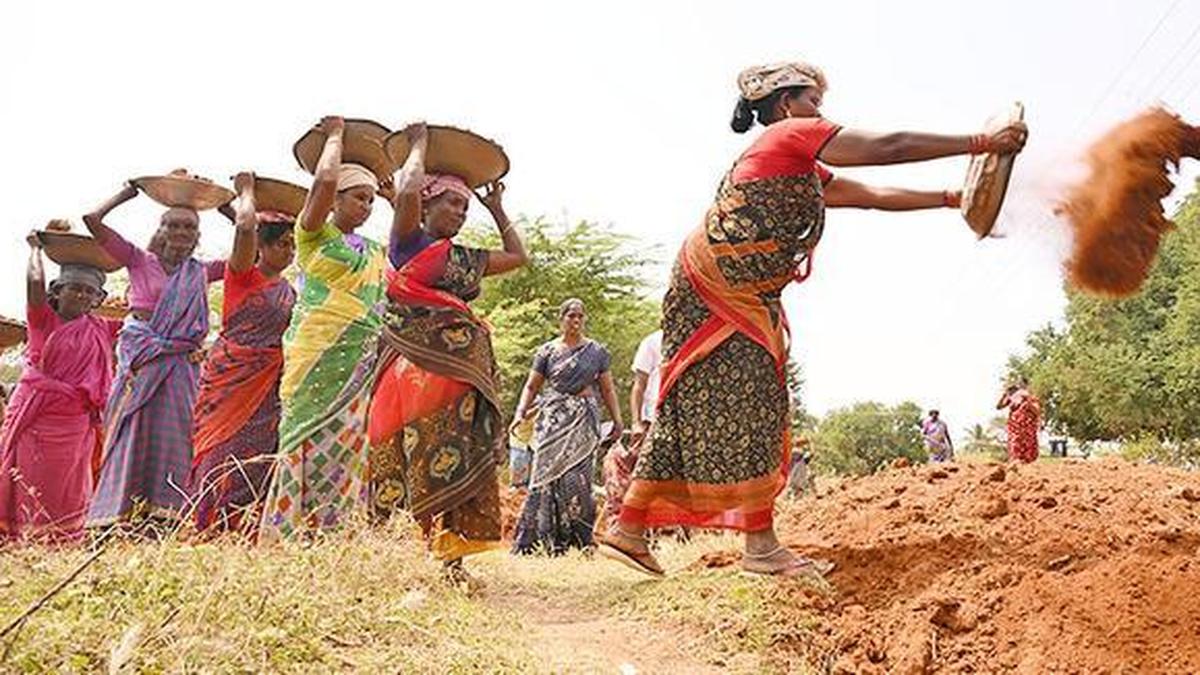
Picture Courtesy: THE HINDU
The Union government introduced new legislation titled the "Viksit Bharat — Guarantee For Rozgar And Ajeevika Mission (Gramin)" (VB-GRAM G) Bill 2025 to replace the Mahatma Gandhi National Rural Employment Guarantee Act (MGNREGA) 2005.
|
Read all about: Mahatma Gandhi National Rural Employment Guarantee Act l Centre's spending cap on MGNREGS |
It is a strategic replacement for the Mahatma Gandhi National Rural Employment Guarantee Act (MGNREGA), 2005.
It aims to create sustainable livelihood and durable rural infrastructure, aligning with the Viksit Bharat 2047 vision.
It shifts focus from temporary wage employment to long-term economic empowerment through its twin objectives.
Why a New Law? Shortcomings of MGNREGA
Structural Outdatedness
Transformed Rural Economy: Designed in 2005 when rural poverty was 25.7% (2011–12), officials argue MGNREGA's "open-ended" model is outdated. With poverty falling to 4.86% (2023–24) and better digital access and diverse rural livelihoods, the old model no longer fits the current reality. (Source: PIB)
Fragmented Planning: MGNREGA works were often scattered. The new law mandates localized, spatially integrated planning via "Viksit Gram Panchayat Plans," connecting to national systems like PM Gati-Shakti.
Persistent Systemic Failures
Misuse of Funds: Over ₹193 crore in misappropriations were flagged in 2024–25.
Non-existent Work: Audits revealed "ghost assets" where money was spent on projects that were never built.
Inefficient Financial Model
Unpredictable Budgeting: The old "demand-based" model led to constant funding gaps. The new law uses "normative funding" based on objective local data.
Lack of State Accountability: Centre paid 100% of unskilled wages, states had little incentive to curb leakages. The new law shifts to a 60:40 cost-sharing model.
Failure to Provide Security
Underutilization: Despite the "100-day guarantee," the national average was only 50 days, and only 7.6% of households reached the full limit in recent years. (Source: Ministry of Rural Development)
Payment Delays: Chronic delays in wage payments due to "last-mile" digital issues and fund crunches discouraged workers from participating.
Labor Market Distortions
Agricultural Conflict: The new law introduces a 60-day "no-work" period during peak farming seasons (harvest and sowing) to prevent competition for labor, support food security, and stabilize farm wages.
|
Feature |
MGNREGA (Existing) |
VB-G RAM G Bill (Proposed) |
|
Employment Guarantee |
100 days of unskilled manual work per household. |
125 days of work per household. |
|
Nature of Work |
Primarily unskilled manual labour, often with scattered projects. |
Strategic asset creation organised under four priority verticals (Water Security, Core Rural Infra, Livelihood Infra, Climate Mitigation). |
|
Funding Model |
Demand-driven. Union bears 100% of unskilled wage cost and 75% of material cost. |
Normative funding model with Centre-State cost sharing: 60:40 for most states and 90:10 for North-Eastern & Himalayan states. |
|
Work Availability |
Work provided on demand throughout the year. |
Includes a provision for a 60-day pause during peak agricultural seasons (sowing/harvesting) to ensure farm labour availability. |
|
Asset Management |
Assets are geo-tagged but planning is often fragmented. |
Assets consolidated into a Viksit Bharat National Rural Infrastructure Stack, integrated with PM Gati-Shakti for unified planning. |
|
Governance & Monitoring |
Relies on social audits, geo-tagging, and direct benefit transfers (DBT). |
Mandates mandatory biometric authentication, real-time monitoring via apps, AI-based fraud detection, and satellite imagery. |
State Capacity: Shift to a 60:40 cost-sharing model places a greater financial burden on states, which could lead to uneven implementation, especially in poorer states.
Administrative Preparedness: Success depends on the capacity of local bodies to undertake sophisticated, spatially integrated planning.
Technology Dependence: Heavy reliance on digital tools like biometric authentication carries the risk of digital exclusion for marginalised communities and potential disruptions due to technical glitches.
Weakening of Rights: Critics argue that shifting from a 'demand-driven' to a 'normative allocation' model, along with the agricultural pause, could dilute the legal right to work, making it more dependent on budget availability.
Migration: By providing more workdays (125) and focusing on livelihood-enhancing assets, the bill aims to improve local income security and reduce distress migration to urban areas.
Gender Empowerment: MGNREGA saw 59.4% women's participation in FY 2024-25. The new bill's focus on local livelihood infrastructure will further empower women with more work opportunities.
Rural Inequality: While technology aims to curb elite capture, robust and independent social audits and grievance redressal mechanisms will ensure benefits reach the most vulnerable sections of society.
Phased Rollout: A pilot-based implementation in diverse regions can help identify ground-level challenges before a nationwide scale-up.
Capacity Building: Intensive training and capacity building for Panchayati Raj Institutions (PRIs) are essential for effective decentralised planning.
Fiscal Support: The Centre must ensure a realistic and supportive fiscal framework for states, preventing financial constraints from hindering the legal guarantee.
Focus on Quality: The primary measure of success should be the quality and economic utility of assets created, not merely the number of workdays provided.
The bill aligns with the Directive Principles of State Policy (DPSP), particularly Article 41 (Right to Work) and Article 38 (Social Justice). By aiming to create a productive rural workforce, it seeks to harness India's demographic dividend for nation-building.
Source: THE HINDU
|
PRACTICE QUESTION Q. Critically analyze the proposed shift from a demand-driven, rights-based framework under MGNREGA to a supply-driven, budget-capped model under the VB-GRAM G Bill. 150 words |
The "Viksit Bharat — Guarantee For Rozgar And Ajeevika Mission (Gramin)" (VB-GRAM G) Bill, 2025, is a proposed legislation by the Union government to replace the Mahatma Gandhi National Rural Employment Guarantee Act (MGNREGA), 2005.
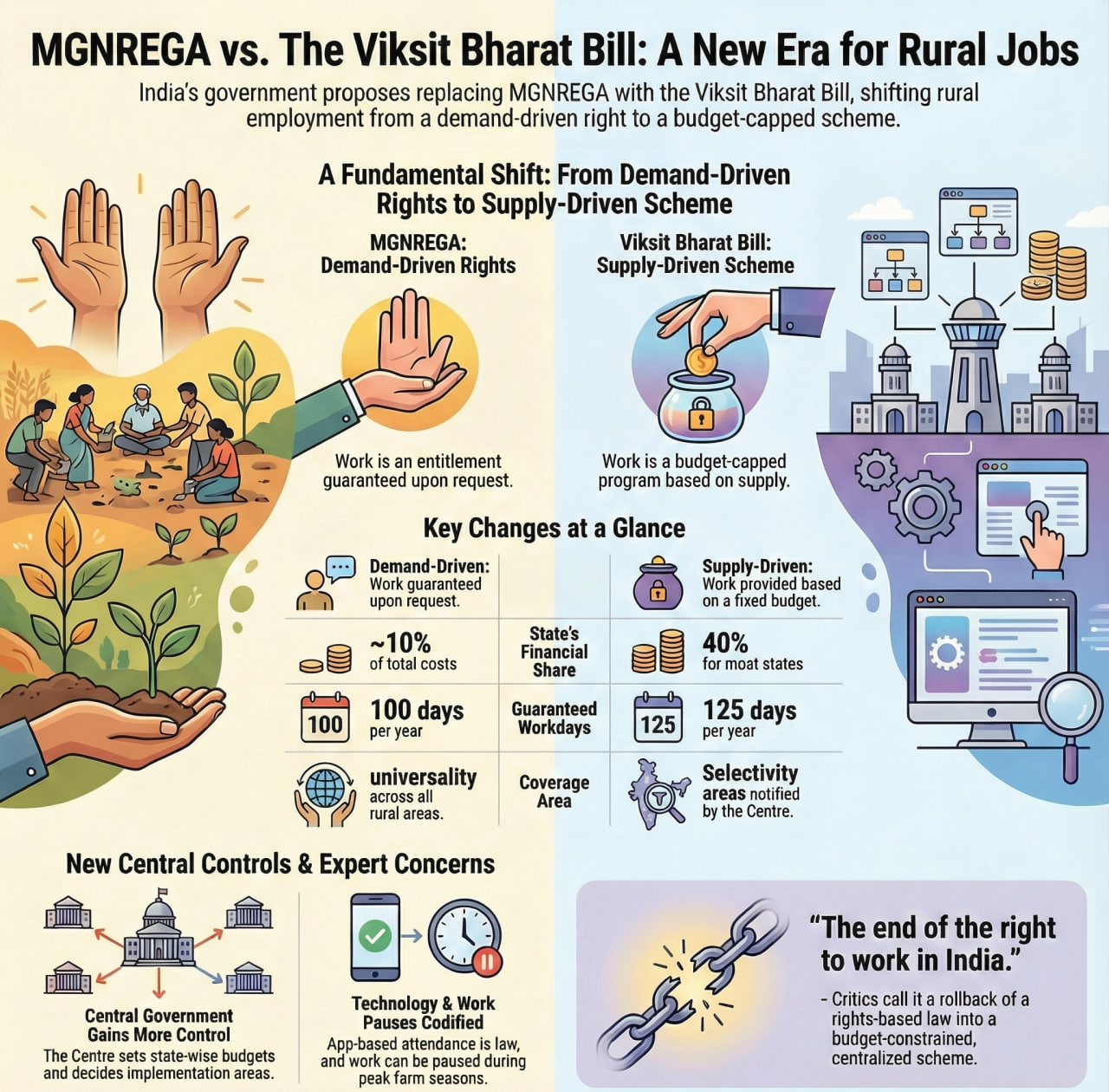
The fundamental difference is the operational model. MGNREGA is a demand-driven, rights-based scheme where the government is legally obligated to provide work when demanded. The VB-GRAM G Bill proposes a supply-driven model, where the government provides work based on a pre-allocated, capped budget.
Critics are concerned that the shift to a supply-driven, budget-capped model erodes the "right to work," the increased financial burden will discourage states from effective implementation, and provisions allowing central notification of areas undermine federalism and decentralized planning.





© 2026 iasgyan. All right reserved