The Petersberg Climate Dialogue is an informal annual forum hosted by Germany to build consensus before COP. The 2026 edition focused on electrification and NCQG finance, while India championed Climate Justice, LiFE, and the financial obligations of developed nations.
Why In News?
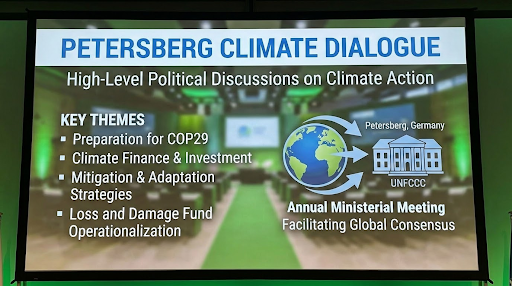
The 17th Petersberg Climate Dialogue in Berlin focused on accelerating electrification to strengthen energy security amid geopolitical tensions, serving as a key precursor to COP31 in Türkiye.
What is the Petersberg Climate Dialogue?
It is an annual high-level ministerial meeting that acts as a "pre-negotiation" forum to build political consensus ahead of UN Climate Change Conferences (COP).
Origin
Operational Mechanism
The 17th Petersberg Climate Dialogue
India’s Stance and Strategic Interests
India utilizes the PCD as a non-binding forum to vocalize the concerns of Global South interests.
Source: DOWNTOEARTH
|
PRACTICE QUESTION Q. Consider the following statements regarding the Petersberg Climate Dialogue (PCD): 1. It is a formal, binding negotiating body under the United Nations Framework Convention on Climate Change (UNFCCC). 2. It is hosted annually by Germany and co-chaired by the country designated to host the upcoming COP. Which of the statements given above is/are correct? a) 1 only b) 2 only c) Both 1 and 2 d) Neither 1 nor 2 Answer: b Explanation: Statement 1 is incorrect: The PCD is described as an informal high-level forum designed for open, frank discussions among ministers to build trust and strengthen multilateral climate negotiations. It is not a formal, binding negotiating body under the UNFCCC. Statement 2 is correct: The PCD is hosted annually by Germany (since 2010) and is regularly co-chaired by the country designated to host the upcoming Conference of the Parties (COP). |
The PCD is an annual, informal political forum initiated by former German Chancellor Angela Merkel in 2010. It brings together ministers and high-level officials from over 40 countries to openly debate and resolve contentious climate issues ahead of the formal UN Climate Change Conferences (COP).
The dialogue is hosted annually in Berlin, Germany. It is uniquely co-chaired by Germany alongside the country that is designated to host the upcoming UN Climate Change Conference (COP). For example, Türkiye and Australia co-hosted the 17th PCD alongside Germany.
India strongly advocates for the principle of Common but Differentiated Responsibilities and Respective Capabilities (CBDR-RC). India pushes for the reform of Multilateral Development Banks (MDBs) to ensure accessible, concessionary climate finance and firmly opposes unilateral trade barriers like the EU's Carbon Border Adjustment Mechanism (CBAM).

© 2026 iasgyan. All right reserved