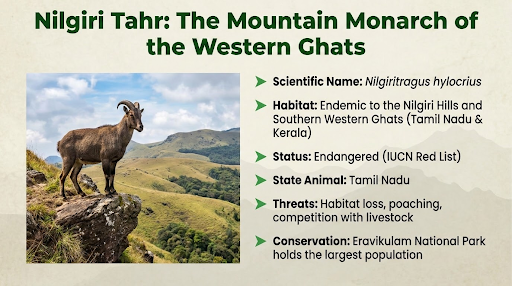
The Nilgiri Tahr, Tamil Nadu's state animal, is an Endangered mountain ungulate endemic to the Western Ghats. The 2026 synchronized survey utilized the 'Varudai' app to estimate populations across fragmented shola-grassland habitats in Tamil Nadu and Kerala.
Why In News?
The Tamil Nadu Forest Department has initiated the third synchronized survey of the Nilgiri Tahr, covering a 3,100 km range across the Western Ghats to ensure accurate population estimation.
About Nilgiri Tahr
The Nilgiri Tahr (Nilgiritragus hylocrius), locally known as Varudai, is the only mountain ungulate in southern India.
As the State Animal of Tamil Nadu, it serves as an indicator species for the health of the high-altitude shola-grassland ecosystem of the Western Ghats.
Biological and Ecological Profile
Conservation Status
Recent Survey
In April 2026, the Tamil Nadu Government launched the Third Synchronized Nilgiri Tahr Survey.
Project Nilgiri Tahr
Launched by the Tamil Nadu government in 2022-23 with an outlay of ₹25.14 crore, this is India’s first state-led project dedicated to a specific ungulate.
Objectives:
Source: THEHINDU
|
PRACTICE QUESTION Q. Consider the following statements regarding the Nilgiri Tahr:
Which of the statements given above is/are correct? A) 1 and 2 only B) 2 only C) 2 and 3 only D) 1, 2, and 3 Answer: B Explanation: Statement 1 is incorrect: The Nilgiri Tahr is endemic to the Western Ghats of South India, not the Himalayas. It is recognized as the only mountain ungulate found in Southern India. Statement 2 is correct: The Nilgiri Tahr (Nilgiritragus hylocrius) is the official state animal of Tamil Nadu. Statement 3 is incorrect: On the IUCN Red List, the Nilgiri Tahr is categorized as 'Endangered', not 'Critically Endangered'. |
The Nilgiri Tahr is classified as "Endangered" on the IUCN Red List due to its restricted and highly fragmented habitat. In India, it receives the highest degree of legal protection under Schedule I of the Wildlife Protection Act, 1972.
Launched by the Tamil Nadu government in 2022-23, it is India’s first state-led conservation project dedicated to a specific ungulate. The project aims to restore shola-grasslands, treat diseases in wild herds, and reintroduce the Tahr to its historical, vacant habitats.
Eravikulam National Park in Kerala currently hosts the largest single contiguous population of Nilgiri Tahrs in the world, largely due to successful community-led protection models involving indigenous tribes.




© 2026 iasgyan. All right reserved