Light pollution is the excessive or inappropriate use of outdoor artificial light. It disrupts ecosystems, affects human health by interfering with sleep-regulating hormones like melatonin, and obscures our view of the stars and the Milky Way.
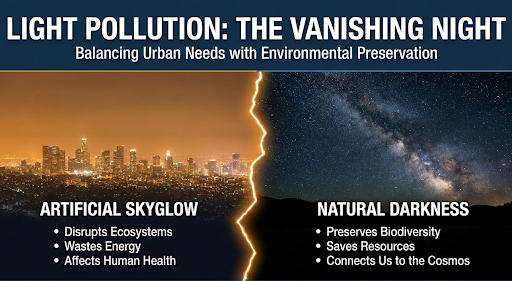
Light pollution, driven by excessive urban artificial lighting, is affecting astronomical observations in Chile's Atacama Desert and disrupting global nocturnal ecosystems.
Light pollution is the presence of anthropogenic (human-made) light in the night environment at levels that are excessive or harmful.
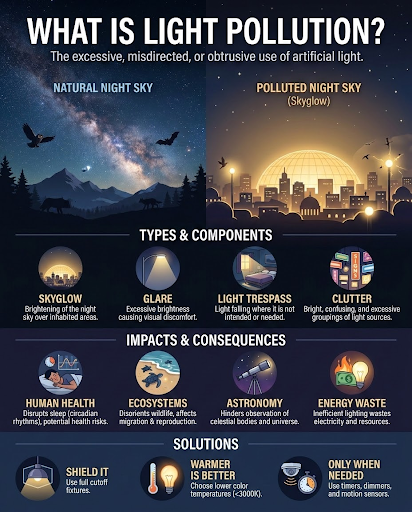
Light pollution is classified into four types based on how the light is dispersed:
The "LED Revolution": Replacing sodium-vapor lamps with Blue-rich White LEDs increases atmospheric scattering and skyglow.
Urbanization: Expanding cities and infrastructure utilize unshielded fixtures, allowing light to escape in all directions.
Safety Misconceptions: The unproven belief that more light ensures safety causes over-illumination in residential and commercial zones.
Commercial Advertising: Massive Digital Billboards and LED-covered facades generate intense light clutter and glare.
Satellite Mega-Constellations: Reflective satellites disrupt astronomical observations, even in remote regions like the Atacama Desert.
Human Health: Chronic exposure to artificial light at night suppresses melatonin production, disrupting the circadian rhythm. This is linked to sleep disorders, obesity, diabetes, and an increased risk of certain cancers.
Wildlife and Ecosystems:
Astronomy: Skyglow acts as a "luminous fog," preventing telescopes from capturing faint light from distant galaxies.
Growth Rate: India is experiencing one of the fastest increases in light pollution globally due to rapid urbanization. Between 2012 and 2016, India’s "lit area" grew by 33%. (Source: Science Advances)
The LED Transition: Under the SLNP (Street Lighting National Programme), India has replaced millions of conventional lamps with LEDs. While energy-efficient, the high "blue light" content has increased skyglow in cities.
Urban vs Rural Divide: While Tier-1 cities like Delhi and Mumbai are heavily over-lit, rural areas are rapidly losing their dark skies to new highway lighting and industrial corridors.
Hanle Dark Sky Reserve (HDSR): Established in 2022 in Ladakh's Changthang Wildlife Sanctuary, it protects skies around the Indian Astronomical Observatory.
BEE Standards: Bureau of Energy Efficiency (BEE) guidelines for outdoor lighting promote "warm" temperatures to reduce blue light scattering.
Coastal Regulations: States like Odisha restrict seasonal lighting near Olive Ridley Turtle nesting sites to prevent hatchling disorientation.
Global Initiatives: As a Convention on Migratory Species (CMS) signatory, India follows 2022 guidelines to mitigate light pollution's impact on wildlife.
Safety-Brightness Paradox: The misconception that "brighter is safer" causes over-illumination, where glare creates hazardous shadows.
Technological Rebound Effect: Cheaper, efficient LEDs led cities to increase light installations rather than reducing energy use.
Regulatory Gap: The Environment (Protection) Act, 1986 does not define light as a pollutant, leaving it unmonitored.
Blue Light Dilemma: Commercial LEDs emit disruptive blue light that scatters easily, harming circadian rhythms and wildlife.
Economic Priorities: Developing nations often prioritize infrastructure lighting over dark sky preservation, viewing the latter as a luxury.
Policy Integration: India must integrate light pollution standards into its National Environmental Policy. Key actions include creating "Dark Sky Zones" near observatories and sanctuaries.
The 3-S Strategy (Shielding, Spectrum, Scheduling):
Promoting Astro-Tourism: Following the Hanle model, creating "Dark Sky Parks" can generate revenue for local communities, providing a socio-economic incentive to keep skies dark.
Public Awareness: Educating citizens and urban planners that "better lighting" does not mean "more lighting" but rather "smarter lighting".
India must scale "Smart Lighting" and legal frameworks beyond the Hanle Dark Sky Reserve to urban and coastal regions, balancing development with the preservation of nocturnal ecosystems and human health.
Source: THEHINDU
|
PRACTICE QUESTION Q. "Artificial Light at Night (ALAN) is an overlooked environmental pollutant that poses severe threats to biodiversity and human health." Discuss. 150 Words |
Light pollution, or Artificial Light at Night (ALAN), refers to the excessive, misdirected, or obtrusive use of artificial outdoor lighting. It is a human-caused alteration of natural light levels that degrades the nocturnal environment.
The four primary types are Skyglow (brightening of the night sky over cities), Light Trespass (unwanted light spilling onto adjacent properties), Glare (excessive brightness causing visual discomfort), and Clutter (confusing groupings of light sources).
It disrupts the human circadian rhythm by suppressing melatonin production. Prolonged exposure to excessive artificial light at night is linked to sleep disorders, metabolic disruptions (like insulin resistance), and an increased risk of hormone-dependent cancers.

© 2026 iasgyan. All right reserved