Green methanol is vital for India's 2070 net-zero goal. It reduces emissions and import dependence. Despite high costs, policies like the National Green Hydrogen Mission can make India a global leader in clean energy.
Why In News?
India inaugurated its first green methanol plant in Kutch, Gujarat. The facility converts the invasive Prosopis juliflora shrub, known as 'Gando Baval' in the Banni grasslands, into sustainable fuel.
What is Green Methanol?
Methanol (CH₃OH) is the simplest alcohol and presents as a flammable, colorless liquid at ambient temperatures.
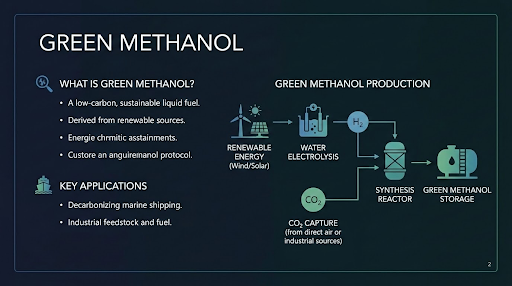
Traditional methanol comes from fossil fuels, but green methanol uses renewable feedstocks like biomass, waste, or green hydrogen synthesized with captured CO₂.
According to the Ministry of New and Renewable Energy (MNRE), Green Methanol is defined by a specific emission threshold:
Why is Green Methanol important for India?
Reducing Import Dependence: Blending 15% methanol in gasoline can result in at least a 15% reduction in India's crude oil imports, saving billions annually. (Source: NITI Aayog)
Decarbonizing Shipping: The Ministry of Ports, Shipping and Waterways is converting vessels to run on green methanol to meet international emission standards, as it emits near-zero particulate matter and sulphur oxides.
Waste-to-Wealth: It allows India to utilize its biomass resources (500 million tonnes annually) and municipal solid waste, solving waste management issues while producing energy. (Source: NITI Aayog)
Energy Security: It serves as a sustainable alternative for cooking fuel (partially replacing LPG) and transportation, reducing reliance on volatile global fossil fuel markets.
Emissions Mitigation: The Kutch plant is expected to cut 30,000 tonnes of annual CO₂ emissions by replacing fossil marine fuels.
Invasive Species Management: Production uses Prosopis juliflora, a weed affecting 1.5 million hectares, to restore ecological balance.
How does the Green Methanol production process work?
Bio-methanol via Gasification: Feedstocks like agricultural residues, municipal solid waste, or invasive weeds are pretreated and gasified to create syngas (a mix of CO, CO₂, H₂, and H₂O).
E-methanol (Power-to-X): This involves a catalytic process that synthesizes captured CO₂ and green hydrogen.
National Thermal Power Corporation (NTPC) launched a plant in Vindhyachal that produces 180 kg of methanol daily by combining 500 kg of CO₂ captured from thermal power emissions with hydrogen.
What are the key applications of Green Methanol?
Marine Fuel: Green methanol is becoming a preferred fuel for short-sea and coastal shipping, supported domestically by initiatives like the Green Tug Transition Programme.
Transportation Fuel: Methanol can be utilized directly in internal combustion engines, blended with gasoline, or used as a hydrogen carrier to power fuel cells in vehicles.
Chemical Feedstock: Foundational raw material used to manufacture chemicals including formaldehyde, acetic acid, dimethyl ether (DME), and olefins, which are critical to the plastics and textile industries.
Power and Cooking: Due to its clean combustion profile, it can replace liquefied petroleum gas as a clean cooking fuel, or be used in gas turbines and portable power generation.
What challenges could hinder large-scale adoption?
High Production Costs
Economic Gap: Green methanol is currently 2-3 times more expensive than fossil-derived methanol. (Source: IRENA)
Driver of Cost: High price of green hydrogen and the capital-intensive nature of electrolyzers and renewable power infrastructure.
Supply Chain & Feedstock Constraints
Biomass Availability: Securing a consistent, large-scale supply of sustainable biomass (without impacting food security) is a logistical hurdle, as availability varies by region and season.
Carbon Capture: Producing e-methanol requires a reliable stream of biogenic or captured CO2. Technologies for Direct Air Capture (DAC) are still nascent and energy-intensive.
Infrastructure Deficits
Storage & Transport: Methanol has a lower energy density than petrol/diesel, requiring larger storage tanks.
Bunkering Gaps: While ports like VOC (Tuticorin) are building facilities, a global network of methanol bunkering stations for ships is still in the early stages of development compared to established oil bunkers.
Policy & Regulatory Uncertainty
Lack of Mandates: Unlike ethanol blending, there are no firm, long-term government mandates for methanol blending in transport or industry, which creates uncertainty for investors.
Carbon Pricing: Without a robust global carbon pricing mechanism or "green premium" subsidies, green methanol struggles to compete with cheap grey methanol.
What should be the way forward?
Policy Support & Market Creation
Mandatory Blending: Enforce the M15 blending mandate (15% methanol in petrol) nationwide to create guaranteed, large-scale domestic demand for producers, as recommended by NITI Aayog.
Financial Subsidies: Provide Viability Gap Funding (VGF) or Production Linked Incentives (PLI) to offset the high initial capital required for green hydrogen electrolyzers and carbon capture units.
Green Procurement: Mandate the use of green methanol in state-run transport undertakings, inland waterways, and government-owned shipping vessels.
Strategic Infrastructure Development
Port Bunkering Networks: Scale up bunkering and storage facilities at major ports, replicating the pilot at VOC Port Authority, to establish India as a global refueling hub for green maritime trade.
Industrial Clusters: Develop co-located production hubs near municipal solid waste centers and thermal power plants (for easy CO2 capture) to drastically reduce feedstock transportation logistics and costs.
R&D and Domestic Technology Scaling
Cost Reduction in Electrolyzers: Research and development on lowering the costs of renewable electricity and water electrolysis, which account for the bulk of e-methanol's production cost.
Advanced Gasification: Commercialize indigenous high-ash coal and biomass gasification technologies to efficiently convert local agricultural residue and municipal waste into clean syngas.
International Collaborations
Global Standards: Partner with global maritime bodies and certification agencies to ensure India’s produced green methanol meets international sustainability criteria for export markets.
Conclusion
Green methanol is a vital catalyst for India's energy security and its 2070 net-zero goal, offering a solution to replace imported fossil fuels and reduce emissions despite current cost and scaling challenges.
Source: THEHINDU
|
PRACTICE QUESTION Q. Consider the following statements regarding 'Green Methanol': 1. It is produced by combining green hydrogen with captured carbon dioxide or through biomass gasification. 2. It eliminates the emission of greenhouse gases entirely at the tailpipe when burned as a fuel. 3. 'Power-to-X' is a prominent technological route used in its production. Which of the statements given above is/are correct? a) 1 and 2 only b) 1 and 3 only c) 2 and 3 only d) 1, 2, and 3 Answer: b Explanation: Statement 1 is correct: Green methanol is produced through two primary pathways: combining green hydrogen (from renewable electrolysis) with captured carbon dioxide (Bio-methanol or E-methanol) or through the gasification of sustainable biomass. Statement 2 is incorrect: While green methanol is low-carbon over its lifecycle, burning it in an engine still releases carbon dioxide at the tailpipe. The "net-zero" claim comes from the fact that the CO2 released was previously captured or absorbed by biomass, balancing the cycle, but it does not strictly "eliminate" tailpipe emissions. Statement 3 is correct: "Power-to-X" refers to converting renewable electricity into liquid or gaseous fuels. Producing e-methanol by combining green hydrogen (made via power) with CO2 is a classic example of this technology. |
Green methanol is an ultra-low carbon or carbon-neutral liquid fuel produced using sustainable biomass (bio-methanol) or by combining green hydrogen from renewable energy with captured carbon dioxide (e-methanol).
Grey methanol is produced from fossil fuels like natural gas and coal, emitting high levels of CO2 during production. Blue methanol uses fossil fuels but captures the emitted CO2 using CCUS technology. Green methanol relies entirely on renewable energy and biogenic or captured carbon, making it highly sustainable.
Key challenges include the high cost of production (nearly three times that of conventional grey methanol), massive renewable electricity requirements for electrolysis, a deficit in carbon capture (CCUS) infrastructure, and the lack of specialized port infrastructure for bunkering.


© 2026 iasgyan. All right reserved