Coal production is rising, but 89% of methane emissions go unreported. Since methane traps 80x more heat than CO2, India must mandate Tier 3 monitoring and satellite verification. Monetizing captured methane will ensure energy security while meeting Net-Zero 2070 climate targets.
The Global Coal Mine Methane (CMM) Review 2026 reports that 2023 global CMM emissions remained flat at nearly 35 million tonnes, with 89% missing from national inventories.
It is a potent greenhouse gas, primarily composed of methane (CH4), that is released from coal seams and surrounding rock strata before, during, and after mining operations.
A recent report, the Global Coal Mine Methane Review 2026 by energy think tank Ember, highlights critical gaps in the reporting and mitigation of Coal Mine Methane (CMM) Emissions.
Key Findings: Global Status of CMM Emissions
Stagnant Emissions Despite Rising Production: In 2023, global CMM emissions stalled at 34.7 million tonnes (mt), rising only 0.6% since 2021 despite coal production jumping from 8,100 mt to over 8,650 mt.
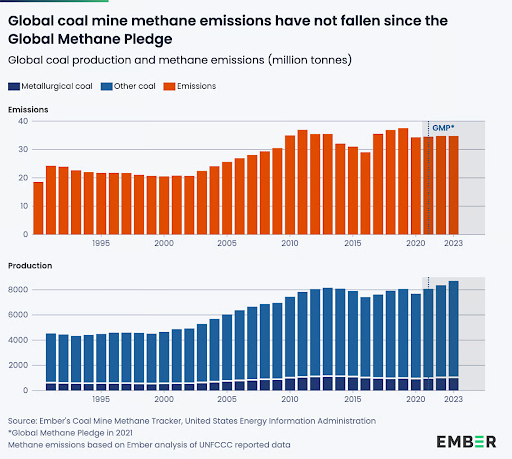
Massive Reporting Deficit: A lack of transparency persists, as approximately 89% of global CMM emissions went unreported in official UNFCCC inventories. In 2023, just 23 of 73 coal-producing countries shared data.
Geographical Concentration: Just seven countries—China, the United States, Russia, India, Australia, Poland, and Ukraine—are responsible for 94% of all CMM emissions. China alone contributes a staggering 76% of the global total.
Flawed Measurement: About 99% of reported coal production relies on generic emission factors, instead of direct, continuous, mine-level measurements. This prevents accurate tracking and identification of "super-emitting" mines.
Underutilization of Technology: Proven technologies like Ventilation Air Methane (VAM) oxidizers and drainage capture systems exist and could cut CMM emissions by 54-63% by 2030. However, high upfront costs and a lack of carbon market incentives hinder their adoption.
Leaks from Abandoned Mines: Closed and abandoned mines often continue to leak methane indefinitely, as post-closure monitoring is rarely mandated or enforced.
Mandate Advanced Measurement
Governments must legally require all mining operations (active and closed) to adopt continuous, source-level monitoring to create accurate emission baselines.
Leverage Technology for Verification
Regulatory bodies should use satellite data and third-party aerial surveys to independently verify official industry reports and identify undeclared "super-emitting" hotspots.
Monetize Methane Capture
Create strong financial incentives by integrating CMM projects into carbon markets, providing subsidies for capture technology, and promoting the sale of captured gas. This can turn a liability into a revenue-generating asset.
Enforce Supply Chain Accountability
Major industrial consumers, especially in the steel sector, should demand verified mine-level methane data from their coal suppliers, using market pressure to drive mitigation efforts.
Mitigating Coal Mine Methane is a high-impact climate action providing a "triple win": lowering greenhouse gas emissions, increasing safety, and strengthening energy security. For nations like India, converting this hazardous waste into energy is a vital strategic necessity for sustainable development.
Source: DOWNTOEARTH
|
PRACTICE QUESTION Q. Consider the following statements regarding Coal Mine Methane (CMM): 1. Methane has a higher Global Warming Potential than Carbon Dioxide over a 20-year timeframe. 2. India is the largest emitter of Coal Mine Methane globally. 3. The Moonidih Mine Project in Jharia Coalfield is a pilot project for CMM capture in India. Which of the statements given above is/are correct? a) 1 and 2 only b) 2 and 3 only c) 1 and 3 only d) 1, 2, and 3 Answer: c Explanation: Statement 1 is correct: Methane (CH₄) is a potent short-lived greenhouse gas. Over a 20-year period, its Global Warming Potential (GWP) is higher than that of carbon dioxide (CO₂), estimated at roughly 84–86 times greater. Statement 2 is incorrect: India is not the largest emitter of Coal Mine Methane (CMM). Globally, China is the largest emitter of CMM. While India is a major emitter of total methane (ranking in the top 4 alongside China, the USA, and Russia), it is not the world leader in this specific category. Statement 3 is correct: The Moonidih Mine Project in the Jharia Coalfield is indeed a prominent pilot project for capturing Coal Mine Methane in India. Capturing this methane not only improves mine safety by removing explosive gases but also provides a source of clean fuel and reduces greenhouse gas emissions. |
Coal Mine Methane (CMM) is a greenhouse gas released from coal seams during mining operations. Methane is highly potent, trapping over 80 times more heat than carbon dioxide over a 20-year timeframe, thereby significantly accelerating global warming.
Launched in 2021, the Global Methane Pledge is a major international climate agreement in which participating countries committed to reducing global methane emissions by 30% by 2030, compared to 2020 levels, to mitigate near-term climate change.
Since methane is a primary component of natural gas, capturing CMM using modern drainage and ventilation technologies allows it to be utilized for generating electricity, fueling mine vehicles, or supplying natural gas networks. This improves energy security and turns a hazard into a resource.


© 2026 iasgyan. All right reserved