Channa stewartii, or the Assamese snakehead, is an endemic freshwater ornamental fish of Northeast India. Recently, ICAR-CIFRI achieved India's first hormone-free captive breeding of this species.
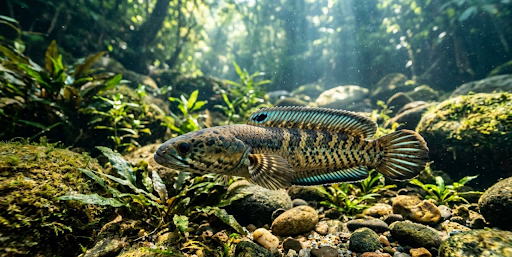
The Central Inland Fisheries Research Institute (ICAR-CIFRI) conducted the first hormone-free captive breeding and larval rearing of Channa stewartii.
Habitat and Geographic Distribution
Key Biological & Physical Characteristics
Economic & Ecological Significance
Ornamental Value: Due to its striking coloration and manageable size, it is a highly prized species in the global ornamental aquarium trade.
logical Indicator: Presence and health of Channa stewartii populations act as an indicator of biodiversity and the overall health of the ecosystems in Northeast India.
Conservation Status & Threats
Source: DECCANHERALD
|
PRACTICE QUESTION Q. With reference to the Channa stewartii, consider the following statements:
Which of the statements given above is/are correct? A) 1 and 2 only B) 2 and 3 only C) 1 and 3 only D) 1, 2, and 3 Answer: C. Explanation: Statement 1 is CORRECT: Channa stewartii (and other snakeheads in the genus Channa) are obligate air-breathing fish. They possess a primitive lung-like structure called a suprabranchial organ (or labyrinth organ), which allows them to inhale atmospheric air to survive in oxygen-poor waters. Without access to the surface to gulp air, these fish can actually drown. Statement 2 is INCORRECT: The species is endemic to the Northeastern region of India, specifically found in the hill streams of Assam and Arunachal Pradesh, as well as parts of the Eastern Himalayas. Statement 3 is CORRECT: In May 2026, the ICAR-Central Inland Fisheries Research Institute (ICAR-CIFRI) successfully conducted India's first hormone-free captive breeding of Channa stewartii. |
Channa stewartii, commonly known as the Assamese snakehead, is a colorful, freshwater dwarf snakehead fish endemic to the Brahmaputra and Ganges river basins.
It is an obligate air-breathing fish that possesses a unique suprabranchial organ, allowing it to extract oxygen directly from atmospheric air and survive in oxygen-deprived waters.
While globally listed as 'Least Concern' by the IUCN, regional populations are at high risk due to overexploitation for the aquarium trade, illegal fishing, and habitat destruction.




© 2026 iasgyan. All right reserved