Sikkim’s organic success and new infrastructure like the Sevoke-Rangpo railway showcase a green growth model. To balance food security, India should adopt a "Landscape Approach," combining natural farming with premium organic zones in fragile ecosystems.
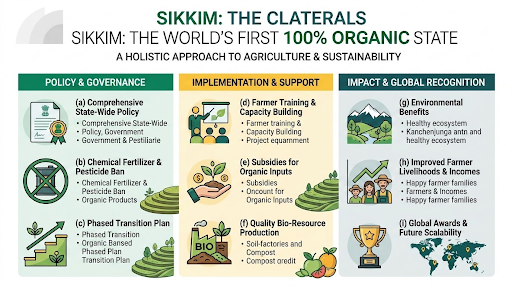
At Sikkim's 50th Statehood Day, Prime Minister Narendra Modi praised the state's 100% organic model as a national agricultural blueprint.
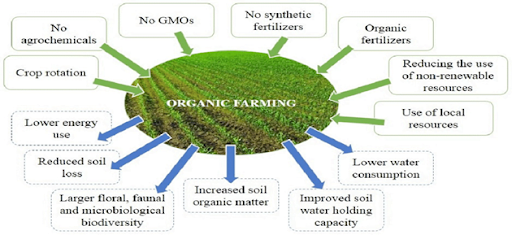
Foundational Pillars of the Sikkim Model
Ecological Significance
Sikkim’s organic transition has enhanced environmental sustainability by integrating agricultural practices with ecological health.
This model proves that agriculture and conservation can successfully coexist in sensitive regions.
Structural & Technical Challenges
Economic & Market Challenges
Policy & Infrastructure Challenges
|
Alternative Scalable Model: Andhra Pradesh's Natural Farming The Andhra Pradesh Community Managed Natural Farming (APCNF) offers a more scalable and hybrid model for larger agricultural states. Instead of aiming for costly organic certification, it focuses on:
|
Adopt "Landscape Approach" to agriculture.
Phased Implementation: Adopting a gradual transition rather than an abrupt change allows farmers to integrate organic methods while mitigating potential economic disruptions.
Robust Political Commitment: Enduring leadership and policy stability are essential for driving extensive agricultural shifts.
Governance and Infrastructure: Success relies on specialized agencies and integrated administrative frameworks to manage implementation effectively.
Cultivator-First Strategy: Priority must be given to ongoing education, technical mentorship, and accessible organic inputs for the farming community.
Prioritizing Soil Vitality: Improving biological activity and fertility within the soil is fundamental to achieving long-term agricultural sustainability.
Enhanced Commercial Connectivity: Organic farming viability depends on establishing reliable market access and ensuring equitable price premiums for producers.
Harmonizing Productivity and Ecology: Environmental objectives must be balanced with the need to maintain food security and sufficient harvest volumes.
Advancement through Research: Scientific breakthroughs are vital for improving climate adaptability, pest control, and overall crop performance.
Localized Strategies: Models must be tailored to specific socio-economic and agro-climatic realities rather than applied as universal templates.
Holistic Integration: To maximize impact, organic agriculture should be synergized with rural development, value-added processing, and tourism.
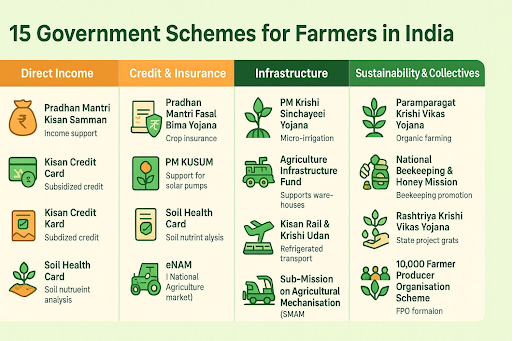
The Sikkim experience shows that organic farming is not just an agricultural reform but a holistic development mission. For India, the path forward lies in gradual, farmer-focused, research-backed, and region-specific strategies that balance sustainability with productivity and market viability.
Source: THEHINDU
|
PRACTICE QUESTION Q. "While Sikkim provides a successful template for 100% organic farming, its blanket replication across India poses macroeconomic and food security challenges." Critically analyze. 150 words. |
Sikkim is recognized globally as the world's first 100% organic state. It achieved this through a meticulous, 13-year phased transition (Sikkim Organic Mission) by systematically restricting chemical fertilizers, preserving biodiversity, and building local capacity, setting a gold standard for agroecology.
The "Act Fast" policy is a progression of the "Act East" policy. It focuses on the rapid, accelerated execution of strategic infrastructure, connectivity, and healthcare projects in the North-Eastern states to integrate them fully with mainland India's economic growth.
Blanket replication is structurally unviable because transitioning to 100% organic farming often causes an initial 10% to 20% yield drop. Doing this nationally in high-production states like Punjab would threaten India's food security obligations under the National Food Security Act (NFSA).




© 2026 iasgyan. All right reserved